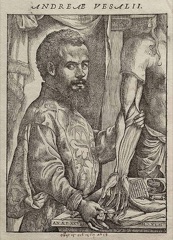
Andreas Vesalius
1514–1564 · Flemish anatomist whose Fabric of the Human Body founded modern anatomy.
Andreas Vesalius was born in Brussels into a family of physicians to the Holy Roman Emperors. He studied at Louvain and Paris, where he was so eager to study bones that he collected them from cemeteries and from the gallows outside the city. At twenty-three he became professor of surgery and anatomy at the University of Padua in Italy. Unlike most professors, who read aloud from Galen while an assistant cut, Vesalius dissected bodies himself in front of students. He found that Galen's anatomy, based on animals, was wrong in more than two hundred details; for example, the human jaw is a single bone, and the breastbone has three parts, not seven. In 1543, at twenty-eight, he published De humani corporis fabrica, On the Fabric of the Human Body, with magnificent detailed woodcut illustrations, probably made in the workshop of the painter Titian. It was published the same year as Copernicus's book on the heavens. He became physician to the emperor Charles V and his son Philip II of Spain. He died in 1564 on the island of Zakynthos, returning from a pilgrimage to Jerusalem.
Andreas Vesalius is also an author in the library: author page and works.
Faith: Went on a pilgrimage to the Holy Land in 1564 and died on the return journey; his personal beliefs are not otherwise well documented. Source: Wikipedia

Key dates
- 1514 Born in Brussels
- 1537 Professor at Padua
- 1543 On the Fabric of the Human Body
- 1544 Physician to Charles V
- 1564 Dies on Zakynthos
Record-breaker
Firsts and records, worded as the sources give them ("first known", "at the time").
- The skeleton he prepared in Basel, which still survives, is the world's oldest surviving anatomical preparation. (Source: Andreas Vesalius (Wikipedia))
Read about them
Grades 9–12
- On the Fabric of the Human Body (Preface) · In the library
More lives
William Gilbert · William Harvey · John of God · Paracelsus · Ambroise Paré · Thomas Sydenham