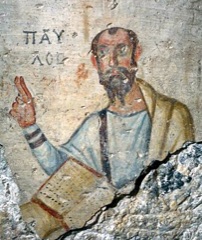
Paul the Apostle
c. 5–c. 64/67 · Jewish Pharisee who became the leading missionary of early Christianity; his letters are the oldest writings in the New Testament.
Paul, also called Saul, was born in Tarsus in Cilicia, in what is now southern Turkey, a Jew and a Roman citizen. He was trained as a Pharisee in Jerusalem and at first persecuted the followers of Jesus. According to the Acts of the Apostles, he was converted after a vision of the risen Christ on the road to Damascus. Over the following decades he travelled through Syria, Asia Minor, Greece and Macedonia, founding churches in cities such as Philippi, Thessalonica, Corinth and Ephesus, and argued that non-Jewish believers need not follow the Jewish law to belong to the church. His letters to these communities, written in the 50s, are the earliest surviving Christian writings and form much of the New Testament. Arrested in Jerusalem, he appealed to the emperor and was taken to Rome. Early Christian tradition holds that he was executed there under Nero in the 60s. His teaching on grace and faith shaped Augustine, Luther and much later theology. Christians read his letters as Scripture, inspired by God.
Faith: Apostle and missionary of the early Christian movement who preached to Gentiles. Source: Encyclopaedia Britannica
Further reading
- Paul: A Very Short Introduction by E. P. Sanders (Oxford University Press, 2001), ISBN 9780192854513
See also: The apostle Peter
Key dates
- c. 34 Conversion on the road to Damascus
- c. 46–57 Missionary journeys
- c. 49 Council of Jerusalem
- c. 57 Writes the Letter to the Romans
- c. 64–67 Traditionally executed in Rome
Watch


Videos load from YouTube in privacy-enhanced mode only when you press play.
Read about them
Grades 9–12
- The Bible · In the library
More lives
Athanasius of Alexandria · Augustine of Hippo · Basil the Great · Eusebius of Caesarea · Gregory of Nyssa · Ignatius of Antioch