David Livingstone
1813–1873 · Scottish missionary doctor who crossed Africa and campaigned against the slave trade.
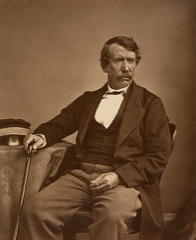
David Livingstone was born in Blantyre, Scotland, and at ten went to work in a cotton mill, studying Latin and science in the evenings. He trained as a doctor and in 1841 went to southern Africa with the London Missionary Society. Restless with mission stations, he began exploring, and between 1853 and 1856 he crossed the continent from Luanda on the Atlantic to Quelimane on the Indian Ocean, the first European known to do so. On the way he saw the great waterfall that the local people called the Smoke That Thunders and named it Victoria Falls. His book Missionary Travels made him famous. He hoped that commerce and Christianity would end the Arab and Portuguese slave trade in East Africa, and his reports of its cruelty helped turn British opinion against it. From 1866 he searched for the source of the Nile. In 1871 the journalist Henry Morton Stanley found him at Ujiji. He died in 1873 in present-day Zambia; his attendants carried his body to the coast, and he was buried in Westminster Abbey.
Faith: Scottish Christian missionary in Africa. Source: Encyclopaedia Britannica

Key dates
- 1841 Arrives in southern Africa
- 1855 Reaches Victoria Falls
- 1856 Completes crossing of Africa
- 1857 Publishes Missionary Travels
- 1871 Found by Stanley at Ujiji
- 1873 Dies in present-day Zambia
Fun facts
- A lion once attacked him and crushed his left arm; he survived because a companion, Mebalwe, distracted the lion. (Source: David Livingstone (Wikipedia))
Record-breaker
Firsts and records, worded as the sources give them ("first known", "at the time").
- He was the first European to see the great waterfall that local people called Mosi-oa-Tunya, 'the smoke that thunders', and he named it Victoria Falls after Queen Victoria. (Source: David Livingstone (Wikipedia))
More lives
Clara Barton · Claude Bernard · Elizabeth Blackwell · Eugen Bleuler · Josef Breuer · Jean-Martin Charcot