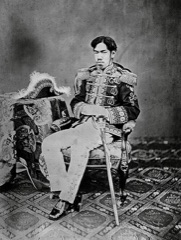
Emperor Meiji
1852–1912 · Emperor of Japan during its rapid transformation into a modern industrial state.
Mutsuhito, known after his death as Emperor Meiji, came to the throne of Japan in 1867 at fourteen. For more than two centuries real power had rested with the shogun, a military ruler, while the emperor lived in seclusion in Kyoto. In 1868, a group of young samurai from southwestern Japan overthrew the shogun in the name of the emperor, an event called the Meiji Restoration. The capital moved to Edo, renamed Tokyo. In the emperor's name, the new leaders abolished the feudal domains and the samurai class, built railways, telegraphs and factories, introduced compulsory schooling and a conscript army, and sent students abroad to learn Western science, law and industry. The Charter Oath of 1868 promised that knowledge would be sought throughout the world. In 1889 the emperor granted a constitution creating a parliament. Japan defeated China in 1895 and Russia in 1905 and annexed Korea in 1910. Meiji wrote many thousands of short poems. He died in 1912, and his reign gave its name to the era.
Faith: Shinto; as emperor he was the central figure of Japan's state religion. Source: Wikipedia

Key dates
- 1867 Becomes emperor
- 1868 Meiji Restoration; Charter Oath
- 1871 Feudal domains abolished
- 1889 Meiji Constitution
- 1905 Japan defeats Russia
- 1912 Dies in Tokyo