Frederick the Great
1712–1786 · King of Prussia, a brilliant general and patron of the Enlightenment.
Frederick II of Prussia loved music, French books and philosophy as a young man, to the fury of his strict, soldierly father, Frederick William I. When eighteen-year-old Frederick tried to run away, his father imprisoned him and forced him to watch the execution of his friend and fellow runaway. Frederick became king in 1740 and almost at once invaded the rich Austrian province of Silesia, starting a long rivalry with Maria Theresa. In the Seven Years' War, from 1756 to 1763, Prussia fought Austria, France and Russia at once and came close to destruction, but Frederick's skill and stubbornness, and a lucky change of ruler in Russia, saved it. He wrote poetry and histories, played the flute and composed music, invited Voltaire to his palace of Sanssouci, ended torture in most cases, allowed religious toleration, and drained marshes for farming. He called himself the first servant of the state. He took part in the first partition of Poland in 1772 and died in 1786.
Frederick the Great is also an author in the library: author page and works.
Faith: Unlike his devoutly Calvinist father, he was a religious skeptic and has been described as a deist; as king he allowed religious freedom. Source: Wikipedia
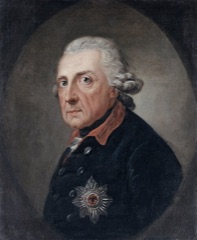

Key dates
- 1730 Imprisoned after trying to flee
- 1740 Becomes king; invades Silesia
- 1756–1763 Seven Years' War
- 1772 First partition of Poland
- 1786 Dies at Potsdam
Fun facts
- His people nicknamed him 'Old Fritz'. (Source: Frederick the Great (Wikipedia))
- He is buried at his favourite palace, Sanssouci in Potsdam. (Source: Frederick the Great (Wikipedia))
Read about them
Grades 9–12
- Instructions for His Generals · In the library
More lives
Catherine the Great · Toussaint Louverture · Maria Theresa · Horatio Nelson · Thomas Nelson Jr. · Peter the Great