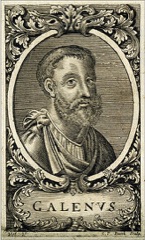
Galen
129–c. 216 · Greek physician in Rome whose writings dominated medicine for 1,400 years.
Galen was born in Pergamon, a wealthy Greek city in Asia Minor, the son of an architect. According to Galen, his father had a dream in which the god Asclepius told him his son should study medicine. He studied in Smyrna, Corinth and Alexandria, then returned home as physician to the gladiators, which taught him much about wounds. Around 162 he moved to Rome, where he won fame by public demonstrations of anatomy, and he became physician to the emperor Marcus Aurelius and his son Commodus. Because dissecting human bodies was not allowed, he dissected animals such as Barbary apes and pigs, and some of his conclusions about human anatomy were therefore wrong. Still, he showed that arteries carry blood, not air, and that the brain controls the voice and nerves. He wrote hundreds of works, in Greek, on anatomy, physiology, drugs and the practice of medicine, and argued that the best physician must also be a philosopher. His writings, built on Hippocrates and the theory of four humors, were the foundation of medicine in Europe and the Islamic world until Vesalius.
Galen is also an author in the library: author page and works.
Faith: Faith not well documented beyond the Greek religion of his time; he said his father sent him to study medicine after a dream of the healing god Asclepius. Source: Wikipedia

Key dates
- 129 Born in Pergamon
- 157 Physician to the gladiators
- c. 162 Moves to Rome
- 169 Physician to the imperial family
- c. 216 Dies
Fun facts
- A crater on the Moon is named after him. (Source: Galen (Wikipedia))
Record-breaker
Firsts and records, worded as the sources give them ("first known", "at the time").
- He was the first to show that the voice is made by the larynx (voice box), and the first to recognise the difference between dark blood in veins and bright blood in arteries. (Source: Galen (Wikipedia))
Read about them
Grades 9–12
- Galen: Selected Works · In the library
More lives
Aulus Cornelius Celsus · Pedanius Dioscorides · Herophilus · Hippocrates