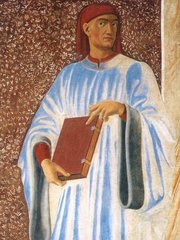
Giovanni Boccaccio
1313–1375 · Florentine author of the Decameron, friend of Petrarch, and early champion of Dante, one of the founders of Renaissance humanism.
Giovanni Boccaccio was born in 1313, in Florence or nearby Certaldo, the son of the Florentine merchant Boccaccino di Chellino; his mother is unknown. As a boy he went to Naples, where his father worked for the Bardi bank. He disliked banking, studied canon law, and found his vocation in poetry at the court of King Robert, writing Il Filostrato and the Teseida, which Chaucer later reworked. Back in Florence from about 1341, he wrote the Decameron in the years after the Black Death of 1348, a hundred tales told by ten young people fleeing the plague. From 1350 he was a close friend of Petrarch, whom he called his teacher. He served Florence as an envoy, encouraged the study of Greek, took minor orders, and wrote Latin works of learning, among them On Famous Women and a genealogy of the pagan gods. He wrote a life of Dante and in 1373 began public lectures on the Divine Comedy. He died at Certaldo in 1375.
Giovanni Boccaccio is also an author in the library: author page and works.
Faith: Catholic; he took minor orders in the 1350s, and his later Latin and Dante writings are more devout than the Decameron. A story that he renounced the Decameron as profane in 1362 is not well supported. Source: Wikipedia
See also: Dante Alighieri · Francesco Petrarch · Geoffrey Chaucer

Key dates
- 1313 Born in Florence or Certaldo
- 1320s Goes to Naples, where he trains in banking and studies canon law
- c. 1341 Returns to Florence
- 1348 The Black Death strikes Florence
- c. 1349–1353 Writes the Decameron
- 1350 Meets Petrarch in Florence; they remain lifelong friends
- 1373 Begins public lectures on Dante's Divine Comedy in Florence
- 1375 Dies at Certaldo
Major works
- Il Filostrato (c. 1338) · Verse romance of Troilus and Criseida, the source of Chaucer's Troilus and Criseyde
- Teseida (c. 1340–1341) · Epic of Theseus, Arcita, and Palemone, reworked by Chaucer as The Knight's Tale
- The Decameron (c. 1349–1353) · In the library · A hundred tales told during the plague of 1348
- Life of Dante (Trattatello in laude di Dante) (1350s) · His admiring biography of Dante
- On Famous Women (De mulieribus claris) (1361–1375) · Latin lives of famous women, ancient and medieval
- Genealogy of the Pagan Gods (Genealogia deorum gentilium) (1360, revised later) · Latin reference work on classical mythology and a defense of poetry
- Commentary on the Divine Comedy (Esposizioni) (1373–1374) · His unfinished public lectures on Dante's Inferno
Fun facts
- A revised copy of the Decameron in Boccaccio's own hand, made late in his life, survives in Berlin; the scholar Vittore Branca identified it in 1962 as Codex Hamilton 90. (Source: The Decameron (Wikipedia))
- At his death his library went to the monastery of Santo Spirito in Florence. (Source: Giovanni Boccaccio (Wikipedia))
In their words
“'Tis humane to have compassion on the afflicted”
“whoso goes a reading among these stories, let him pass over those that vex him, and read those that please him”
Read about them
Grades 9–12
- The Decameron · In the library · Mature; teachers usually assign selected tales
More lives
Cædmon · Geoffrey Chaucer · Dante Alighieri · Einhard · Anna Komnene · Thomas Malory
Notes: His birthplace is uncertain: modern sources give Florence or Certaldo, and older accounts, including the 1903 translator's introduction in the library's Decameron, say Paris.