Work record
The Decameron
Giovanni BoccaccioThe Decameron by Giovanni Boccaccio (c. 1349–1353)The Decameron is a collection of one hundred tales written in Florentine Italian by Giovanni Boccaccio around 1349 to 1353, just after the Black Death.c. 1349-1353 · Medieval · Short Stories · Italian
Abstract
Background. Written in Florentine prose in the years right after 1348, when plague emptied Florence, the book is dedicated to women in love, whom its author says have fewer distractions than men.
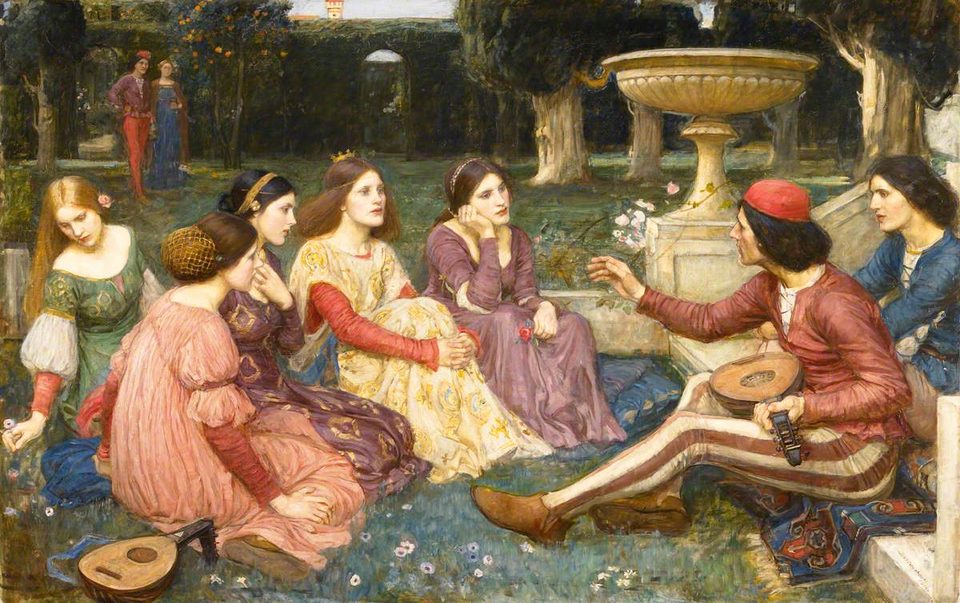
Content. Ten young Florentines, seven women and three men, escape the epidemic and pass a fortnight in rural gardens. A king or queen chosen for each day names a topic, and every member of the party narrates a novella. Topics include fortune, effort, fatal love, happy love, quick replies, tricks, and generosity, with two open days.
Range. The hundred stories mix the tragic, comic, bawdy, and devout. Hypocritical friars and nuns are mocked; a Jewish merchant is converted by the survival of the Church; a moneylender evades Saladin with a parable of three rings; a ruined nobleman sacrifices his falcon; a patient peasant wife endures her lord's trials.
Themes. Death and the civil order that holds against it, Fortune set against human wit and industry, love in its noble and base forms, religious hypocrisy and true piety, courtesy, and liberality.
Significance. It shaped Italian prose and gave plots to Chaucer, Shakespeare, Lessing, and Keats, while its frankness drew censorship, including a place on the Church's Index of Prohibited Books in 1559. Teachers usually assign selected tales.
Main characters
- Pampinea: Eldest of the seven ladies, who proposes the retreat and rules the first day
- Dioneo: Witty young man who tells the last tale each day on any theme
- Pamfilo: Young man who tells the first tale and rules the tenth day
- Ser Ciappelletto: Villainous notary who becomes a saint by a false confession
- Federigo degli Alberighi: Ruined nobleman who serves his falcon to the lady he loves
- Griselda: Peasant wife who bears her husband's cruel trials

Summary
The Decameron is a collection of one hundred tales written in Florentine Italian by Giovanni Boccaccio around 1349 to 1353, just after the Black Death. Its title is Greek for ten days. In the opening, Boccaccio describes the plague of 1348 in Florence without softening it: corpses carried away by the cartload, the sick abandoned by neighbors and kin, and the ordinary rules of law and religion collapsing under fear. One Tuesday morning seven young women meet after Mass in the church of Santa Maria Novella. Led by Pampinea, they decide to leave the dying city, and three young men of their acquaintance go with them to a series of country villas outside Florence. There, in gardens and beside fountains, they keep an orderly and graceful life: each day one of them is crowned king or queen, sets a theme, and each of the ten tells one story. They rest on Fridays, in honor of the Passion, and on Saturdays, so the ten days of storytelling fill two weeks, and each day closes with dancing and a song. The themes move from free choice on the first day through fortune, people who gain what they desire by effort, loves that end in death, loves that end happily, witty replies, tricks played by wives and then by everyone, a second free day, and finally deeds of generosity and magnificence. The tales range across the whole Mediterranean world, from merchants, pirates, and kings to friars, nuns, peasants, and painters. Some are tragic, like the story of Tancred, who sends his daughter her lover's heart in a golden cup, or Lisabetta, who hides her murdered lover's head in a pot of basil. Many are comic and bawdy, and a good number mock greedy, lustful, or hypocritical clergy, beginning with Ser Ciappelletto, a scoundrel whose false deathbed confession makes him a popular saint. Others are serious moral and religious tales: Abraham the Jew, who is converted because the Church survives the corruption of Rome; Melchisedech and the parable of the three rings; and Federigo, who sacrifices his falcon for the woman he loves. The last day honors magnanimity and ends with Griselda, the peasant wife whose husband tests her patience with cruel trials. In the introduction to the fourth day and in his conclusion Boccaccio defends himself against critics who called his work indecent or frivolous. The Decameron became a model for Italian prose and a storehouse of plots for Chaucer, Shakespeare, Keats, and many others. This library hosts the 1903 English translation by J. M. Rigg.
Virtues in this work
- Charity: The Proem opens with compassion for the afflicted, and the plague description shows what is lost when charity fails.
- Magnanimity: The tenth day honors great-souled generosity, from Nathan and Mitridanes to Titus and Gisippus.
- Fortitude: Griselda endures her husband's trials with steady patience, though the company condemns his cruelty.
- Humility: Griselda calls her rank a loan rather than a possession, and Federigo bears his poverty without bitterness.
Plot or Argument
- Proem and First Day: the plague and the company
Boccaccio dedicates the book to ladies in love who have little to distract them, then describes the plague of 1348 in Florence. Seven young women and three young men leave the city for a villa, choose Pampinea as queen, and tell tales on any subject. The day includes Ser Ciappelletto's false confession, Abraham the Jew's conversion, and Melchisedech's parable of the three rings.
- Second Day: fortune's reversals
Under Filomena the company tells of people who suffer shipwreck, robbery, exile, or captivity and come at last to unexpected happiness, among them Landolfo Ruffolo, Andreuccio da Perugia, Madam Beritola, and the slandered wife of Bernabo of Genoa, who survives disguised as a man.
- Third Day: gaining what one desires
Under Neifile the tales concern people who win or recover what they want by effort or cunning. Many are bawdy and several mock monks and friars; the day also contains Gillette of Narbonne, who cures the King of France and wins her reluctant husband, the source of Shakespeare's All's Well That Ends Well.
- Fourth Day: loves that end in death
Boccaccio interrupts to defend his book against critics. Under Filostrato the company tells tragic tales, among them Tancred and his daughter Ghismonda, Lisabetta and the pot of basil, and Guillaume de Roussillon, who makes his wife eat her lover's heart.
- Fifth Day: lovers made happy after trials
Under Fiammetta the tales bring lovers through danger to a happy end. They include Cimon, who is made wise by love; Nastagio degli Onesti and the vision of the hunted lady; and Federigo degli Alberighi, who serves his falcon to the woman he loves.
- Sixth Day: the ready answer
Under Elisa the company tells short tales of quick wit that saves the speaker, including Cisti the baker, Chichibio the cook and the one-legged cranes, the painter Giotto, Guido Cavalcanti, and Fra Cipolla, who passes off coals as relics of St. Lawrence.
- Seventh and Eighth Days: tricks
Under Dioneo the tales are about tricks wives play on their husbands, and under Lauretta about tricks that people of every kind play on one another. This is the most bawdy and cynical part of the book, and it introduces the gullible painter Calandrino and his pranksters Bruno and Buffalmacco.
- Ninth Day: free subjects
Under Emilia each speaker again chooses a subject. The tales include more Calandrino pranks, an abbess caught in her own hypocrisy, Talano's warning dream, and two young men who ask Solomon for counsel.
- Tenth Day: generosity and magnificence
Under Pamfilo the company tells of liberal and noble deeds: Nathan, who offers his life to a jealous rival; Titus and Gisippus, friends who each would die for the other; Saladin and Messer Torello; and finally Griselda, whose husband tests her with cruel trials that she bears to the end.
- The Author's Conclusion
After the company returns to Florence, Boccaccio answers those who will say his tales are indecent, too long, too full of jests, or unfair to friars. He tells readers to skip what offends them, since each tale's heading tells what it contains, and he closes with thanks to God.
Characters
- Pampinea, narrator
Eldest of the seven young women, who proposes leaving Florence and rules the first day.
- Fiammetta, narrator
Queen of the fifth day; the name recurs in Boccaccio's earlier works for a beloved lady.
- Filomena, narrator
Queen of the second day, who sets the theme of misfortune turned to happiness.
- Neifile, narrator
Queen of the third day, who moves the company to new villas.
- Elisa, narrator
Queen of the sixth day, devoted to witty retorts.
- Pamfilo, narrator
Young man who tells the first tale and rules the tenth day of magnanimous deeds.
- Filostrato, narrator
Lovelorn young man who rules the fourth day and chooses loves that end in death.
- Dioneo, narrator
Witty young man allowed to tell the last tale of each day on any subject; he tells many of the bawdiest tales and the tale of Griselda.
- Ser Ciappelletto, character
Wicked notary whose false confession on his deathbed makes him venerated as a saint (Day 1, Novel 1).
- Melchisedech, character
Jewish moneylender of Alexandria who answers Saladin with the parable of the three rings (Day 1, Novel 3).
- Federigo degli Alberighi, character
Florentine nobleman ruined by his generosity, who serves his last falcon to the lady he loves (Day 5, Novel 9).
- Calandrino, character
Gullible Florentine painter, the butt of his friends Bruno and Buffalmacco in several tales.
- Griselda, character
Peasant woman who marries the Marquis of Saluzzo and endures his cruel tests of her obedience (Day 10, Novel 10).
- Gualtieri, character
Marquis of Saluzzo who tests his wife Griselda by taking away her children and pretending to repudiate her.
Lessons
Charity in a time of plague
Boccaccio's opening shows what fear did to Florence in 1348: the sick were abandoned by neighbors, kin, and even parents, and the dead were buried without mourning. The ten young people answer the disaster by withdrawing to order, courtesy, and stories, not by nursing the sick. Students can weigh that response against the Christian call to stay with the suffering.
- What does Boccaccio say happened to families and neighbors during the plague?
- Is the company's flight from Florence prudent, selfish, or both?
- Who in Christian history stayed with the sick during plagues, and why?
Satire of the clergy and the truth of the faith
Many tales mock friars, monks, and priests who are greedy, lustful, or false, beginning with Ser Ciappelletto. Yet the second tale argues that the Church must be upheld by God because it survives such ministers. Students should distinguish satire of hypocrites from mockery of the faith they betray, and ask where Boccaccio's book does each.
- Why does Abraham decide to be baptized after seeing Rome?
- Which tales attack hypocrisy, and which seem to mock holy things themselves?
- Can a reader learn from satire without approving of everything in it?
Generosity and magnanimity
The tenth day honors liberality: Nathan offers his life to a jealous young man, Titus and Gisippus each try to die for the other, and Federigo on the fifth day gives up his last falcon. These tales show a nobility of soul that gives without counting the cost. Students can ask which acts are truly generous and which are proud display.
- What does Federigo sacrifice, and how does Monna Giovanna judge him?
- What makes Nathan's offer to Mitridanes so surprising?
- Is magnanimity the same as Christian charity?
Patience, power, and Griselda
Griselda bears her husband's cruel tests without complaint, and Petrarch and Chaucer later retold her story as an example of patience. Yet Dioneo introduces the tale as mad folly that no one should copy, and the guests at the end condemn Gualtieri's harshness. The tale asks students to separate admirable endurance from obedience to wrong.
- How does Griselda describe her rank and her marriage when she is sent away?
- Why do the guests praise Griselda but censure Gualtieri?
- When is patience a virtue, and when does it become consent to injustice?
Fortune and human effort
The second and third days set fortune, which raises and ruins people suddenly, beside industry and wit, by which people win what they want. Boccaccio's characters rarely look to providence; they trust luck and cleverness. Students can compare that outlook with the Christian teaching that God governs what we call chance.
- Which tale of the second day shows fortune most clearly?
- Do the clever characters deserve what they gain?
- How does Boethius or Scripture answer the idea of blind fortune?
Context
Florence in the 1340s was one of the richest cities in Europe, a republic of merchants and bankers whose great banking houses, the Bardi and Peruzzi, failed in the mid-1340s. In 1348 the Black Death reached the city and killed a very large part of its people; Boccaccio's stepmother died in the epidemic and his father died in 1349. The church of Santa Maria Novella, where the company meets, belonged to the Dominicans. Tuscan writers had already raised their vernacular to literary dignity in Dante's Divine Comedy, and Boccaccio, a devoted reader of Dante, did the same for prose. Older collections of tales, French fabliaux, and the exempla of preachers gave him models and many plots.
Composition
Boccaccio probably wrote the Decameron between about 1349 and 1353, drawing on stories he had gathered for years. He calls it the book called Decameron, otherwise Prince Galeotto, after the go-between in the Lancelot romance. Late in life he made a revised copy in his own hand, now in Berlin and identified in 1962 as Codex Hamilton 90. The library's text is the English translation by J. M. Rigg, published in London in 1903 in two volumes with illustrations by Louis Chalon.
Reception
The book was copied widely, especially among merchants, and its style became a model for Italian prose. Petrarch translated the Griselda tale into Latin, and Chaucer drew on Boccaccio for several Canterbury Tales. Its frank and anticlerical tales brought it into conflict with the Church: copies were burned in Savonarola's bonfire of 1497, it was placed on the Index of 1559, and expurgated editions followed in 1573 and 1582. Shakespeare took plots from it for All's Well That Ends Well and Cymbeline, Lessing used the ring parable in Nathan the Wise, and Keats retold Lisabetta's story in Isabella, or the Pot of Basil.
Comparisons
- The Canterbury Tales
Chaucer's pilgrims also tell tales in a frame, and the Clerk's Tale retells Griselda; Chaucer's company travels toward a shrine, while Boccaccio's flees a plague to a garden.
- The Divine Comedy
Boccaccio revered Dante and lectured on him, but where Dante's hundred cantos rise toward God, Boccaccio's hundred tales stay on earth among human appetites and wit.
- The Arabian Nights Entertainments
Both are frame-tale collections; Scheherazade tells stories to stay alive, while Boccaccio's company tells them to keep cheerful order while death fills the city.
- All's Well That Ends Well
Shakespeare's play comes, through a later English version, from Gillette of Narbonne, the third day's ninth tale.
- Cymbeline
The wager on a wife's chastity in Shakespeare's play comes from the tale of Bernabo of Genoa, the second day's ninth tale.
- Troilus and Criseyde
Chaucer's poem reworks Boccaccio's earlier Il Filostrato, showing how deeply the English poet drew on the Italian.
Quotes
Frequently cited
“Tis humane to have compassion on the afflicted”
Frequently cited
“brother was forsaken by brother, nephew by uncle, brother by sister, and oftentimes husband by wife”
Frequently cited
“Each of these peoples deems itself to have the true inheritance, the true law, the true commandments of God”
Frequently cited
“I had rather have a man without wealth than wealth without a man”
“the goodness of God spares to regard our errors when they result from unavoidable ignorance”
“your religion continually grows, and shines more and more clear”
“the rank I had with you was of your and God's bestowal, nor did I ever make as if it were mine by gift, or so esteem it, but still accounted it as a loan”
“they censured as intolerably harsh the probation to which he had subjected Griselda”
“whoso goes a reading among these stories, let him pass over those that vex him, and read those that please him”
“they may be readily cured thereof by the Lament of Jeremiah, the Passion of the Saviour, or the Complaint of the Magdalen”
For Students
A reading companion for classical Christian high school students. See the student guide.
Reading Guide
Watch for
- The plague description in the First Day's introduction, and how the company's orderly life in the villas answers the chaos of the city.
- Each tale's heading, which tells what it contains; Boccaccio himself says readers may skip what offends them, and teachers should choose tales with care.
- Satire of greedy and lustful clergy, set beside tales such as Abraham the Jew (Day 1, Novel 2) that defend the truth of the Church.
- Fortune and wit as the forces that move most plots, and how seldom the characters speak of providence.
- Mature content: many tales are frankly sexual, some are violent or cruel (Day 4; Day 5, Novel 8; Day 8, Novel 7), and the Griselda tale turns on a husband's abuse of power.
Key terms and names
- Frame story
- A story that contains other stories; here, ten young people telling tales to one another during the plague.
- Novella
- A short prose tale; Rigg calls each of Boccaccio's hundred tales a Novel.
- Black Death
- The plague pandemic that reached Florence in 1348 and killed a very large share of Europe's people.
- Fortune
- In medieval thought, the power that turns a wheel raising and casting down human beings, often set against providence.
- Anticlerical satire
- Mockery of priests, monks, friars, and nuns, usually for greed, lust, or hypocrisy.
- Magnanimity
- Greatness of soul shown in noble and generous deeds, the theme of the tenth day.
- Brigata
- Italian for company or band, used of the ten young storytellers.
Seminar Questions
- Comprehension Who are the ten storytellers, why do they leave Florence, and how do they order their days?
- Comprehension What happens in the tales of Ser Ciappelletto and of Abraham the Jew, and how does the second answer the first?
- Comprehension What tests does Gualtieri set Griselda, and how does the company judge them?
- Interpretation Is the company's withdrawal into gardens and stories wise, or is it a flight from the duty of charity?
- Interpretation Does Boccaccio's satire of the clergy serve the Church by exposing hypocrisy, or does it weaken reverence for holy things? Use two tales.
- Interpretation What does the parable of the three rings suggest about religious truth, and how would a Christian answer Melchisedech?
- Big Question Should a book be judged by its best tales, its worst tales, or the author's purpose in gathering them?
- Big Question Is patience under injustice always a virtue?
Faith Connections
- Matthew 25:36 (Scripture)
I was sick, and ye visited me. Boccaccio records that in the plague the sick were abandoned even by their kin; Christ counts care for the sick as care for Himself.
- Matthew 23:27-28 (Scripture)
Christ's woe against hypocrites, whited sepulchres beautiful outside and full of uncleanness within, is a measure for the book's satire of false clergy.
- Ecclesiastes 9:11 (Scripture)
Time and chance happeneth to them all. The book's fortune tales can be read beside the Preacher's sober view of chance under a sovereign God.
- Boethius, The Consolation of Philosophy, Book II (Church Fathers)
Lady Philosophy teaches that Fortune's gifts were never truly ours; Griselda speaks of her rank as a loan from her husband and from God.
Logic and Rhetoric
Central argument: Storytelling can preserve order, courtesy, and good cheer in the face of death, and tales of human folly, wit, love, and generosity show people as they are; Boccaccio argues that a reader can take what profits and pass over the rest.
Rhetorical device: frame narrative. Each of the hundred tales is introduced by a short heading that summarizes it and is set within the company's day, so listeners' reactions, laughter, blushes, and judgments shape how the tale is received.
Debate: Resolved: that the young people of the Decameron were right to leave Florence during the plague.
Memory Work
Tis humane to have compassion on the afflicted
I had rather have a man without wealth than wealth without a man
Writing Prompts
Essay: Using the tales of Ser Ciappelletto and Abraham the Jew (Day 1, Novels 1-2), explain how Boccaccio can mock bad clergy and still affirm the Church, and judge whether he succeeds.
Comparison with The Canterbury Tales: Compare Boccaccio's Griselda (Day 10, Novel 10) with Chaucer's Clerk's Tale. How does each storyteller frame her patience, and what does each want the reader to learn?
Medical Lens
The introduction to the First Day is one of the most famous eyewitness-style descriptions of the Black Death: Boccaccio records the tumours called gavoccioli in the groin and armpits, the black or livid spots that followed, the helplessness of physicians and of the many untrained people practising medicine, the city's cleansing and its refusal of entry to the sick, public processions and prayers, and the breakdown of care for the sick and the dead. Several later tales mock physicians and quacks, among them Master Simone, the gullible doctor of the eighth and ninth days.
- First Day: Introduction
Symptoms and course of the plague of 1348 in Florence, the uselessness of medicine, and the mass graves dug for the dead.
- First Day: Introduction
How the citizens responded: some shut themselves away in moderation, some gave themselves to excess, many fled, and the sick were abandoned.
- Day 8, Novel 9
Bruno and Buffalmacco make a fool of Master Simone, a physician who is vain of his learning.
Creative Prompts
- Essay
Boccaccio's company leaves plague-stricken Florence for a garden. Write an essay on how Christians should respond to an epidemic, comparing the company with those who stayed to care for the sick.
- Fiction
Write a tale for the tenth day, on a deed of true generosity, in the plain storytelling manner of the Decameron, with a short heading that tells what the tale contains.
- Dialogue
Stage a conversation between Griselda and Gualtieri ten years after the story ends, in which she tells him honestly what his tests cost her.
- Classroom
Make a chart of the ten days: who rules, the theme, and one tale from each day that is suitable for class, noting which tales Chaucer, Shakespeare, and Keats borrowed.
Further Reading
- The Canterbury Tales, Geoffrey Chaucer
The English frame-tale collection most indebted to Boccaccio.
- The Life of Dante, Giovanni Boccaccio
Boccaccio's admiring biography of the poet he most revered.
- On Famous Women, Giovanni Boccaccio
His Latin collection of lives of famous women, ancient and medieval.
- The Black Death, Philip Ziegler
- Isabella, or the Pot of Basil, John Keats
Keats's verse retelling of the fourth day's fifth tale, written in 1818.
Verification notes
Dates of composition (c. 1349-1353), the frame story, the Index of 1559, the expurgated editions of 1573 and 1582, Savonarola's bonfire, Codex Hamilton 90, and the borrowings by Chaucer, Shakespeare, Lessing, and Keats were checked at https://en.wikipedia.org/wiki/The_Decameron and https://www.britannica.com/biography/Giovanni-Boccaccio. The text is the English translation by J. M. Rigg (London, 1903), from Project Gutenberg #3726 (Volume I) and #13102 (Volume II), joined into one file with the Gutenberg license header and footer removed; the 1903 edition's Introduction, both contents lists, and the list of Louis Chalon's illustrations are kept (the illustrations are not). Rigg's numbered notes, printed as (1), (2) after each tale, are given as [1], [2] so the reader can link them. Day and tale headings follow the translation; the short tale titles in the reader's contents are the library's own. Spellings of names follow Rigg (Elisa, Pamfilo). All quotations were checked by exact search against the stored text.
- Wikipedia's table of translations says Rigg's 1903 edition left part of the third day's tenth tale in Italian; the Gutenberg transcription gives that tale wholly in English and does not say where the English of that passage comes from.