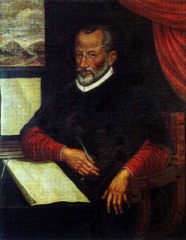
Giovanni Pierluigi da Palestrina
c. 1525–1594 · Italian composer whose smooth, clear church polyphony became a model for centuries.
Giovanni Pierluigi was born around 1525 in Palestrina, a town near Rome, and took its name. He sang as a choirboy at the church of Santa Maria Maggiore in Rome, and in 1544 became organist and choirmaster in his hometown cathedral. When its bishop became Pope Julius III, he brought Palestrina to Rome to direct the choir of St. Peter's Basilica. He spent nearly his entire career in Rome's great churches. He wrote more than a hundred Masses, hundreds of motets and other sacred works, and some secular madrigals. His music weaves several independent voice parts together while keeping the words clear and the harmonies smooth and balanced. A long-told story says his Pope Marcellus Mass persuaded the Council of Trent not to ban polyphonic music in church; historians consider this an exaggeration, but his style did match the council's desire for clarity. He lost his first wife and two sons to plague, remarried, and managed his second wife's fur business. His style was later studied as the model of counterpoint by composers including Bach and Mozart's teachers. He died in Rome in 1594.
Faith: A Catholic composer remembered as the ideal composer of Catholic church music after the Council of Trent. Source: Wikipedia

Key dates
- 1544 Organist at Palestrina cathedral
- 1551 Choirmaster at St. Peter's
- 1562 Pope Marcellus Mass published by 1567
- 1594 Dies in Rome
More lives
Fra Angelico · Filippo Brunelleschi · Benvenuto Cellini · Albrecht Dürer · Leonardo da Vinci · Michelangelo
Notes: The story that his Mass saved church polyphony at Trent is regarded by historians as legend.