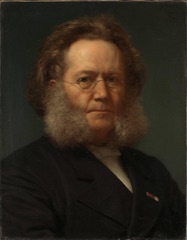
Henrik Ibsen
1828–1906 · Norwegian playwright, author of A Doll's House, Hedda Gabler and Peer Gynt, often called the father of modern drama.
Henrik Ibsen was born in 1828 in Skien, Norway, into a merchant family whose business failed when he was a boy. At fifteen he was apprenticed to a pharmacist in Grimstad, and he wrote his first play while studying to enter university. He then worked for years as a writer and stage director at theaters in Bergen and Christiania (now Oslo), learning stagecraft. In 1864 he left Norway and lived for twenty-seven years in Italy and Germany. His verse dramas Brand (1866) and Peer Gynt (1867) made his name. He then wrote prose plays about middle-class life that questioned social conventions: A Doll's House (1879), in which Nora Helmer leaves her husband and children to find her own identity, caused great controversy; Ghosts, An Enemy of the People, The Wild Duck and Hedda Gabler followed. Their realistic dialogue and serious subjects changed European theater. He returned to Norway in 1891 and was celebrated as a national figure. After a series of strokes, he died in Christiania in 1906.
Henrik Ibsen is also an author in the library: author page and works.
Faith: Baptized in the Lutheran state church of Norway; his adult beliefs are not well documented. Source: Wikipedia

Key dates
- 1828 Born in Skien, Norway
- 1851 Joins the theater in Bergen
- 1864 Leaves Norway
- 1867 Peer Gynt published
- 1879 A Doll's House premieres
- 1891 Returns to Norway
- 1906 Dies in Christiania
Fun facts
- The asteroid 5696 Ibsen is named after him, and Norway declared 2006 the 'Ibsen Year'. (Source: Henrik Ibsen (Wikipedia))
Read about them
Grades 9–12
- A Doll's House and Other Plays · In the library
- Hedda Gabler, The Master Builder and The Wild Duck · In the library
More lives
Edwin A. Abbott · Jane Addams · Louisa May Alcott · Hans Christian Andersen · Jane Austen · Honoré de Balzac