J. P. Morgan
1837–1913 · American banker who financed railroads and steel and twice helped steady the U.S. economy.
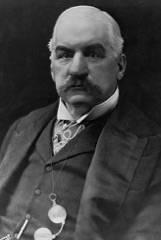
John Pierpont Morgan was born in Hartford, Connecticut, the son of a wealthy banker, and was educated in Boston, Switzerland and Germany. He joined his father's banking business and set up his own firm in New York, later known as J. P. Morgan and Company. He became the most powerful banker in America. He reorganized struggling railroads, combining rival lines, and helped create giant companies including General Electric and, in 1901, United States Steel, the first company valued at over a billion dollars, built partly on Andrew Carnegie's mills. Critics accused him of creating monopolies, and President Theodore Roosevelt's government sued to break up one of his railroad combinations. In 1895 he arranged a gold loan to the U.S. Treasury, and in the financial panic of 1907 he gathered bankers in his library and organized loans to stop the collapse of banks and trust companies; that experience helped lead to the creation of the Federal Reserve in 1913. He collected art and rare books, now in the Morgan Library. He died in Rome in 1913.
Faith: A prominent member of the Protestant Episcopal Church. Source: Encyclopaedia Britannica (1911) (via Wikisource)
Key dates
- 1871 Founds what became J. P. Morgan and Company
- 1895 Arranges a gold loan to the Treasury
- 1901 Forms U.S. Steel
- 1907 Organizes the rescue in the Panic of 1907
- 1913 Dies in Rome
Watch


Videos load from YouTube in privacy-enhanced mode only when you press play.
More lives
Andrew Carnegie · Thomas Edison · Cyrus McCormick · Alfred Nobel · John D. Rockefeller · Cornelius Vanderbilt