James Watt
1736–1819 · Scottish engineer whose improved steam engine powered the Industrial Revolution.
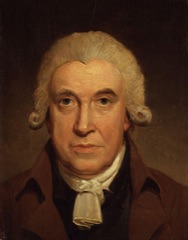
James Watt was born in Greenock, Scotland, the son of a shipwright and merchant. Often in poor health as a child, he was taught much at home and loved making models in his father's workshop. He trained as a maker of mathematical instruments in London and then worked at the University of Glasgow. In 1764 he was asked to repair a model of a Newcomen steam engine, the kind used to pump water from mines, and noticed how much fuel it wasted by heating and cooling the same cylinder. In 1765, on a Sunday walk, he hit on the idea of a separate condenser, which made the engine far more efficient. Developing it took years. In 1775 he went into partnership with the Birmingham manufacturer Matthew Boulton, and their firm built engines for mines, mills and factories. Watt added a way to turn the engine's motion into rotation, a governor to control its speed, and a gauge for measuring power, and coined the term horsepower. The unit of power, the watt, is named for him. He died in 1819.
Faith: Raised by Presbyterian Covenanter parents; he later became a deist. Source: Wikipedia

Key dates
- 1736 Born in Greenock
- 1765 Conceives the separate condenser
- 1769 Patents his improvement
- 1775 Partnership with Matthew Boulton
- 1819 Dies near Birmingham
Fun facts
- The watt, the unit of power, is named after him. (Source: James Watt (Wikipedia))
Record-breaker
Firsts and records, worded as the sources give them ("first known", "at the time").
- The Bank of England £50 note showing him and Matthew Boulton was the first Bank of England note to feature two portraits side by side. (Source: James Watt (Wikipedia))