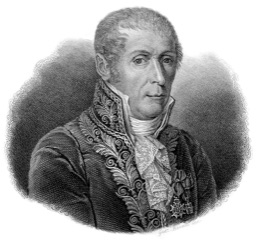
Alessandro Volta
1745–1827 · Italian physicist who invented the electric battery.
Alessandro Volta was born in Como, in northern Italy, to a noble family. He was slow to speak as a child but became a keen student of natural science. In 1775 he improved a device for producing static electricity, and in 1776 he discovered methane gas in the marshes of Lake Maggiore. He became professor of physics at the University of Pavia. In the 1780s his fellow scientist Luigi Galvani found that a dead frog's leg twitched when touched by two different metals, and believed the electricity came from the animal. Volta disagreed and argued that the electricity came from the contact of the two metals. To prove it, in 1799 and 1800 he built a stack of alternating zinc and copper discs separated by cloth soaked in salt water. This voltaic pile produced a steady electric current, the first electric battery, and made possible many new experiments with electricity. Napoleon made him a count. Volta was a devout Catholic. He died in Como in 1827. The unit of electric potential, the volt, is named for him.
Faith: Raised Catholic and remained a practicing Catholic throughout his life; he wrote a public declaration of his faith. Source: Wikipedia

Key dates
- 1776 Discovers methane
- 1779 Professor at Pavia
- 1800 Announces the voltaic pile
- 1801 Demonstrates it to Napoleon
- 1827 Dies in Como
More lives
Leonhard Euler · Benjamin Franklin · Antoine Lavoisier · Carl Linnaeus · James Watt · Gilbert White