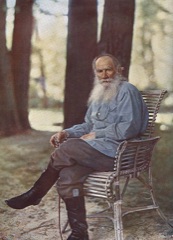
Leo Tolstoy
1828–1910 · Russian novelist, author of War and Peace and Anna Karenina, and later a religious and moral thinker.
Leo Tolstoy was born in 1828 at Yasnaya Polyana, his family's estate south of Moscow. Both his parents died when he was a child, and he was raised by relatives. He studied at Kazan University but left without a degree. In 1851 he joined the army in the Caucasus and later served in the Crimean War during the siege of Sevastopol, experiences he described in his early stories. Back at Yasnaya Polyana, he founded schools for peasant children. In 1862 he married Sophia Behrs, and they had thirteen children. His novel War and Peace (1869) follows several aristocratic families through the Napoleonic invasion of Russia, and Anna Karenina (1878) tells of a woman's tragic love affair alongside the story of a landowner's search for meaning. After a spiritual crisis he developed his own form of Christianity based on the Sermon on the Mount, rejecting violence and private property and was excommunicated by the Russian Orthodox Church in 1901. His later works include The Death of Ivan Ilyich (1886). In 1910, at 82, he left home secretly and died at the railway station of Astapovo.
Leo Tolstoy is also an author in the library: author page and works.
Faith: Renounced the Orthodox faith and attacked the Orthodox Church, which formally excommunicated him in 1901. Source: Encyclopaedia Britannica (1911) (via Wikisource)
Further reading
- Leo Tolstoy: A Very Short Introduction by Liza Knapp (Oxford University Press, 2019)

Key dates
- 1828 Born at Yasnaya Polyana
- 1854–1855 Serves at Sevastopol
- 1862 Marries Sophia Behrs
- 1869 War and Peace completed
- 1878 Anna Karenina published
- 1886 The Death of Ivan Ilyich
- 1910 Dies at Astapovo
Read about them
Grades 9–12
- War and Peace · In the library
- The Death of Ivan Ilyich · In the library
- Anna Karenina · In the library
- A Confession · In the library
- Resurrection · In the library
More lives
Edwin A. Abbott · Jane Addams · Louisa May Alcott · Hans Christian Andersen · Jane Austen · Honoré de Balzac