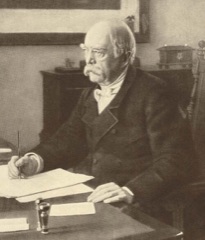
Otto von Bismarck
1815–1898 · Prussian statesman who unified Germany and became its first chancellor.
Otto von Bismarck came from a family of Prussian landowners, called Junkers. After a wild youth he entered politics and diplomacy, and in 1862 King William I made him minister-president of Prussia. He declared that the great questions of the day would be decided not by speeches and majority votes but by iron and blood. Through three short wars, against Denmark in 1864, Austria in 1866 and France in 1870 and 1871, he united the German states under Prussian leadership. In January 1871 William was proclaimed German Emperor in the Hall of Mirrors at Versailles, and Bismarck became chancellor. For nearly twenty years he kept peace in Europe through a web of alliances. At home he fought the Catholic Church in the Kulturkampf and tried to suppress the socialists, but he also created the world's first national programs of health, accident and old-age insurance for workers. The young emperor William II dismissed him in 1890. He died in 1898.
Faith: A Protestant who led a struggle against the Roman Catholic Church in the 1870s. Source: Encyclopaedia Britannica (1911) (via Wikisource)

Key dates
- 1862 Becomes minister-president of Prussia
- 1866 Defeats Austria
- 1871 German Empire proclaimed; becomes chancellor
- 1883–1889 Worker insurance laws
- 1890 Dismissed by William II
- 1898 Dies
Fun facts
- His firm style of government earned him the nickname 'the Iron Chancellor'. (Source: Otto von Bismarck (Wikipedia))
More lives
John Quincy Adams · Susan B. Anthony · Frédéric Bastiat · Simón Bolívar · John C. Calhoun · Henry Clay