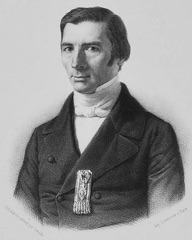
Frédéric Bastiat
1801–1850 · French economist and member of the National Assembly, author of The Law and the parable of the broken window.
Claude-Frédéric Bastiat was born in 1801 in Bayonne, in southwestern France, the son of a merchant. Orphaned by the age of nine, he was raised by relatives and later managed the family estate at Mugron, in the Landes region, where he served as a local justice of the peace. He read widely in economics, especially Adam Smith and Jean-Baptiste Say, and was inspired by the campaign in Britain led by Richard Cobden to abolish tariffs on grain. From 1844 he wrote essays and pamphlets for free trade, using humor and vivid examples, such as his satirical petition from candle makers asking the government to block out the sun. In 1848 he was elected to the French National Assembly. In his essay What Is Seen and What Is Not Seen, he told the parable of a broken window, arguing that the money spent to repair it is not a gain to society, because it could have been spent elsewhere. The Law (1850) argued that law should protect life, liberty and property rather than be used for 'plunder'. He died of tuberculosis in Rome in 1850.
Frédéric Bastiat is also an author in the library: author page and works.
Faith: Faith not well documented; he was educated at a Benedictine school. Source: Wikipedia

Key dates
- 1801 Born in Bayonne
- 1844 Begins writing on free trade
- 1845 The Candlemakers' Petition
- 1848 Elected to the National Assembly
- 1850 The Law and What Is Seen and What Is Not Seen; dies in Rome
Read about them
Grades 9–12
- The Law · In the library
More lives
John Quincy Adams · Susan B. Anthony · Otto von Bismarck · Eugen von Böhm-Bawerk · Simón Bolívar · John C. Calhoun