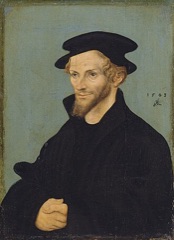
Philip Melanchthon
1497–1560 · German humanist scholar, Martin Luther's chief colleague at Wittenberg and author of the Augsburg Confession.
Philip Melanchthon was born Philipp Schwartzerdt in 1497 at Bretten in the Palatinate; his great-uncle, the scholar Johann Reuchlin, gave him the Greek form of his surname. A brilliant student of Greek at Heidelberg and Tübingen, he was appointed professor of Greek at Wittenberg in 1518 at the age of twenty-one and quickly became Martin Luther's closest ally. His Loci Communes (1521) was the first systematic Protestant theology. In 1530 he drafted the Augsburg Confession, presented to Emperor Charles V as a statement of Lutheran belief, and soon afterwards its Apology. Gentler than Luther, he sought agreement with Catholics and with Reformed theologians, which drew criticism from stricter Lutherans after Luther's death. A reformer of schools and universities across Protestant Germany, he was called the Teacher of Germany (Praeceptor Germaniae). He died in Wittenberg in 1560 and is buried beside Luther in the Castle Church. His Augsburg Confession remains the chief Lutheran statement of faith.
Philip Melanchthon is also an author in the library: author page and works.
Faith: Collaborator and friend of Martin Luther, whom he called his intellectual father in theology. Source: Catholic Encyclopedia (1913)
See also: Martin Luther

Key dates
- 1497 Born at Bretten
- 1518 Professor of Greek at Wittenberg
- 1521 Loci Communes
- 1530 Augsburg Confession
- 1560 Dies in Wittenberg
Read about them
Grades 9–12
- The Augsburg Confession · In the library
- Selected Sermons and Reformation Treatises · In the library
More lives
Fra Angelico · Thieleman J. van Braght · John Bunyan · Robert Burton · John Calvin · Thomas Cranmer