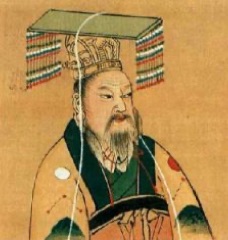
Qin Shi Huang
259–210 BC · First emperor of a unified China, who standardized writing and began the Great Wall.
Ying Zheng became king of the state of Qin, in western China, in 246 BC at about thirteen. China was then divided among warring states. Over about ten years his armies conquered the six rival kingdoms, and in 221 BC he declared himself Qin Shi Huang, the First Emperor. Guided by his minister Li Si and the strict philosophy called Legalism, he replaced the old noble domains with provinces run by officials, and standardized writing, coins, weights and measures, and even the width of cart axles. He joined earlier walls into a long defensive wall in the north, an early form of the Great Wall, and built roads and canals, using vast numbers of forced laborers, many of whom died. In 213 BC he ordered many books burned, and tradition says he had scholars killed. He searched for a potion of immortality and died in 210 BC while traveling. His tomb near Xi'an was guarded by thousands of life-sized clay soldiers, the Terracotta Army, found by farmers in 1974. His dynasty collapsed four years after his death.
Faith: Faith not well documented. Source: Wikipedia

Key dates
- 246 BC Becomes king of Qin
- 221 BC Unifies China as First Emperor
- 213 BC Orders the burning of books
- 210 BC Dies
- 1974 Terracotta Army discovered
More lives
Alexander the Great · Ashoka · Augustus · Cleopatra VII · Constantine the Great · Cyrus the Great