Story maps · Grades 9–12
A Tale of Two Cities: A Story Map
The PDF is one tabloid page (11 × 17 in). On letter paper, choose “Fit to page.”
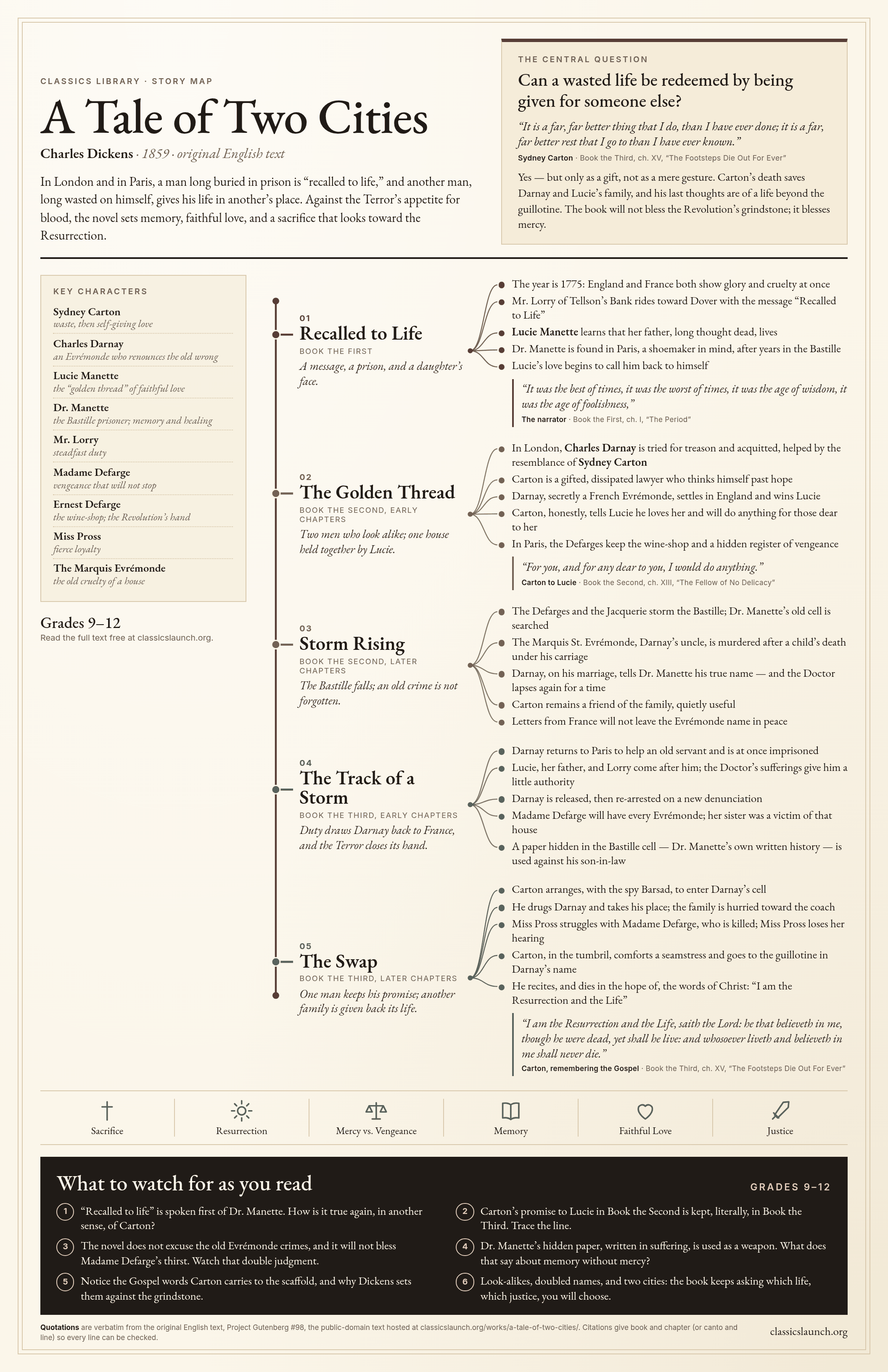
In London and in Paris, a man long buried in prison is “recalled to life,” and another man, long wasted on himself, gives his life in another’s place. Against the Terror’s appetite for blood, the novel sets memory, faithful love, and a sacrifice that looks toward the Resurrection.
The central question
Can a wasted life be redeemed by being given for someone else?
“It is a far, far better thing that I do, than I have ever done; it is a far, far better rest that I go to than I have ever known.”
Yes — but only as a gift, not as a mere gesture. Carton’s death saves Darnay and Lucie’s family, and his last thoughts are of a life beyond the guillotine. The book will not bless the Revolution’s grindstone; it blesses mercy.
- 01
Recalled to Life
Book the First
A message, a prison, and a daughter’s face.
- The year is 1775: England and France both show glory and cruelty at once
- Mr. Lorry of Tellson’s Bank rides toward Dover with the message “Recalled to Life”
- Lucie Manette learns that her father, long thought dead, lives
- Dr. Manette is found in Paris, a shoemaker in mind, after years in the Bastille
- Lucie’s love begins to call him back to himself
“It was the best of times, it was the worst of times, it was the age of wisdom, it was the age of foolishness,”
- 02
The Golden Thread
Book the Second, early chapters
Two men who look alike; one house held together by Lucie.
- In London, Charles Darnay is tried for treason and acquitted, helped by the resemblance of Sydney Carton
- Carton is a gifted, dissipated lawyer who thinks himself past hope
- Darnay, secretly a French Evrémonde, settles in England and wins Lucie
- Carton, honestly, tells Lucie he loves her and will do anything for those dear to her
- In Paris, the Defarges keep the wine-shop and a hidden register of vengeance
“For you, and for any dear to you, I would do anything.”
- 03
Storm Rising
Book the Second, later chapters
The Bastille falls; an old crime is not forgotten.
- The Defarges and the Jacquerie storm the Bastille; Dr. Manette’s old cell is searched
- The Marquis St. Evrémonde, Darnay’s uncle, is murdered after a child’s death under his carriage
- Darnay, on his marriage, tells Dr. Manette his true name — and the Doctor lapses again for a time
- Carton remains a friend of the family, quietly useful
- Letters from France will not leave the Evrémonde name in peace
- 04
The Track of a Storm
Book the Third, early chapters
Duty draws Darnay back to France, and the Terror closes its hand.
- Darnay returns to Paris to help an old servant and is at once imprisoned
- Lucie, her father, and Lorry come after him; the Doctor’s sufferings give him a little authority
- Darnay is released, then re-arrested on a new denunciation
- Madame Defarge will have every Evrémonde; her sister was a victim of that house
- A paper hidden in the Bastille cell — Dr. Manette’s own written history — is used against his son-in-law
- 05
The Swap
Book the Third, later chapters
One man keeps his promise; another family is given back its life.
- Carton arranges, with the spy Barsad, to enter Darnay’s cell
- He drugs Darnay and takes his place; the family is hurried toward the coach
- Miss Pross struggles with Madame Defarge, who is killed; Miss Pross loses her hearing
- Carton, in the tumbril, comforts a seamstress and goes to the guillotine in Darnay’s name
- He recites, and dies in the hope of, the words of Christ: “I am the Resurrection and the Life”
“I am the Resurrection and the Life, saith the Lord: he that believeth in me, though he were dead, yet shall he live: and whosoever liveth and believeth in me shall never die.”
- Sacrifice
- Resurrection
- Mercy vs. Vengeance
- Memory
- Faithful Love
- Justice
What to watch for as you read
Grades 9–12- “Recalled to life” is spoken first of Dr. Manette. How is it true again, in another sense, of Carton?
- Carton’s promise to Lucie in Book the Second is kept, literally, in Book the Third. Trace the line.
- The novel does not excuse the old Evrémonde crimes, and it will not bless Madame Defarge’s thirst. Watch that double judgment.
- Dr. Manette’s hidden paper, written in suffering, is used as a weapon. What does that say about memory without mercy?
- Notice the Gospel words Carton carries to the scaffold, and why Dickens sets them against the grindstone.
- Look-alikes, doubled names, and two cities: the book keeps asking which life, which justice, you will choose.
Every quotation is word for word from the original English text hosted in this library and is checked against that text each time the site is built. Citations give book and chapter (or canto and line).