Story maps · Grades 9–12
Adventures of Huckleberry Finn: A Story Map
The PDF is one tabloid page (11 × 17 in). On letter paper, choose “Fit to page.”
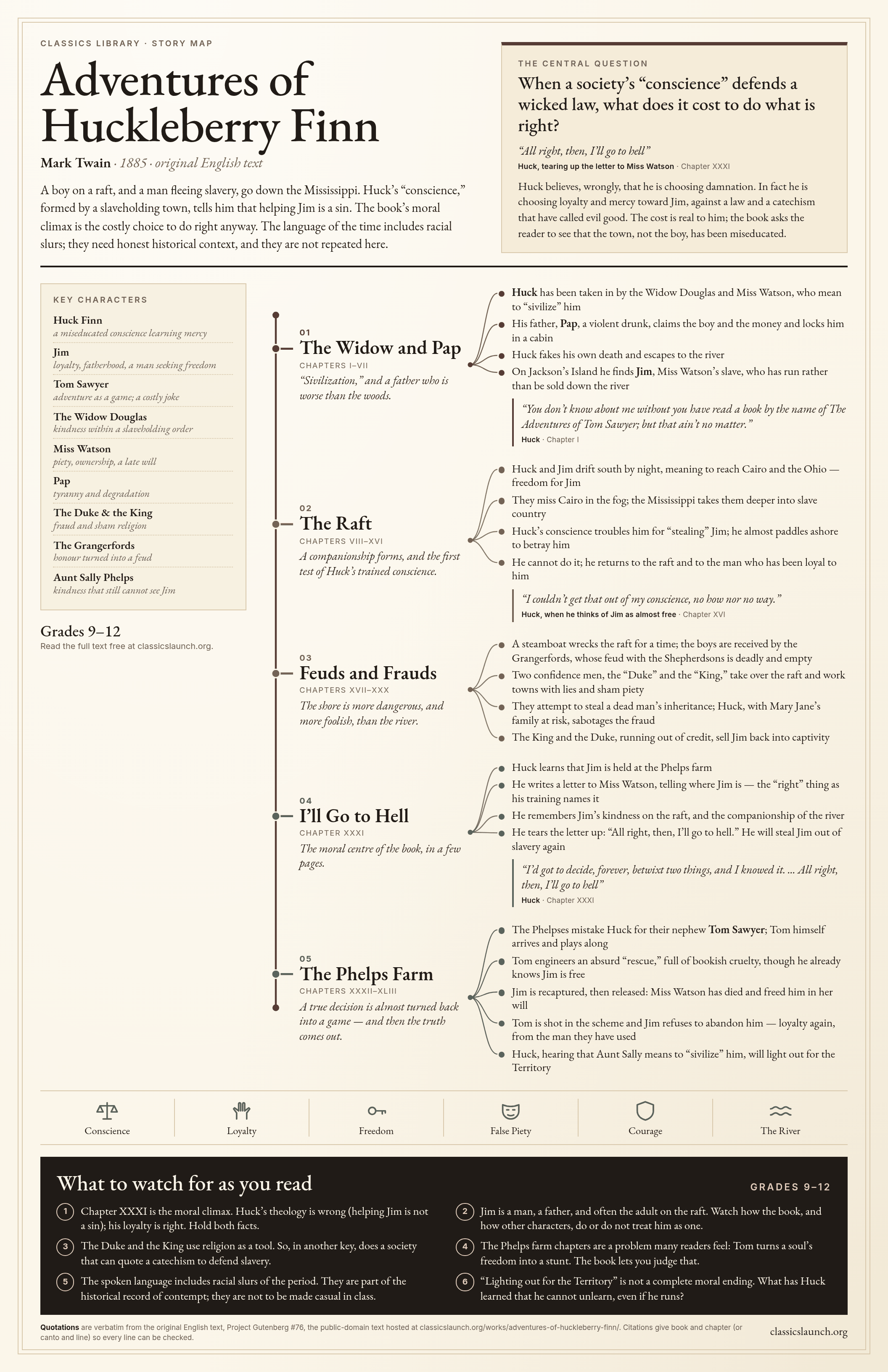
A boy on a raft, and a man fleeing slavery, go down the Mississippi. Huck’s “conscience,” formed by a slaveholding town, tells him that helping Jim is a sin. The book’s moral climax is the costly choice to do right anyway. The language of the time includes racial slurs; they need honest historical context, and they are not repeated here.
The central question
When a society’s “conscience” defends a wicked law, what does it cost to do what is right?
“All right, then, I’ll go to hell”
Huck believes, wrongly, that he is choosing damnation. In fact he is choosing loyalty and mercy toward Jim, against a law and a catechism that have called evil good. The cost is real to him; the book asks the reader to see that the town, not the boy, has been miseducated.
- 01
The Widow and Pap
Chapters I–VII
“Sivilization,” and a father who is worse than the woods.
- Huck has been taken in by the Widow Douglas and Miss Watson, who mean to “sivilize” him
- His father, Pap, a violent drunk, claims the boy and the money and locks him in a cabin
- Huck fakes his own death and escapes to the river
- On Jackson’s Island he finds Jim, Miss Watson’s slave, who has run rather than be sold down the river
“You don’t know about me without you have read a book by the name of The Adventures of Tom Sawyer; but that ain’t no matter.”
- 02
The Raft
Chapters VIII–XVI
A companionship forms, and the first test of Huck’s trained conscience.
- Huck and Jim drift south by night, meaning to reach Cairo and the Ohio — freedom for Jim
- They miss Cairo in the fog; the Mississippi takes them deeper into slave country
- Huck’s conscience troubles him for “stealing” Jim; he almost paddles ashore to betray him
- He cannot do it; he returns to the raft and to the man who has been loyal to him
“I couldn’t get that out of my conscience, no how nor no way.”
- 03
Feuds and Frauds
Chapters XVII–XXX
The shore is more dangerous, and more foolish, than the river.
- A steamboat wrecks the raft for a time; the boys are received by the Grangerfords, whose feud with the Shepherdsons is deadly and empty
- Two confidence men, the “Duke” and the “King,” take over the raft and work towns with lies and sham piety
- They attempt to steal a dead man’s inheritance; Huck, with Mary Jane’s family at risk, sabotages the fraud
- The King and the Duke, running out of credit, sell Jim back into captivity
- 04
I’ll Go to Hell
Chapter XXXI
The moral centre of the book, in a few pages.
- Huck learns that Jim is held at the Phelps farm
- He writes a letter to Miss Watson, telling where Jim is — the “right” thing as his training names it
- He remembers Jim’s kindness on the raft, and the companionship of the river
- He tears the letter up: “All right, then, I’ll go to hell.” He will steal Jim out of slavery again
“I’d got to decide, forever, betwixt two things, and I knowed it. ... All right, then, I’ll go to hell”
- 05
The Phelps Farm
Chapters XXXII–XLIII
A true decision is almost turned back into a game — and then the truth comes out.
- The Phelpses mistake Huck for their nephew Tom Sawyer; Tom himself arrives and plays along
- Tom engineers an absurd “rescue,” full of bookish cruelty, though he already knows Jim is free
- Jim is recaptured, then released: Miss Watson has died and freed him in her will
- Tom is shot in the scheme and Jim refuses to abandon him — loyalty again, from the man they have used
- Huck, hearing that Aunt Sally means to “sivilize” him, will light out for the Territory
- Conscience
- Loyalty
- Freedom
- False Piety
- Courage
- The River
What to watch for as you read
Grades 9–12- Chapter XXXI is the moral climax. Huck’s theology is wrong (helping Jim is not a sin); his loyalty is right. Hold both facts.
- Jim is a man, a father, and often the adult on the raft. Watch how the book, and how other characters, do or do not treat him as one.
- The Duke and the King use religion as a tool. So, in another key, does a society that can quote a catechism to defend slavery.
- The Phelps farm chapters are a problem many readers feel: Tom turns a soul’s freedom into a stunt. The book lets you judge that.
- The spoken language includes racial slurs of the period. They are part of the historical record of contempt; they are not to be made casual in class.
- “Lighting out for the Territory” is not a complete moral ending. What has Huck learned that he cannot unlearn, even if he runs?
Every quotation is word for word from the original English text hosted in this library and is checked against that text each time the site is built. Citations give book and chapter (or canto and line).