Story maps · Grades 9–12
Hamlet: A Story Map
The PDF is one tabloid page (11 × 17 in). On letter paper, choose “Fit to page.”
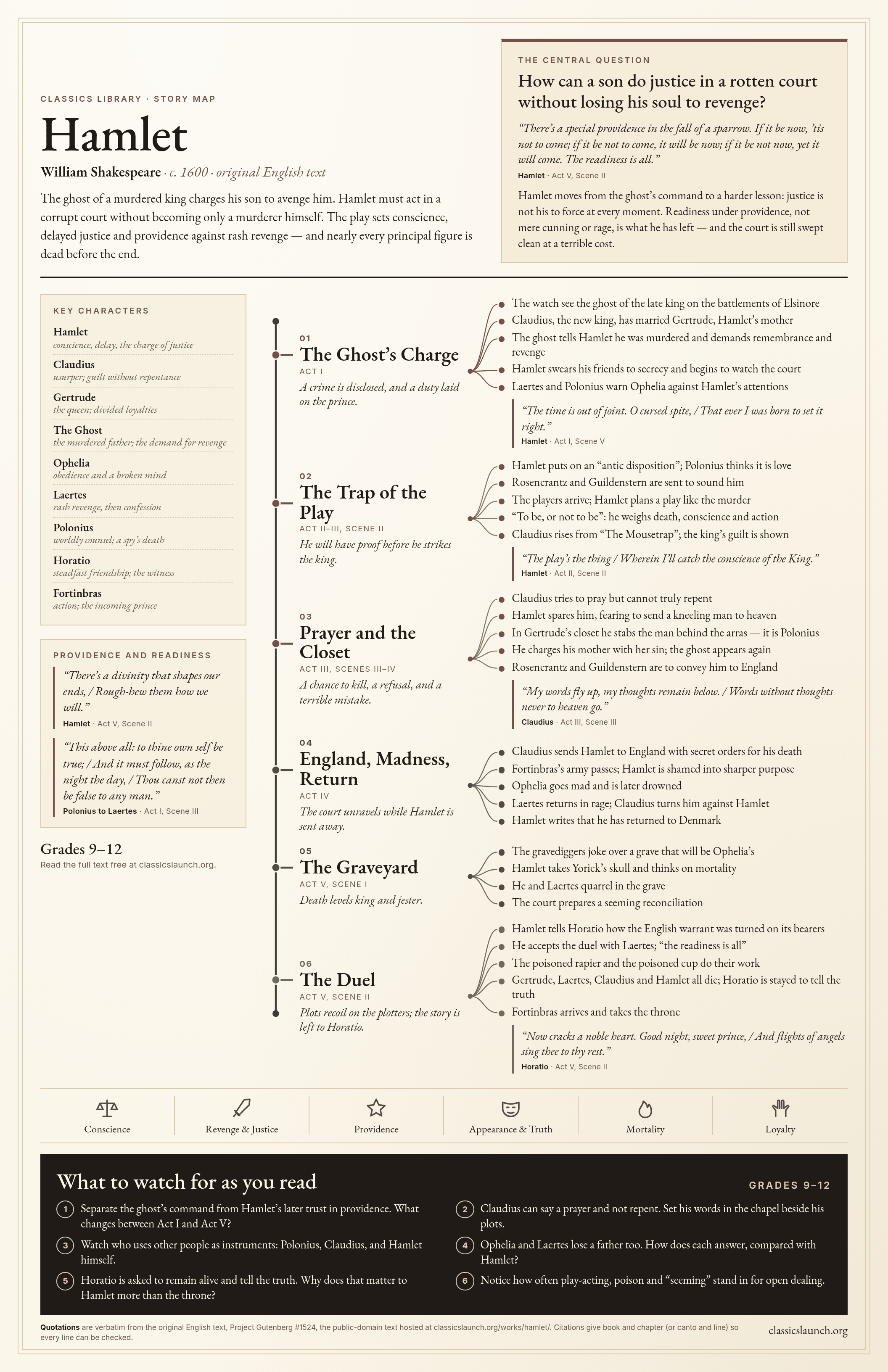
The ghost of a murdered king charges his son to avenge him. Hamlet must act in a corrupt court without becoming only a murderer himself. The play sets conscience, delayed justice and providence against rash revenge — and nearly every principal figure is dead before the end.
The central question
How can a son do justice in a rotten court without losing his soul to revenge?
“There’s a special providence in the fall of a sparrow. If it be now, ’tis not to come; if it be not to come, it will be now; if it be not now, yet it will come. The readiness is all.”
Hamlet moves from the ghost’s command to a harder lesson: justice is not his to force at every moment. Readiness under providence, not mere cunning or rage, is what he has left — and the court is still swept clean at a terrible cost.
- 01
The Ghost’s Charge
Act I
A crime is disclosed, and a duty laid on the prince.
- The watch see the ghost of the late king on the battlements of Elsinore
- Claudius, the new king, has married Gertrude, Hamlet’s mother
- The ghost tells Hamlet he was murdered and demands remembrance and revenge
- Hamlet swears his friends to secrecy and begins to watch the court
- Laertes and Polonius warn Ophelia against Hamlet’s attentions
“The time is out of joint. O cursed spite, / That ever I was born to set it right.”
- 02
The Trap of the Play
Act II–III, Scene II
He will have proof before he strikes the king.
- Hamlet puts on an “antic disposition”; Polonius thinks it is love
- Rosencrantz and Guildenstern are sent to sound him
- The players arrive; Hamlet plans a play like the murder
- “To be, or not to be”: he weighs death, conscience and action
- Claudius rises from “The Mousetrap”; the king’s guilt is shown
“The play’s the thing / Wherein I’ll catch the conscience of the King.”
- 03
Prayer and the Closet
Act III, Scenes III–IV
A chance to kill, a refusal, and a terrible mistake.
- Claudius tries to pray but cannot truly repent
- Hamlet spares him, fearing to send a kneeling man to heaven
- In Gertrude’s closet he stabs the man behind the arras — it is Polonius
- He charges his mother with her sin; the ghost appears again
- Rosencrantz and Guildenstern are to convey him to England
“My words fly up, my thoughts remain below. / Words without thoughts never to heaven go.”
- 04
England, Madness, Return
Act IV
The court unravels while Hamlet is sent away.
- Claudius sends Hamlet to England with secret orders for his death
- Fortinbras’s army passes; Hamlet is shamed into sharper purpose
- Ophelia goes mad and is later drowned
- Laertes returns in rage; Claudius turns him against Hamlet
- Hamlet writes that he has returned to Denmark
- 05
The Graveyard
Act V, Scene I
Death levels king and jester.
- The gravediggers joke over a grave that will be Ophelia’s
- Hamlet takes Yorick’s skull and thinks on mortality
- He and Laertes quarrel in the grave
- The court prepares a seeming reconciliation
- 06
The Duel
Act V, Scene II
Plots recoil on the plotters; the story is left to Horatio.
- Hamlet tells Horatio how the English warrant was turned on its bearers
- He accepts the duel with Laertes; “the readiness is all”
- The poisoned rapier and the poisoned cup do their work
- Gertrude, Laertes, Claudius and Hamlet all die; Horatio is stayed to tell the truth
- Fortinbras arrives and takes the throne
“Now cracks a noble heart. Good night, sweet prince, / And flights of angels sing thee to thy rest.”
- Conscience
- Revenge & Justice
- Providence
- Appearance & Truth
- Mortality
- Loyalty
What to watch for as you read
Grades 9–12- Separate the ghost’s command from Hamlet’s later trust in providence. What changes between Act I and Act V?
- Claudius can say a prayer and not repent. Set his words in the chapel beside his plots.
- Watch who uses other people as instruments: Polonius, Claudius, and Hamlet himself.
- Ophelia and Laertes lose a father too. How does each answer, compared with Hamlet?
- Horatio is asked to remain alive and tell the truth. Why does that matter to Hamlet more than the throne?
- Notice how often play-acting, poison and “seeming” stand in for open dealing.
Every quotation is word for word from the original English text hosted in this library and is checked against that text each time the site is built. Citations give book and chapter (or canto and line).