Work record
Hamlet
c. 1600 · Renaissance Early Modern · Drama · English
Abstract
Background. Shakespeare reshaped the Amleth legend from Saxo Grammaticus and Belleforest, probably by way of a lost English play, within the revenge tradition that Kyd's Spanish Tragedy had made popular.
Plot. Called home from Wittenberg, Prince Hamlet hears from his father's ghost that Claudius, now king and Gertrude's husband, poisoned him in the orchard. Feigning madness, Hamlet tests the charge with the Mousetrap play, spares Claudius at prayer, stabs Polonius behind the arras, and is shipped to England, returning by way of pirates. Ophelia goes mad and drowns; Laertes and Claudius arrange a poisoned foil and cup, and the fencing match kills queen, Laertes, king and prince before Fortinbras enters.
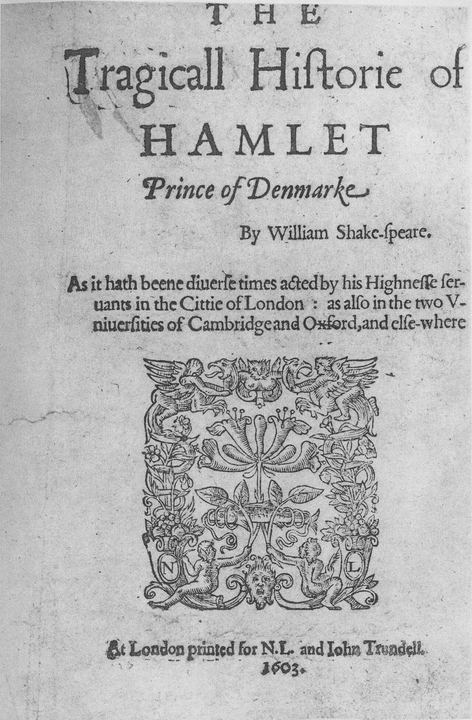
Structure. The play survives in three early texts that differ considerably; the First Quarto places 'To be, or not to be' earlier, and modern editions combine the Second Quarto and Folio.
Themes. Mourning and melancholy, the doubtful standing of ghosts between purgatory and demonic deceit, feigned and real madness in Hamlet and Ophelia, conscience and delay, and the prince's late, quiet trust in providence: the readiness is all.
Significance. Shakespeare's longest play and the most discussed, it has supplied English with many of its best-known lines and invited Romantic, psychoanalytic and theological readings of its hero.
Main characters
- Hamlet: Grieving Danish prince and Wittenberg student charged to avenge his father
- Claudius: Hamlet's uncle, who poisoned his brother and took his crown and queen
- Gertrude: Queen, Hamlet's mother, swiftly remarried to Claudius
- The Ghost: Spirit of the murdered King Hamlet, demanding revenge from purgatorial fire
- Polonius: Talkative Lord Chamberlain, killed while hiding behind the arras
- Ophelia: Polonius's daughter, loved and then spurned by Hamlet, who goes mad
- Laertes: Polonius's son, a swift avenger set against Hamlet's hesitation
- Horatio: Hamlet's steady friend, left to tell his story
- Rosencrantz and Guildenstern: School friends recruited to spy, sent to death in England
- Fortinbras: Norwegian prince who arrives to claim Denmark

Watch the summary
Hamlet in 163 seconds · 2:43
Summary
Hamlet opens on the battlements of Elsinore, where sentries and the scholar Horatio see the ghost of the late King Hamlet of Denmark. Prince Hamlet, called home from university at Wittenberg for his father's funeral, is grieving and disgusted that his mother Gertrude has married his uncle Claudius, now king, within two months. The Ghost tells Hamlet that Claudius murdered him by pouring poison into his ear as he slept, and commands revenge, though Hamlet must leave his mother to heaven. Hamlet swears to remember, then decides to put on an antic disposition, feigning madness. The court's counselor Polonius, who has forbidden his daughter Ophelia to receive Hamlet's love, believes the prince is mad for her; Claudius sets Hamlet's school friends Rosencrantz and Guildenstern to spy on him. Hamlet, doubting whether the Ghost may be a devil, has visiting players perform a play reenacting the murder; Claudius rises in alarm, and Hamlet is certain. He then comes upon Claudius at prayer and spares him, lest he die in a state of grace; alone, Claudius admits his words fly up while his thoughts remain below. In his mother's chamber Hamlet stabs Polonius, who is hiding behind a tapestry, and rebukes Gertrude until the Ghost appears again. Claudius sends Hamlet to England with sealed orders for his death. Ophelia, her father dead and her lover gone, loses her reason, sings fragments of songs and hands out flowers, and is later drowned. Her brother Laertes returns from France demanding vengeance, and Claudius plots with him a fencing match with an unblunted, poisoned rapier and a poisoned cup in reserve. Hamlet, having discovered the orders and sent Rosencrantz and Guildenstern to their deaths instead, returns by way of a pirate ship. In the graveyard he contemplates the skull of the jester Yorick and grapples with Laertes in Ophelia's grave. Before the match he tells Horatio that there is a special providence in the fall of a sparrow and that the readiness is all. In the duel Gertrude drinks the poisoned cup, Laertes and Hamlet are wounded with the poisoned blade, Laertes confesses, and Hamlet kills Claudius. Dying, Hamlet asks Horatio to tell his story and names Fortinbras of Norway, who arrives to claim the throne and give Hamlet a soldier's funeral.
Virtues in this work
- Prudence: Hamlet refuses to act on the Ghost's word alone and tests it with the Mousetrap.
- Friendship: Horatio stays loyal to Hamlet to the end and is charged with telling his story truly.
- Faith: In Act 5 Hamlet trusts the special providence in the fall of a sparrow and goes to the duel ready for whatever comes.
- Justice: Claudius's murder of his brother is exposed and punished, and the throne passes to Fortinbras.
Plot or Argument
- Act I: The Ghost
The Ghost appears on the platform; Hamlet grieves his father and his mother's hasty marriage, learns of the murder, swears revenge and resolves to feign madness.
- Act II: Antic disposition
Polonius blames love for Hamlet's madness; Rosencrantz and Guildenstern are set to spy; the players arrive and Hamlet plans the Mousetrap to test the Ghost's word.
- Act III: The Mousetrap
Hamlet meditates on being and not being, rejects Ophelia, watches Claudius break off the play, spares him at prayer, kills Polonius and confronts Gertrude.
- Act IV: Madness and plots
Hamlet is sent to England; Ophelia goes mad and drowns; Laertes returns in rage and Claudius plots the poisoned duel.
- Act V: The readiness is all
Hamlet returns, meditates on death in the graveyard, accepts providence, and dies in the duel after killing Claudius; Fortinbras inherits Denmark.
Characters
- Hamlet, Prince of Denmark
A brilliant, grieving, witty and self-searching scholar charged by his father's ghost to avenge a murder.
- Claudius, King of Denmark
Hamlet's uncle, a capable politician who has murdered his brother and married his widow, and who cannot repent.
- Gertrude, Queen of Denmark
Hamlet's mother, whose quick remarriage wounds her son.
- The Ghost, Hamlet's father
The late king, suffering in purgatorial fire, who demands revenge.
- Polonius, Lord Chamberlain
A meddling, sententious counselor and loving father who dies spying behind the arras.
- Ophelia, Polonius's daughter
A gentle, obedient young woman loved by Hamlet, who loses her mind after her father's death.
- Laertes, Polonius's son
A hot-blooded young man whose revenge for his father mirrors and contrasts with Hamlet's.
- Horatio, Hamlet's friend
A loyal, level-headed scholar who survives to tell Hamlet's story.
- Rosencrantz and Guildenstern, school friends
Courtiers used by Claudius to spy on Hamlet and later sent to their deaths.
- Fortinbras, Prince of Norway
A decisive young soldier whose action contrasts with Hamlet's delay and who takes the throne.
Lessons
Conscience and the command to act
Hamlet must avenge a murder yet fears damning himself on a ghost's word. His delay is not mere weakness: he tests the Ghost, weighs the soul's fate, and thinks about what killing means. The play makes readers think about the moral weight of action.
- Why does Hamlet stage the Mousetrap before acting?
- Why does he spare Claudius at prayer?
- What does he mean by conscience making cowards of us all?
Repentance that will not let go
Claudius wants forgiveness but will not give up his crown, his queen or his ambition. Shakespeare shows that true repentance requires surrender of the fruits of sin.
- What does Claudius ask himself in his prayer?
- Why do his words fly up while his thoughts remain below?
Providence and readiness
After his sea voyage Hamlet speaks of a divinity that shapes our ends and of special providence in the fall of a sparrow. His final calm comes from trust rather than from a finished plan.
- How has Hamlet changed between Act III and Act V?
- What does 'the readiness is all' mean?
Fathers and children
Hamlet, Laertes and Fortinbras are all sons of slain fathers, each answering differently. Polonius's counsel to Laertes and his use of Ophelia show the good and the harm a parent can do.
- How do Hamlet and Laertes differ in revenge?
- Is Polonius a good father?
Context
Hamlet draws on the Danish legend of Amleth told by Saxo Grammaticus and retold by Belleforest, and probably on a lost earlier English Hamlet play. It belongs to the Elizabethan tradition of revenge tragedy, popularized by Kyd's Spanish Tragedy, and reflects contemporary interest in melancholy, the nature of ghosts and debates between Catholic and Protestant ideas of purgatory. Hamlet's university, Wittenberg, was Luther's.
Composition
Shakespeare wrote Hamlet around 1599-1601. It survives in three early texts: a short First Quarto (1603), a fuller Second Quarto (1604-05) and the First Folio (1623). Modern editions, like the text attached here, combine readings from these.
Reception
Hamlet was popular from its first performances and has been the most performed and discussed of Shakespeare's plays. Its soliloquies, especially 'To be, or not to be', are among the best-known passages in English, and the prince has been interpreted by Romantic, psychological and religious critics in many ways.
Comparisons
- macbeth
Macbeth acts on a supernatural prompting too quickly and is destroyed by guilt; Hamlet hesitates and tests the Ghost.
- the-oresteia
Orestes must avenge a murdered father on a parent; Aeschylus ends with a court of justice, Shakespeare with providence and death.
- king-lear
Both tragedies probe madness, real and feigned, and the bonds between parents and children.
- the-anatomy-of-melancholy
Burton's encyclopedia of melancholy, published two decades later, describes the scholarly sadness Hamlet displays.
Quotes
Frequently cited
“O that this too too solid flesh would melt, Thaw, and resolve itself into a dew”
Frequently cited
“This above all: to thine own self be true; And it must follow, as the night the day, Thou canst not then be false to any man”
Frequently cited
“Something is rotten in the state of Denmark”
Frequently cited
“The time is out of joint. O cursed spite, That ever I was born to set it right”
Frequently cited
“The play’s the thing Wherein I’ll catch the conscience of the King”
Frequently cited
“To be, or not to be, that is the question”
Frequently cited
“My words fly up, my thoughts remain below. Words without thoughts never to heaven go”
Frequently cited
“There’s rosemary, that’s for remembrance”
Frequently cited
“There’s a divinity that shapes our ends, Rough-hew them how we will”
Frequently cited
“There’s a special providence in the fall of a sparrow. If it be now, ’tis not to come; if it be not to come, it will be now; if it be not now, yet it will come. The readiness is all”
Frequently cited
“Now cracks a noble heart. Good night, sweet prince, And flights of angels sing thee to thy rest”
“I have of late, but wherefore I know not, lost all my mirth, forgone all custom of exercises; and indeed, it goes so heavily with my disposition that this goodly frame the earth, seems to me a sterile promontory”
“Thus conscience does make cowards of us all”
For Students
A reading companion for classical Christian high school students. See the student guide.
Reading Guide
Watch for
- Hamlet's first soliloquy in Act 1, Scene 2, before he has seen the Ghost: what already troubles him?
- The Ghost's command in Act 1, Scene 5, including what he tells Hamlet not to do to his mother.
- Every time Hamlet seems mad: is he pretending, and to whom?
- Claudius at prayer in Act 3, Scene 3, and why Hamlet does not kill him.
- Hamlet's words to Horatio in Act 5, Scene 2 about providence and readiness, compared with his soliloquies earlier.
Key terms and names
- Soliloquy
- A speech in which a character alone on stage speaks his thoughts aloud; Hamlet has seven.
- Antic disposition
- Hamlet's phrase for the madness he plans to feign.
- Revenge tragedy
- An Elizabethan genre in which a wronged person, often urged by a ghost, seeks vengeance and dies with his enemies.
- Mousetrap
- Hamlet's name for the play-within-the-play meant to expose Claudius's guilt.
- Melancholy
- In Renaissance medicine, a condition of the black bile bringing sadness, fear and brooding; Hamlet is the classic stage melancholic.
- Purgatory
- In Catholic teaching, a state of purification after death; the Ghost says he is confined to fires for a time.
- Arras
- A wall tapestry; Polonius hides behind one and is killed through it.
Seminar Questions
- Comprehension What does the Ghost tell Hamlet about his death, and what does he command?
- Comprehension Why does Hamlet arrange for the players to perform The Murder of Gonzago?
- Comprehension How do Gertrude, Laertes, Claudius and Hamlet each die?
- Interpretation Is Hamlet ever truly mad, or only pretending? Use at least two scenes as evidence.
- Interpretation Hamlet spares Claudius at prayer so that he will not go to heaven. Is this a reason, an excuse, or a sign of something worse?
- Interpretation How does Hamlet's attitude toward death change between 'To be, or not to be' and 'the readiness is all'?
- Big Question Can a person ever be commanded to take revenge, and what does the play suggest about leaving vengeance to God?
Faith Connections
- Matthew 10:29 (Scripture)
Not one sparrow falls to the ground without your Father. Hamlet's 'special providence in the fall of a sparrow' directly echoes Christ's words.
- Romans 12:19 (Scripture)
Vengeance is mine; I will repay, saith the Lord. The Ghost's command to revenge stands in tension with this teaching, and the play leaves the outcome to providence.
- Psalm 51:16-17 (Scripture)
God desires a broken and contrite heart rather than sacrifice. Claudius's prayer fails because his words are not joined to a contrite heart willing to give up his crime's rewards.
- Augustine, City of God I.17-22 (Church Fathers)
Augustine argues that self-killing is forbidden by the commandment against murder; Hamlet recalls that the Everlasting has fixed his canon against self-slaughter.
Logic and Rhetoric
Central argument: Hamlet is commanded to avenge a murder but fears acting wrongly on uncertain evidence. He tests the Ghost and confirms Claudius's guilt, yet his delay and rashness cause other deaths. At sea he learns that providence shapes events beyond his plans. Therefore the play suggests that human schemes of justice are uncertain and costly, and that peace comes from readiness to accept God's governance.
Rhetorical device: soliloquy as argument. In 'To be, or not to be' Hamlet sets out alternatives, weighs them, considers the unknown after death and concludes that conscience makes cowards of us all, as if reasoning a disputation aloud.
Debate: Resolved: that Hamlet was right to delay killing Claudius until he had tested the Ghost.
Memory Work
To be, or not to be, that is the question
There’s a special providence in the fall of a sparrow. If it be now, ’tis not to come; if it be not to come, it will be now; if it be not now, yet it will come. The readiness is all
Writing Prompts
Essay: Trace Hamlet's thinking about death through three passages: the first soliloquy, 'To be, or not to be,' and the graveyard and sparrow speeches in Act 5. Argue what changes in him and why.
Comparison with Macbeth: Hamlet and Macbeth both receive messages from the supernatural that urge them to kill a king. Compare how each responds and argue what the contrast teaches about conscience.
Medical Lens
Hamlet is a central text for the history of melancholy: the black-clad scholar who has lost all his mirth, which Elizabethan readers would connect with treatises such as Timothy Bright's Treatise of Melancholie (1586). The play sets Hamlet's assumed madness, which he controls, beside Ophelia's real derangement after bereavement, and raises the moral and legal questions of suicide in the soliloquies and the gravediggers' debate over her burial. Poisons drive the plot from the hebenon poured in the king's ear to the envenomed rapier and the poisoned cup. Readings of Hamlet as a case of clinical depression are interpretive; the play itself frames his state in terms of grief, conscience and melancholy.
- Act 1, Scene 2
Hamlet's first soliloquy wishes his flesh would melt and regrets the divine law against self-slaughter.
- Act 1, Scene 5
The Ghost describes the juice of hebenon poured in his ear, curdling his blood and covering his body with a leprous crust.
- Act 2, Scene 2
Hamlet describes the loss of mirth and pleasure in exercise, and Polonius diagnoses love-madness.
- Act 3, Scene 1
The 'To be, or not to be' soliloquy weighs death, sleep and the dreams that may come after.
- Act 4, Scene 5
Ophelia's madness after her father's death: songs, flowers and broken speech.
- Act 4, Scene 7 and Act 5, Scene 1
Gertrude reports Ophelia's drowning; the gravediggers and the priest dispute whether she died by her own act and deserves Christian burial.
- Act 5, Scene 2
The poisoned rapier and cup kill Gertrude, Laertes, Claudius and Hamlet.
Listen to the book
Public-domain audiobook from LibriVox, read by Sam Stinson. Recording: Hamlet (version 2) on LibriVox (Internet Archive).
LibriVox recordings are volunteer readings released into the public domain. The reading may follow a different edition from the text in this library.
Creative Prompts
- Classroom
Stage the Mousetrap scene in Act 3, Scene 2 with half the class watching Claudius and half watching Hamlet, then compare what each group saw.
- Essay
Compare Hamlet's response to his father's death with those of Laertes and Fortinbras, and argue which the play holds up as the right response.
- Dialogue
Write the conversation Horatio has with Fortinbras when he tells Hamlet's story.
Further Reading
- Shakespearean Tragedy, A. C. Bradley
- What Happens in Hamlet, John Dover Wilson
- The Spanish Tragedy, Thomas Kyd
- Hamlet in Purgatory, Stephen Greenblatt
Verification notes
Plot, sources and textual history are standard. Act and scene locators follow the attached Gutenberg modern-spelling text. Quotes are verified against that text.
No verification flags recorded.