Story maps · Grades 9–12
Jane Eyre: A Story Map
The PDF is one tabloid page (11 × 17 in). On letter paper, choose “Fit to page.”
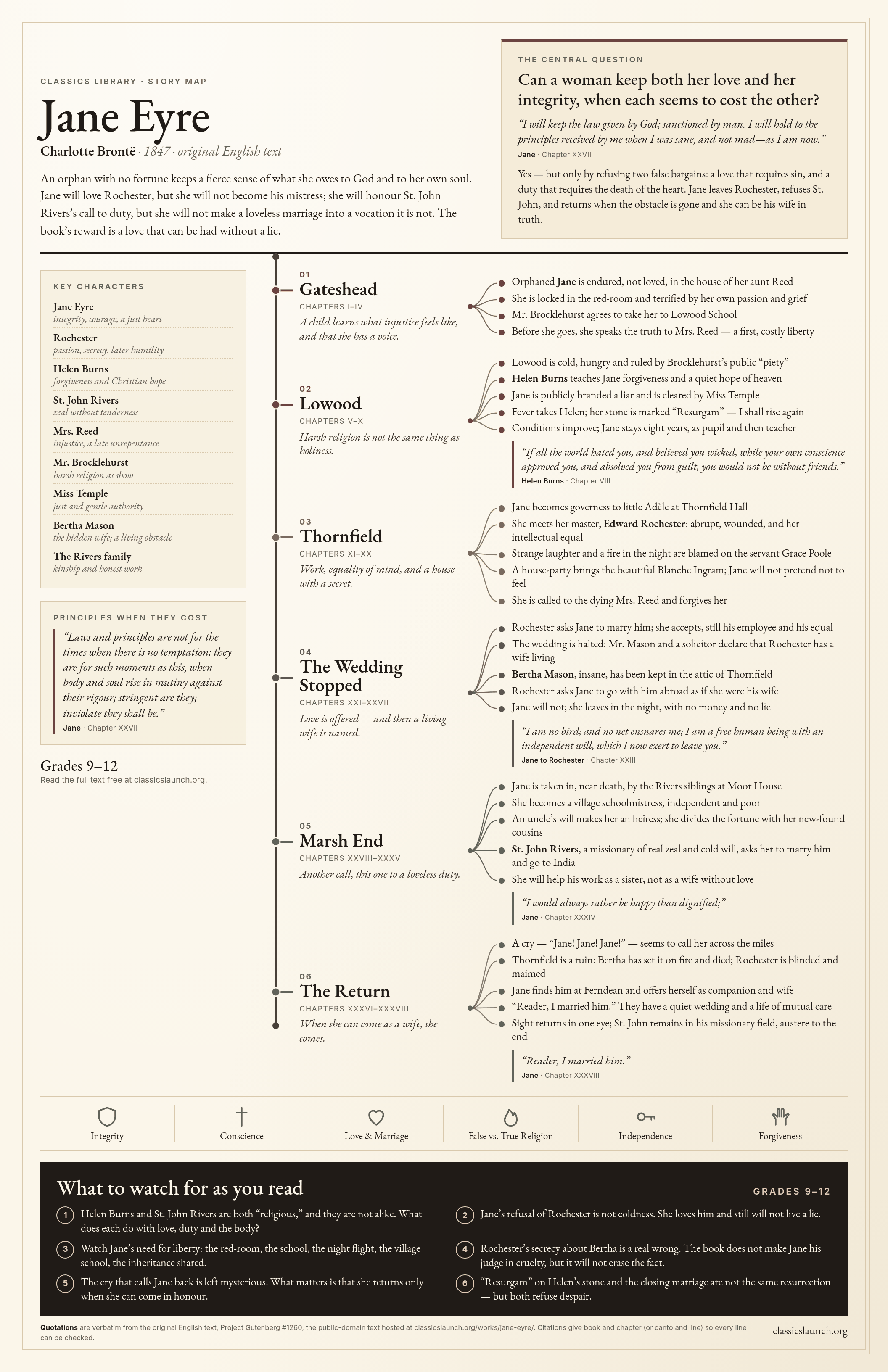
An orphan with no fortune keeps a fierce sense of what she owes to God and to her own soul. Jane will love Rochester, but she will not become his mistress; she will honour St. John Rivers’s call to duty, but she will not make a loveless marriage into a vocation it is not. The book’s reward is a love that can be had without a lie.
The central question
Can a woman keep both her love and her integrity, when each seems to cost the other?
“I will keep the law given by God; sanctioned by man. I will hold to the principles received by me when I was sane, and not mad—as I am now.”
Yes — but only by refusing two false bargains: a love that requires sin, and a duty that requires the death of the heart. Jane leaves Rochester, refuses St. John, and returns when the obstacle is gone and she can be his wife in truth.
- 01
Gateshead
Chapters I–IV
A child learns what injustice feels like, and that she has a voice.
- Orphaned Jane is endured, not loved, in the house of her aunt Reed
- She is locked in the red-room and terrified by her own passion and grief
- Mr. Brocklehurst agrees to take her to Lowood School
- Before she goes, she speaks the truth to Mrs. Reed — a first, costly liberty
- 02
Lowood
Chapters V–X
Harsh religion is not the same thing as holiness.
- Lowood is cold, hungry and ruled by Brocklehurst’s public “piety”
- Helen Burns teaches Jane forgiveness and a quiet hope of heaven
- Jane is publicly branded a liar and is cleared by Miss Temple
- Fever takes Helen; her stone is marked “Resurgam” — I shall rise again
- Conditions improve; Jane stays eight years, as pupil and then teacher
“If all the world hated you, and believed you wicked, while your own conscience approved you, and absolved you from guilt, you would not be without friends.”
- 03
Thornfield
Chapters XI–XX
Work, equality of mind, and a house with a secret.
- Jane becomes governess to little Adèle at Thornfield Hall
- She meets her master, Edward Rochester: abrupt, wounded, and her intellectual equal
- Strange laughter and a fire in the night are blamed on the servant Grace Poole
- A house-party brings the beautiful Blanche Ingram; Jane will not pretend not to feel
- She is called to the dying Mrs. Reed and forgives her
- 04
The Wedding Stopped
Chapters XXI–XXVII
Love is offered — and then a living wife is named.
- Rochester asks Jane to marry him; she accepts, still his employee and his equal
- The wedding is halted: Mr. Mason and a solicitor declare that Rochester has a wife living
- Bertha Mason, insane, has been kept in the attic of Thornfield
- Rochester asks Jane to go with him abroad as if she were his wife
- Jane will not; she leaves in the night, with no money and no lie
“I am no bird; and no net ensnares me; I am a free human being with an independent will, which I now exert to leave you.”
- 05
Marsh End
Chapters XXVIII–XXXV
Another call, this one to a loveless duty.
- Jane is taken in, near death, by the Rivers siblings at Moor House
- She becomes a village schoolmistress, independent and poor
- An uncle’s will makes her an heiress; she divides the fortune with her new-found cousins
- St. John Rivers, a missionary of real zeal and cold will, asks her to marry him and go to India
- She will help his work as a sister, not as a wife without love
“I would always rather be happy than dignified;”
- 06
The Return
Chapters XXXVI–XXXVIII
When she can come as a wife, she comes.
- A cry — “Jane! Jane! Jane!” — seems to call her across the miles
- Thornfield is a ruin: Bertha has set it on fire and died; Rochester is blinded and maimed
- Jane finds him at Ferndean and offers herself as companion and wife
- “Reader, I married him.” They have a quiet wedding and a life of mutual care
- Sight returns in one eye; St. John remains in his missionary field, austere to the end
“Reader, I married him.”
- Integrity
- Conscience
- Love & Marriage
- False vs. True Religion
- Independence
- Forgiveness
What to watch for as you read
Grades 9–12- Helen Burns and St. John Rivers are both “religious,” and they are not alike. What does each do with love, duty and the body?
- Jane’s refusal of Rochester is not coldness. She loves him and still will not live a lie.
- Watch Jane’s need for liberty: the red-room, the school, the night flight, the village school, the inheritance shared.
- Rochester’s secrecy about Bertha is a real wrong. The book does not make Jane his judge in cruelty, but it will not erase the fact.
- The cry that calls Jane back is left mysterious. What matters is that she returns only when she can come in honour.
- “Resurgam” on Helen’s stone and the closing marriage are not the same resurrection — but both refuse despair.
Every quotation is word for word from the original English text hosted in this library and is checked against that text each time the site is built. Citations give book and chapter (or canto and line).