Story maps · Grades 9–10
Julius Caesar: A Story Map
The PDF is one tabloid page (11 × 17 in). On letter paper, choose “Fit to page.”
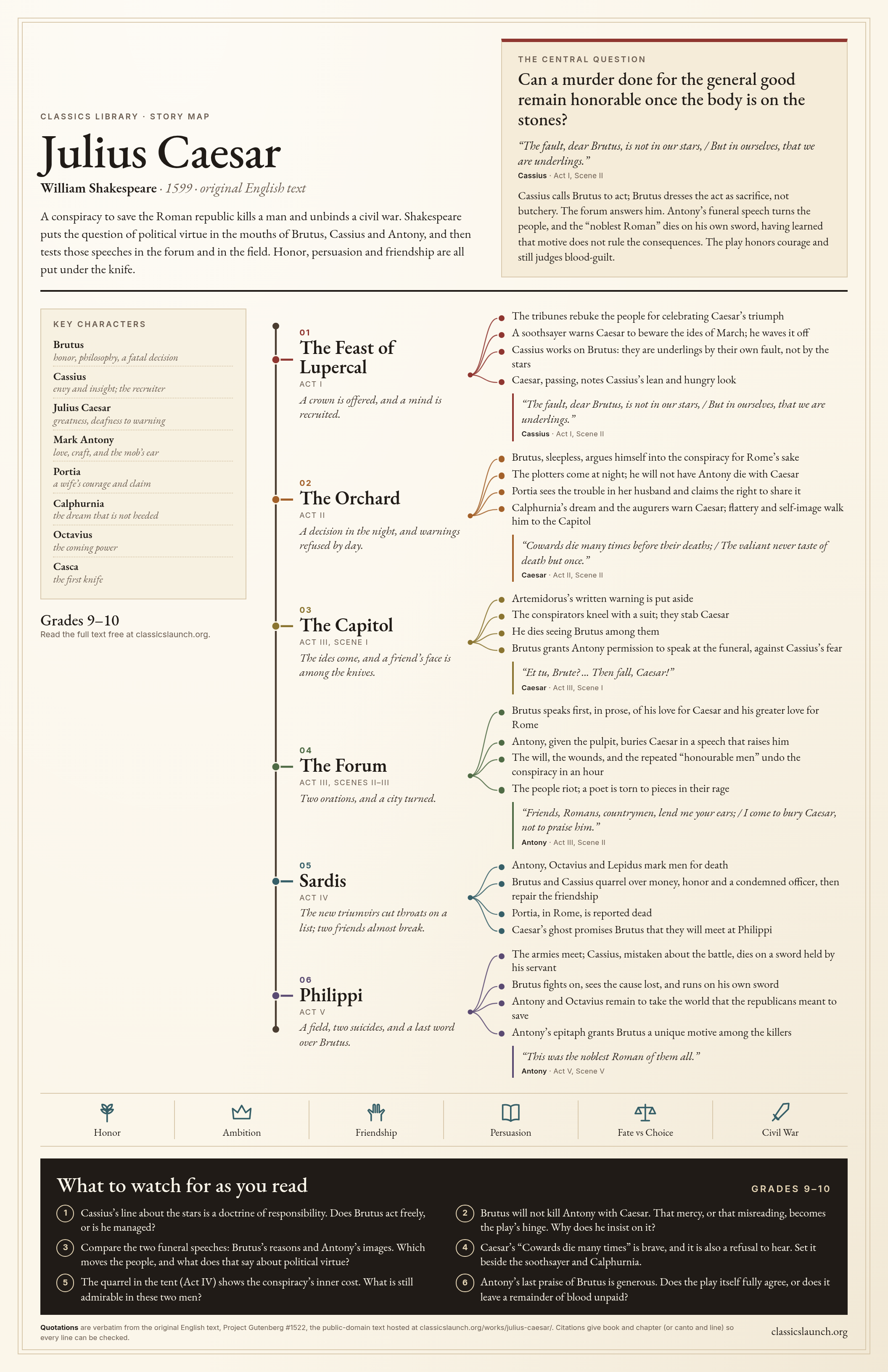
A conspiracy to save the Roman republic kills a man and unbinds a civil war. Shakespeare puts the question of political virtue in the mouths of Brutus, Cassius and Antony, and then tests those speeches in the forum and in the field. Honor, persuasion and friendship are all put under the knife.
The central question
Can a murder done for the general good remain honorable once the body is on the stones?
“The fault, dear Brutus, is not in our stars, / But in ourselves, that we are underlings.”
Cassius calls Brutus to act; Brutus dresses the act as sacrifice, not butchery. The forum answers him. Antony’s funeral speech turns the people, and the “noblest Roman” dies on his own sword, having learned that motive does not rule the consequences. The play honors courage and still judges blood-guilt.
- 01
The Feast of Lupercal
Act I
A crown is offered, and a mind is recruited.
- The tribunes rebuke the people for celebrating Caesar’s triumph
- A soothsayer warns Caesar to beware the ides of March; he waves it off
- Cassius works on Brutus: they are underlings by their own fault, not by the stars
- Caesar, passing, notes Cassius’s lean and hungry look
“The fault, dear Brutus, is not in our stars, / But in ourselves, that we are underlings.”
- 02
The Orchard
Act II
A decision in the night, and warnings refused by day.
- Brutus, sleepless, argues himself into the conspiracy for Rome’s sake
- The plotters come at night; he will not have Antony die with Caesar
- Portia sees the trouble in her husband and claims the right to share it
- Calphurnia’s dream and the augurers warn Caesar; flattery and self-image walk him to the Capitol
“Cowards die many times before their deaths; / The valiant never taste of death but once.”
- 03
The Capitol
Act III, Scene I
The ides come, and a friend’s face is among the knives.
- Artemidorus’s written warning is put aside
- The conspirators kneel with a suit; they stab Caesar
- He dies seeing Brutus among them
- Brutus grants Antony permission to speak at the funeral, against Cassius’s fear
“Et tu, Brute? ... Then fall, Caesar!”
- 04
The Forum
Act III, Scenes II–III
Two orations, and a city turned.
- Brutus speaks first, in prose, of his love for Caesar and his greater love for Rome
- Antony, given the pulpit, buries Caesar in a speech that raises him
- The will, the wounds, and the repeated “honourable men” undo the conspiracy in an hour
- The people riot; a poet is torn to pieces in their rage
“Friends, Romans, countrymen, lend me your ears; / I come to bury Caesar, not to praise him.”
- 05
Sardis
Act IV
The new triumvirs cut throats on a list; two friends almost break.
- Antony, Octavius and Lepidus mark men for death
- Brutus and Cassius quarrel over money, honor and a condemned officer, then repair the friendship
- Portia, in Rome, is reported dead
- Caesar’s ghost promises Brutus that they will meet at Philippi
- 06
Philippi
Act V
A field, two suicides, and a last word over Brutus.
- The armies meet; Cassius, mistaken about the battle, dies on a sword held by his servant
- Brutus fights on, sees the cause lost, and runs on his own sword
- Antony and Octavius remain to take the world that the republicans meant to save
- Antony’s epitaph grants Brutus a unique motive among the killers
“This was the noblest Roman of them all.”
- Honor
- Ambition
- Friendship
- Persuasion
- Fate vs Choice
- Civil War
What to watch for as you read
Grades 9–10- Cassius’s line about the stars is a doctrine of responsibility. Does Brutus act freely, or is he managed?
- Brutus will not kill Antony with Caesar. That mercy, or that misreading, becomes the play’s hinge. Why does he insist on it?
- Compare the two funeral speeches: Brutus’s reasons and Antony’s images. Which moves the people, and what does that say about political virtue?
- Caesar’s “Cowards die many times” is brave, and it is also a refusal to hear. Set it beside the soothsayer and Calphurnia.
- The quarrel in the tent (Act IV) shows the conspiracy’s inner cost. What is still admirable in these two men?
- Antony’s last praise of Brutus is generous. Does the play itself fully agree, or does it leave a remainder of blood unpaid?
Every quotation is word for word from the original English text hosted in this library and is checked against that text each time the site is built. Citations give book and chapter (or canto and line).