Story maps · Grades 6–8
Robinson Crusoe: A Story Map
The PDF is one tabloid page (11 × 17 in). On letter paper, choose “Fit to page.”
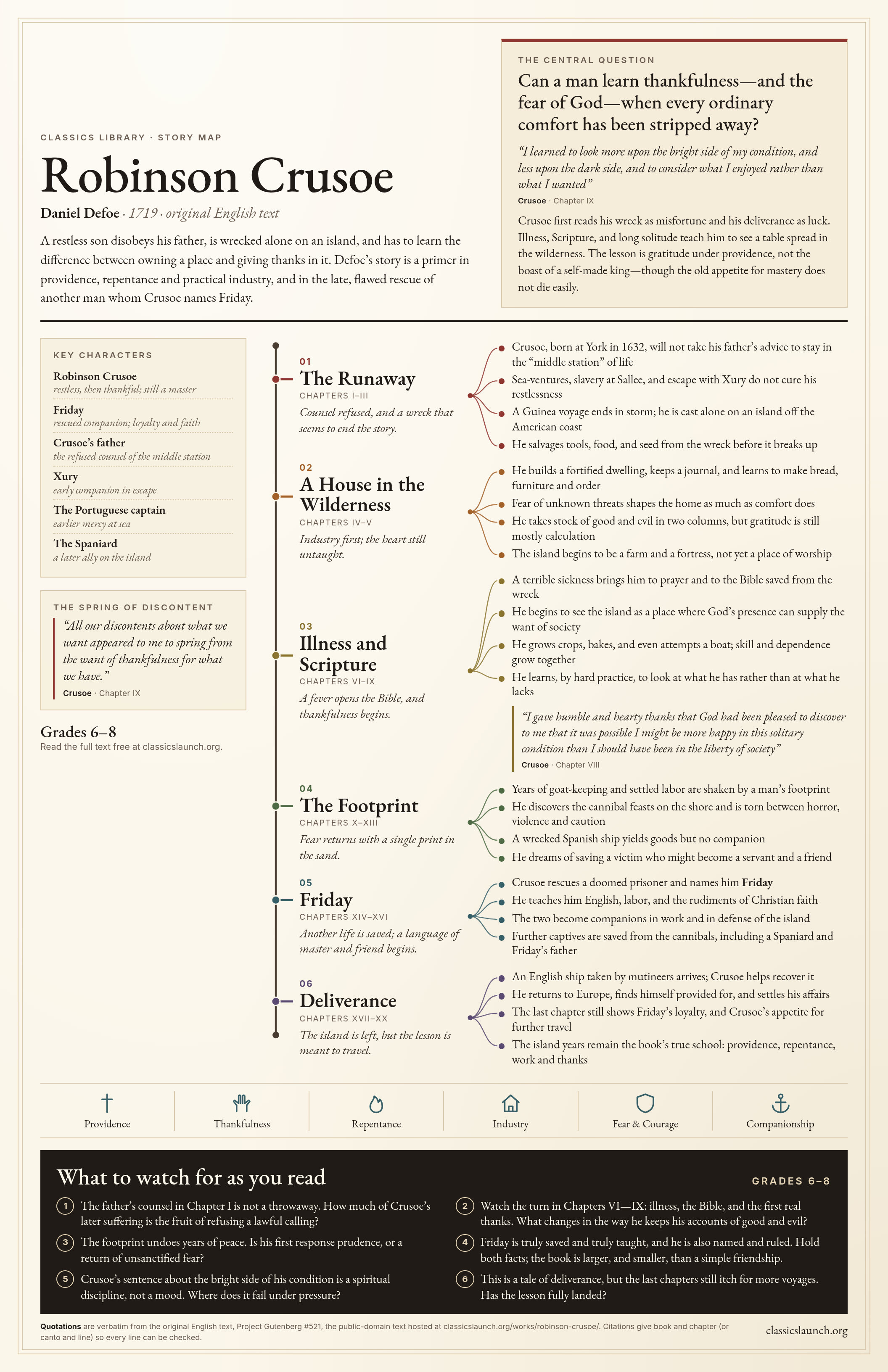
A restless son disobeys his father, is wrecked alone on an island, and has to learn the difference between owning a place and giving thanks in it. Defoe’s story is a primer in providence, repentance and practical industry, and in the late, flawed rescue of another man whom Crusoe names Friday.
The central question
Can a man learn thankfulness—and the fear of God—when every ordinary comfort has been stripped away?
“I learned to look more upon the bright side of my condition, and less upon the dark side, and to consider what I enjoyed rather than what I wanted”
Crusoe first reads his wreck as misfortune and his deliverance as luck. Illness, Scripture, and long solitude teach him to see a table spread in the wilderness. The lesson is gratitude under providence, not the boast of a self-made king—though the old appetite for mastery does not die easily.
- 01
The Runaway
Chapters I–III
Counsel refused, and a wreck that seems to end the story.
- Crusoe, born at York in 1632, will not take his father’s advice to stay in the “middle station” of life
- Sea-ventures, slavery at Sallee, and escape with Xury do not cure his restlessness
- A Guinea voyage ends in storm; he is cast alone on an island off the American coast
- He salvages tools, food, and seed from the wreck before it breaks up
- 02
A House in the Wilderness
Chapters IV–V
Industry first; the heart still untaught.
- He builds a fortified dwelling, keeps a journal, and learns to make bread, furniture and order
- Fear of unknown threats shapes the home as much as comfort does
- He takes stock of good and evil in two columns, but gratitude is still mostly calculation
- The island begins to be a farm and a fortress, not yet a place of worship
- 03
Illness and Scripture
Chapters VI–IX
A fever opens the Bible, and thankfulness begins.
- A terrible sickness brings him to prayer and to the Bible saved from the wreck
- He begins to see the island as a place where God’s presence can supply the want of society
- He grows crops, bakes, and even attempts a boat; skill and dependence grow together
- He learns, by hard practice, to look at what he has rather than at what he lacks
“I gave humble and hearty thanks that God had been pleased to discover to me that it was possible I might be more happy in this solitary condition than I should have been in the liberty of society”
- 04
The Footprint
Chapters X–XIII
Fear returns with a single print in the sand.
- Years of goat-keeping and settled labor are shaken by a man’s footprint
- He discovers the cannibal feasts on the shore and is torn between horror, violence and caution
- A wrecked Spanish ship yields goods but no companion
- He dreams of saving a victim who might become a servant and a friend
- 05
Friday
Chapters XIV–XVI
Another life is saved; a language of master and friend begins.
- Crusoe rescues a doomed prisoner and names him Friday
- He teaches him English, labor, and the rudiments of Christian faith
- The two become companions in work and in defense of the island
- Further captives are saved from the cannibals, including a Spaniard and Friday’s father
- 06
Deliverance
Chapters XVII–XX
The island is left, but the lesson is meant to travel.
- An English ship taken by mutineers arrives; Crusoe helps recover it
- He returns to Europe, finds himself provided for, and settles his affairs
- The last chapter still shows Friday’s loyalty, and Crusoe’s appetite for further travel
- The island years remain the book’s true school: providence, repentance, work and thanks
- Providence
- Thankfulness
- Repentance
- Industry
- Fear & Courage
- Companionship
What to watch for as you read
Grades 6–8- The father’s counsel in Chapter I is not a throwaway. How much of Crusoe’s later suffering is the fruit of refusing a lawful calling?
- Watch the turn in Chapters VI—IX: illness, the Bible, and the first real thanks. What changes in the way he keeps his accounts of good and evil?
- The footprint undoes years of peace. Is his first response prudence, or a return of unsanctified fear?
- Friday is truly saved and truly taught, and he is also named and ruled. Hold both facts; the book is larger, and smaller, than a simple friendship.
- Crusoe’s sentence about the bright side of his condition is a spiritual discipline, not a mood. Where does it fail under pressure?
- This is a tale of deliverance, but the last chapters still itch for more voyages. Has the lesson fully landed?
Every quotation is word for word from the original English text hosted in this library and is checked against that text each time the site is built. Citations give book and chapter (or canto and line).