Story maps · Grades 9–12
The Tempest: A Story Map
The PDF is one tabloid page (11 × 17 in). On letter paper, choose “Fit to page.”
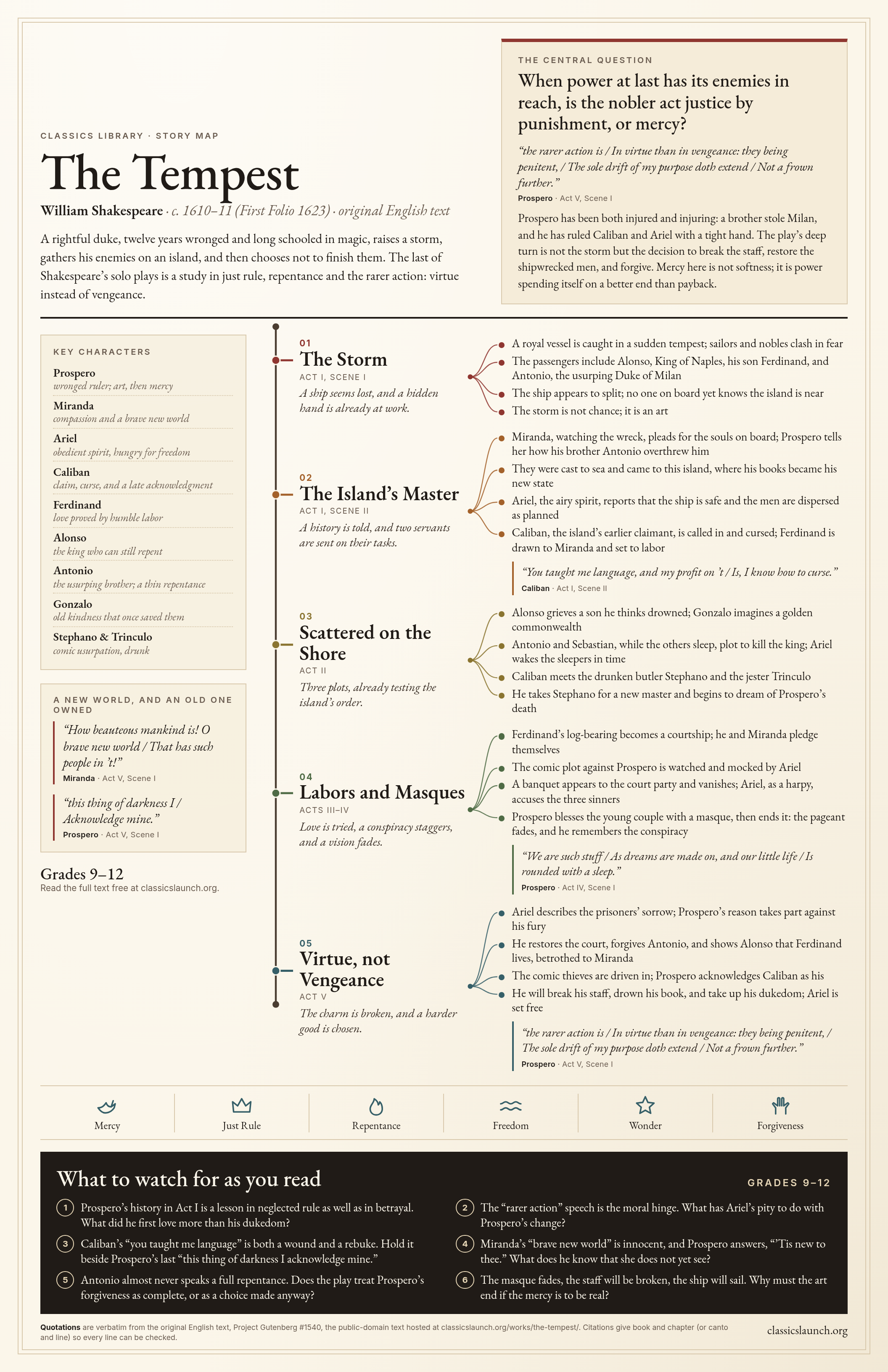
A rightful duke, twelve years wronged and long schooled in magic, raises a storm, gathers his enemies on an island, and then chooses not to finish them. The last of Shakespeare’s solo plays is a study in just rule, repentance and the rarer action: virtue instead of vengeance.
The central question
When power at last has its enemies in reach, is the nobler act justice by punishment, or mercy?
“the rarer action is / In virtue than in vengeance: they being penitent, / The sole drift of my purpose doth extend / Not a frown further.”
Prospero has been both injured and injuring: a brother stole Milan, and he has ruled Caliban and Ariel with a tight hand. The play’s deep turn is not the storm but the decision to break the staff, restore the shipwrecked men, and forgive. Mercy here is not softness; it is power spending itself on a better end than payback.
- 01
The Storm
Act I, Scene I
A ship seems lost, and a hidden hand is already at work.
- A royal vessel is caught in a sudden tempest; sailors and nobles clash in fear
- The passengers include Alonso, King of Naples, his son Ferdinand, and Antonio, the usurping Duke of Milan
- The ship appears to split; no one on board yet knows the island is near
- The storm is not chance; it is an art
- 02
The Island’s Master
Act I, Scene II
A history is told, and two servants are sent on their tasks.
- Miranda, watching the wreck, pleads for the souls on board; Prospero tells her how his brother Antonio overthrew him
- They were cast to sea and came to this island, where his books became his new state
- Ariel, the airy spirit, reports that the ship is safe and the men are dispersed as planned
- Caliban, the island’s earlier claimant, is called in and cursed; Ferdinand is drawn to Miranda and set to labor
“You taught me language, and my profit on ’t / Is, I know how to curse.”
- 03
Scattered on the Shore
Act II
Three plots, already testing the island’s order.
- Alonso grieves a son he thinks drowned; Gonzalo imagines a golden commonwealth
- Antonio and Sebastian, while the others sleep, plot to kill the king; Ariel wakes the sleepers in time
- Caliban meets the drunken butler Stephano and the jester Trinculo
- He takes Stephano for a new master and begins to dream of Prospero’s death
- 04
Labors and Masques
Acts III–IV
Love is tried, a conspiracy staggers, and a vision fades.
- Ferdinand’s log-bearing becomes a courtship; he and Miranda pledge themselves
- The comic plot against Prospero is watched and mocked by Ariel
- A banquet appears to the court party and vanishes; Ariel, as a harpy, accuses the three sinners
- Prospero blesses the young couple with a masque, then ends it: the pageant fades, and he remembers the conspiracy
“We are such stuff / As dreams are made on, and our little life / Is rounded with a sleep.”
- 05
Virtue, not Vengeance
Act V
The charm is broken, and a harder good is chosen.
- Ariel describes the prisoners’ sorrow; Prospero’s reason takes part against his fury
- He restores the court, forgives Antonio, and shows Alonso that Ferdinand lives, betrothed to Miranda
- The comic thieves are driven in; Prospero acknowledges Caliban as his
- He will break his staff, drown his book, and take up his dukedom; Ariel is set free
“the rarer action is / In virtue than in vengeance: they being penitent, / The sole drift of my purpose doth extend / Not a frown further.”
- Mercy
- Just Rule
- Repentance
- Freedom
- Wonder
- Forgiveness
What to watch for as you read
Grades 9–12- Prospero’s history in Act I is a lesson in neglected rule as well as in betrayal. What did he first love more than his dukedom?
- The “rarer action” speech is the moral hinge. What has Ariel’s pity to do with Prospero’s change?
- Caliban’s “you taught me language” is both a wound and a rebuke. Hold it beside Prospero’s last “this thing of darkness I acknowledge mine.”
- Miranda’s “brave new world” is innocent, and Prospero answers, “’Tis new to thee.” What does he know that she does not yet see?
- Antonio almost never speaks a full repentance. Does the play treat Prospero’s forgiveness as complete, or as a choice made anyway?
- The masque fades, the staff will be broken, the ship will sail. Why must the art end if the mercy is to be real?
Every quotation is word for word from the original English text hosted in this library and is checked against that text each time the site is built. Citations give book and chapter (or canto and line).