Work record
The Tempest
c. 1610-11 (First Folio 1623) · Renaissance Early Modern · Drama · English (Early Modern)
Abstract
Background. Shakespeare composed this late romance as reports of the 1609 Sea Venture wreck on Bermuda reached London. He borrowed from Montaigne's Of Cannibals in Florio's English and from Medea's incantation in Ovid.
Plot. Twelve years after his brother Antonio and King Alonso cast him out of Milan, the magician Prospero wrecks their ship on his island by Ariel's art. He scatters the survivors: Ferdinand falls for Miranda and is set to log-bearing, Antonio coaxes Sebastian toward regicide, and Caliban recruits two drunkards to murder his master. A harpy's accusation, a nuptial masque and a pack of spirit hounds bring every party to Prospero's cell, where he pardons his enemies, frees Ariel, and abandons sorcery.
Form. The action fills roughly four afternoon hours in one place, an unusual concentration for Shakespeare. Songs, a masque and spirit pageantry make it one of his most musical plays, and Prospero's closing speech steps outside the fiction to address the audience directly.
Themes. Usurpation and lawful rule, the right to govern a new land and its native, mercy chosen over vengeance, the power and limits of art, and the brevity of life.
Significance. Placed first in the 1623 Folio, it has been reworked by Dryden, composers, filmmakers and novelists. Its phrases have entered common speech, and its Caliban became a central figure in later debates about empire.
Main characters
- Prospero: Exiled Duke of Milan whose books give him command of spirits
- Miranda: His daughter, who has grown up knowing no other people
- Ariel: Airy spirit bound to serve until his promised release
- Caliban: Son of Sycorax, resentful servant who claims the island
- Ferdinand: Neapolitan prince who wins Miranda by patient labor
- Alonso: King of Naples, grieving for his son and his old crime
- Antonio: Prospero's usurping brother, unrepentant to the last
- Sebastian: Alonso's brother, ready to kill for a crown
- Gonzalo: Loyal old lord who once furnished the exiles with books
- Stephano and Trinculo: Drunken butler and jester who join Caliban's plot

Summary
The Tempest opens with a ship breaking apart in a storm off a remote island. On shore, the magician Prospero tells his fifteen-year-old daughter Miranda that he was once Duke of Milan. Absorbed in his books, he left the government to his brother Antonio, who, helped by Alonso, King of Naples, deposed him twelve years before and set father and child adrift in a rotten boat; the kind counsellor Gonzalo supplied them with food, clothes and the books Prospero valued above his dukedom. Now fortune has brought his enemies near, and Prospero has raised the storm through his spirit Ariel, whom he freed from the cloven pine where the witch Sycorax imprisoned him and who serves on the promise of liberty. Prospero also commands Sycorax's son Caliban, who claims the island as his own inheritance; Prospero once taught and housed him until Caliban attempted to violate Miranda, and now he hauls wood and curses. The passengers come ashore unharmed in separate groups. Prince Ferdinand, led by Ariel's song to believe his father drowned, meets Miranda and the two fall in love at first sight; Prospero, to test him, makes him a prisoner and sets him to carry logs. Elsewhere Alonso grieves for his son while Gonzalo imagines an ideal commonwealth; when Ariel charms the others asleep, Antonio urges Alonso's brother Sebastian to murder the king, and Ariel wakes Gonzalo just in time. Caliban, meeting the jester Trinculo and the drunken butler Stephano, worships Stephano for his wine and plots with them to kill Prospero and seize his books. Ariel, appearing as a harpy over a vanishing banquet, accuses Alonso, Antonio and Sebastian of their crime against Prospero and leaves them distracted with guilt. Prospero blesses the betrothal of Ferdinand and Miranda with a masque of the goddesses Iris, Ceres and Juno, breaks it off when he remembers Caliban's plot, and sets spirit hounds on the conspirators. In Act V, moved by Ariel's report of the captives' suffering, he chooses forgiveness over revenge, renounces his magic, and appears to the court in his ducal robes. Alonso restores his dukedom and asks pardon; Antonio says almost nothing; Ferdinand is discovered playing chess with Miranda; the ship is found whole. Prospero sets Ariel free, Caliban resolves to seek grace, and in the Epilogue Prospero, his charms overthrown, asks the audience to release him by their applause and their prayers. Probably written in 1610-11 and performed at court in November 1611, the play stands first in the First Folio of 1623.
Virtues in this work
- Charity: Prospero forgives Alonso, Sebastian and even Antonio when he holds them all helpless in Act 5.
- Temperance: Prospero masters his own fury with his nobler reason, and he charges Ferdinand to keep chaste until the wedding.
- Industry: Ferdinand carries thousands of logs without complaint for Miranda's sake.
- Humility: Prospero breaks his staff, drowns his book and ends by asking the audience to pardon him.
Plot or Argument
- Act I: The storm and the story
The ship splits in a tempest while the Boatswain curses the useless courtiers. Prospero tells Miranda how Antonio usurped Milan, reminds Ariel of his debt and Caliban of his crime, and lets Ariel's song draw Ferdinand to Miranda, then sets the prince to hard labor.
- Act II: Plots among the castaways
Gonzalo comforts Alonso and describes an imagined commonwealth; Antonio tempts Sebastian to kill the sleeping king until Ariel wakes them. Caliban hides under his cloak from the jester Trinculo, is found by the drunken Stephano, and swears to serve him.
- Act III: Love, conspiracy and judgment
Ferdinand carries logs for Miranda's sake and they pledge to marry. Caliban urges Stephano and Trinculo to murder Prospero while he sleeps and to burn his books. Ariel, as a harpy, snatches away a banquet and charges the three men of sin with their wrong to Prospero.
- Act IV: The masque
Prospero gives Miranda to Ferdinand with a warning to keep chaste until the wedding, and spirits present a masque of Iris, Ceres and Juno. Remembering Caliban's plot, Prospero ends the revels, reflects that all the world will dissolve like the vision, and traps the conspirators with fine clothes and spirit hounds.
- Act V and Epilogue: Mercy and release
Prospero chooses virtue over vengeance, abjures his magic, and forgives his enemies. Alonso finds Ferdinand alive and betrothed, the ship is restored, Ariel is freed and Caliban repents. In the Epilogue Prospero, now without his art, asks the audience to set him free.
Characters
- Prospero, rightful Duke of Milan and magician
A scholar exiled with his daughter, who rules the island by his books and must decide between revenge and pardon.
- Miranda, Prospero's daughter
Raised on the island since she was three, compassionate and frank, she sees almost no other human being until Ferdinand.
- Ariel, spirit of the air
Prospero's quick and musical servant, who raises the storm, sings, and longs for his promised freedom.
- Caliban, son of the witch Sycorax
The island's earlier inhabitant, enslaved by Prospero after his attempt on Miranda, who curses, plots, and speaks some of the play's most beautiful poetry.
- Ferdinand, Prince of Naples
Alonso's son, who believes his father drowned and serves patiently to win Miranda.
- Alonso, King of Naples
Helped Antonio depose Prospero; his grief for his son turns to repentance.
- Antonio, usurping Duke of Milan
Prospero's brother, who tempts Sebastian to fratricide and never clearly repents.
- Sebastian, Alonso's brother
Agrees to murder the sleeping king at Antonio's urging.
- Gonzalo, honest old counsellor
Saved Prospero and Miranda with provisions and books; dreams aloud of a perfect commonwealth.
- Stephano, drunken butler
Comes ashore on a butt of wine and is taken by Caliban for a god.
- Trinculo, jester
Alonso's fool, who shelters from the storm under Caliban's cloak.
Lessons
The rarer action
Prospero has every enemy in his power by Act V and every reason to punish them. Ariel's pity for the captives shames him into choosing forgiveness, which he calls a rarer action than vengeance. The play shows that power is proved more truly in mercy than in punishment.
- What does Ariel say that changes Prospero's mind in Act 5, Scene 1?
- Does Prospero truly forgive Antonio, who barely answers him?
- Why must Prospero give up his magic once he decides to forgive?
Rule of oneself before rule of others
Prospero lost Milan because he neglected government for study, and on the island he governs spirits and men by force. Ferdinand must earn Miranda by labor and restraint, and Prospero ends by mastering his own fury. Shakespeare places self-government at the root of every other kind.
- Was Prospero partly to blame for losing his dukedom?
- Why does Prospero make Ferdinand carry logs?
- How does Prospero's anger in Act 4 show what he still has to master?
Master and servant
Ariel serves for the promise of freedom; Caliban serves under compulsion and curses the teacher who gave him language. The play lets both voices speak and does not settle the question of Prospero's right to the island. In the end Prospero acknowledges Caliban as his own.
- How do Ariel and Caliban differ in their service to Prospero?
- Is Caliban's claim to the island just?
- What might Prospero mean when he calls Caliban his own?
Such stuff as dreams
After the masque vanishes, Prospero says the whole world will dissolve like a pageant and that human life ends in sleep. The play holds together delight in art and a sober sense of mortality, and its last word is a request for pardon.
- Why does the masque end so abruptly?
- Is Prospero's speech on the dissolving world hopeful or sad?
- What does the Epilogue ask the audience to do?
Context
The Tempest was written as English companies were beginning to settle Virginia. In 1609 the Sea Venture, flagship of a relief fleet bound for Jamestown, was wrecked on Bermuda, and the survivors' unlooked-for preservation was reported in pamphlets and letters in 1610. The play's island lies in the Mediterranean, on the route between Tunis and Naples, but its storm and its talk of new peoples and of governing a new land draw on that news.
Composition
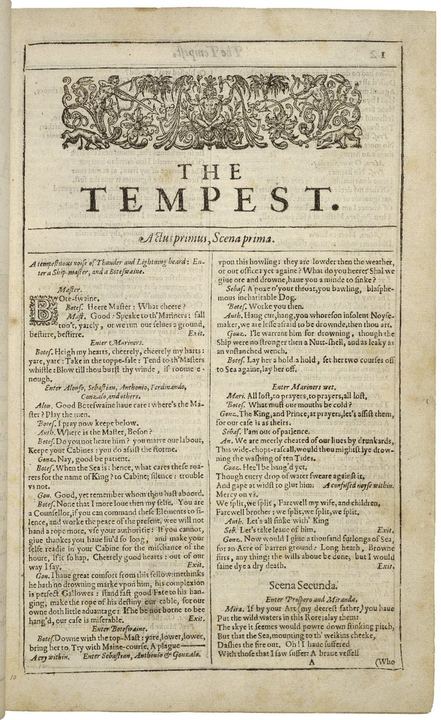
The play is usually dated 1610-11. Its sources include William Strachey's letter on the Bermuda wreck (written 1610, printed 1625), Montaigne's essay Of Cannibals in John Florio's translation (1603), which Gonzalo's commonwealth speech closely follows, and Medea's speech in Ovid's Metamorphoses, which Prospero adapts in abjuring his magic. The Revels Accounts record a performance at Whitehall on 1 November 1611, and it was played again at court during the festivities for Princess Elizabeth's marriage in 1612-13. It was first printed as the opening play of the First Folio in 1623. It is one of only two Shakespeare plays, with The Comedy of Errors, to keep closely to the unities of time and place.
Reception
Since the nineteenth century, readers have often heard in Prospero's farewell to his art a farewell by Shakespeare to the stage, though he went on to collaborate on later plays. The play has been adapted in opera, in Dryden and Davenant's Restoration version, and in film, and it has given English phrases such as brave new world and such stuff as dreams are made on. Twentieth-century writers and directors also gave close attention to Caliban as a figure of the native islander displaced by a newcomer.
Comparisons
- a-midsummer-nights-dream
Both plays use a commanding spirit, Puck or Ariel, to sort lovers and enemies by magic, and both end by turning the audience's imagination back on itself.
- king-lear
A storm, a wronged father and a loving daughter appear in both, but Lear's ends in grief, while Prospero holds the storm in his own hand and ends in reconciliation.
- essays-montaigne
Gonzalo's ideal commonwealth in Act 2, Scene 1 closely follows Montaigne's essay Of Cannibals as translated by Florio.
- robinson-crusoe
Both stories make a castaway master of an island and of a native servant, Caliban or Friday, and raise the question of what rightful rule there would be.
- the-odyssey
Shipwreck, an island ruled by a powerful enchanter and the long road home to a lost kingdom link Prospero's story to Odysseus's.
Quotes
Frequently cited
“You taught me language, and my profit on ’t Is, I know how to curse.”
Frequently cited
“Be not afeard. The isle is full of noises, Sounds, and sweet airs, that give delight, and hurt not.”
Frequently cited
“We are such stuff As dreams are made on, and our little life Is rounded with a sleep.”
Frequently cited
“the rarer action is In virtue than in vengeance”
Frequently cited
“O brave new world That has such people in ’t!”
Frequently cited
“As you from crimes would pardon’d be, Let your indulgence set me free.”
“A solemn air, and the best comforter To an unsettled fancy, cure thy brains”
“I’ll be wise hereafter, And seek for grace.”
For Students
A reading companion for classical Christian high school students. See the student guide.
Reading Guide
Watch for
- Prospero's long account of his overthrow in Act 1, Scene 2, and how often he asks Miranda whether she is listening.
- The parallel plots against rulers: Antonio and Sebastian against Alonso, and Caliban, Stephano and Trinculo against Prospero.
- Ariel's harpy speech in Act 3, Scene 3, where the three men of sin hear their crime named.
- The sudden end of the masque in Act 4 and Prospero's speech on the dissolving world.
- Prospero's choice in Act 5 between virtue and vengeance, and his breaking of his staff and drowning of his book.
Key terms and names
- Masque
- A courtly entertainment of music, dance and allegorical figures; Prospero's spirits perform one with Iris, Ceres and Juno to bless Ferdinand and Miranda.
- Sycorax
- The witch from Algiers, Caliban's mother, who imprisoned Ariel in a cloven pine before Prospero came.
- Harpy
- A winged monster of classical myth; Ariel takes this shape to snatch away the banquet and accuse the guilty courtiers.
- Commonwealth
- Gonzalo's imagined ideal state in Act 2, Scene 1, without trade, rank, labor or sovereignty, which Antonio and Sebastian mock.
- Romance
- The name critics give Shakespeare's late plays of separation, wonder and reunion, of which The Tempest is the last he wrote alone.
- Unities
- The classical rules of a single plot, place and day; The Tempest's action takes about four hours on one island.
Seminar Questions
- Comprehension How did Prospero and Miranda come to the island, and who helped them survive the voyage?
- Comprehension What has Prospero promised Ariel, and why does Caliban serve him unwillingly?
- Comprehension What do Antonio and Sebastian plan while Alonso sleeps, and who stops them?
- Interpretation Why does Prospero test Ferdinand with hard labor instead of simply blessing the match?
- Interpretation Caliban both curses and speaks lovingly of the island's music. What do his two voices show about him?
- Interpretation Why does Prospero give up his magic at the moment of his triumph?
- Big Question Is forgiveness complete if the one forgiven does not repent, as Antonio seems not to?
- Big Question What gives anyone the right to rule over a place or a people?
Faith Connections
- Romans 12:19-21 (Scripture)
Paul tells believers not to avenge themselves but to overcome evil with good. Prospero holds his enemies helpless and chooses virtue over vengeance.
- Matthew 6:12-15 (Scripture)
The Lord's Prayer ties our pardon to our forgiving others. The Epilogue asks the audience to forgive as they would be pardoned for their own crimes.
- Psalm 90:5-6 (Scripture)
The psalmist compares human life to a sleep and to grass that withers by evening, much as Prospero sees life rounded with a sleep.
- Montaigne, Of Cannibals (Great Conversation)
Montaigne praised the peoples of the New World as living closer to nature than Europeans. Shakespeare gives that ideal to Gonzalo and lets the cynical courtiers laugh at it.
Logic and Rhetoric
Central argument: Prospero was wronged and has the power to punish every wrongdoer. But power over others is empty without rule over one's own fury, and the guilty can only be changed by mercy, not by terror. Therefore the play argues that the highest use of power is to lay it down in forgiveness, and that even the forgiver must ask to be forgiven.
Rhetorical device: antithesis. In Act 5, Scene 1 Prospero sets virtue against vengeance and nobler reason against fury, turning his decision into a balanced choice between opposites.
Debate: Resolved: that Prospero's treatment of Caliban is just.
Memory Work
We are such stuff As dreams are made on, and our little life Is rounded with a sleep.
the rarer action is In virtue than in vengeance
Writing Prompts
Essay: Trace the theme of freedom through Ariel, Caliban, Ferdinand and Prospero himself, and argue who is most truly free at the end of the play.
Comparison with King Lear: Both plays begin with a storm and a father wronged by those he trusted. Compare Lear's madness in the storm with Prospero's command of it, and argue what each father must learn.
Medical Lens
Prospero's magic works largely on minds and bodies: he induces sudden sleep in Miranda and the courtiers, punishes Caliban with cramps, side-stitches and pinches, and leaves Alonso, Antonio and Sebastian in fits of distraction that the play treats as guilt made visible. Their cure in Act 5 is music, called the best comforter to an unsettled fancy, which reflects the Renaissance belief, later gathered in Burton's Anatomy of Melancholy (1621), that music could temper disordered passions and restore the mind. Alonso himself says a madness held him. The comic plot shows drunkenness as a counterfeit religion, with Caliban worshipping the bottle-bearer Stephano. Prospero's own vexed and beating mind after the masque, his troubled old brain, and his plan to think of his grave every third thought touch on age and mortality. Reading the courtiers' state as a specific modern disorder would go beyond the text.
- Act 1, Scene 2; Act 2, Scene 1
Prospero charms Miranda asleep, and Ariel brings a heavy, sudden sleep on all the courtiers except Antonio and Sebastian.
- Act 1, Scene 2; Act 4, Scene 1
Prospero threatens and punishes Caliban and the conspirators with cramps, aches and pinches sent by spirits.
- Act 2, Scene 2; Act 3, Scene 2
Stephano's wine makes Caliban drunk and devoted; the three conspirators plot while tipsy.
- Act 3, Scene 3; Act 5, Scene 1
Ariel's harpy speech leaves the three men of sin distracted; Prospero restores them with solemn music, and Alonso says a madness held him.
- Act 4, Scene 1; Act 5, Scene 1
Prospero walks to still his beating mind, confesses his old brain is troubled, and says every third thought will be his grave.
Listen to the book
Public-domain audiobook from LibriVox, read by Various volunteers. Recording: Tempest (version 2) on LibriVox (Internet Archive).
LibriVox recordings are volunteer readings released into the public domain. The reading may follow a different edition from the text in this library.
Creative Prompts
- Classroom
Stage Act 5, Scene 1 twice, once with Antonio silent and sullen and once with him moved, and discuss how each choice changes the ending.
- Essay
Is Prospero a just ruler of the island? Weigh his treatment of Ariel, Caliban and Ferdinand.
- Fiction
Write Ariel's first day of freedom after the ship sails for Naples.
- Dialogue
Write the conversation between Prospero and Antonio on the voyage home that the play never shows.
Further Reading
- The Essays of Montaigne, Michel de Montaigne, trans. John Florio
Of Cannibals is the source of Gonzalo's commonwealth.
- Metamorphoses, Ovid, trans. Arthur Golding
Medea's invocation in Book VII lies behind Prospero's farewell to magic.
- The Winter's Tale, William Shakespeare
A companion late romance of loss, repentance and restoration.
- Shakespeare's Language, Frank Kermode
- The Anatomy of Melancholy, Robert Burton
Collects early modern views on music as a remedy for the passions.
Verification notes
Plot, dating, the 1611 court performance and the Montaigne, Strachey and Ovid sources are standard. Act and scene locators follow the attached Gutenberg text. The idea that Prospero's farewell is Shakespeare's farewell is a later critical tradition, presented as such. Quotes were checked against the attached text.
No verification flags recorded.