Story maps · Grades 9–12
Uncle Tom's Cabin: A Story Map
The PDF is one tabloid page (11 × 17 in). On letter paper, choose “Fit to page.”
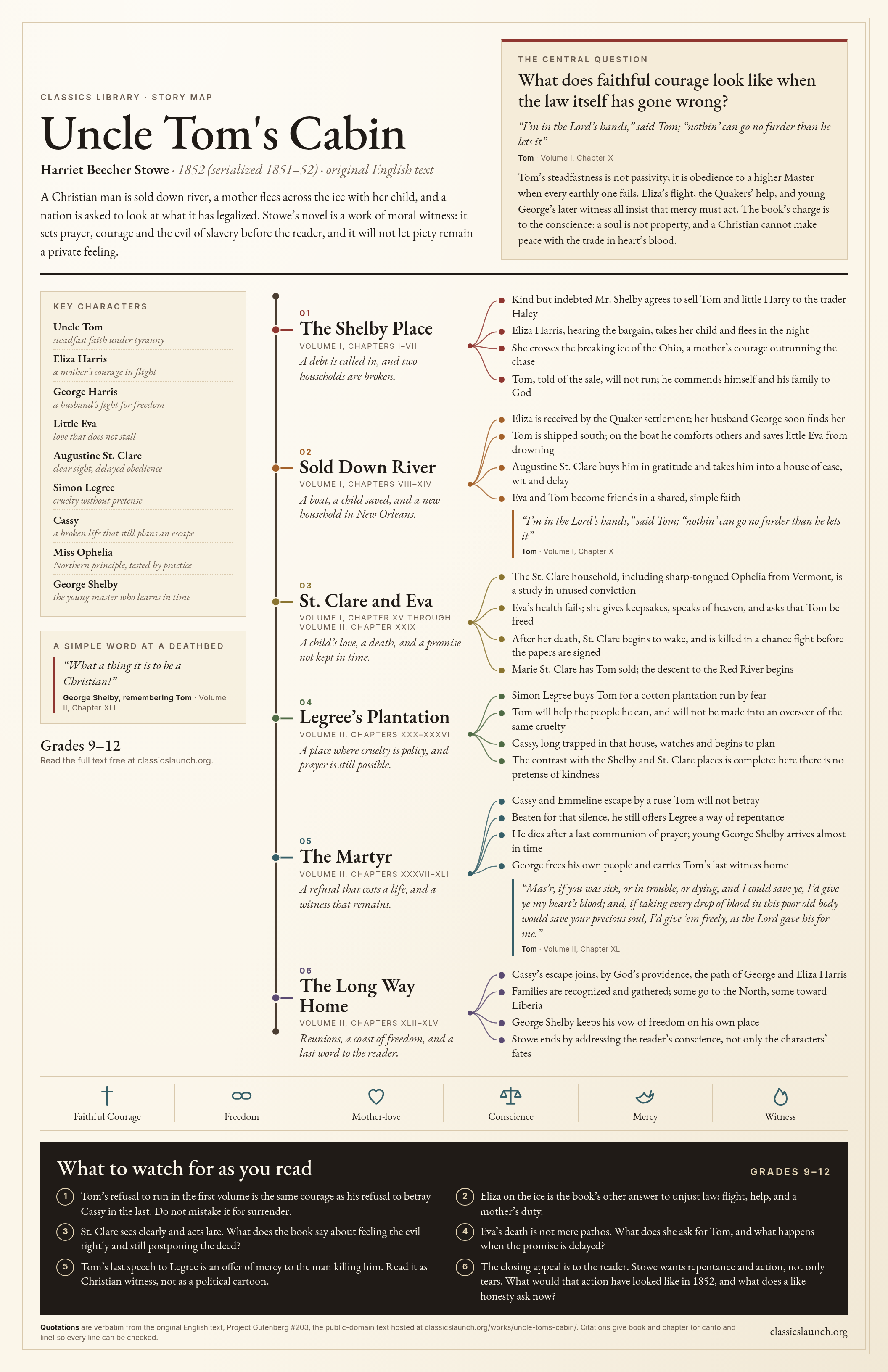
A Christian man is sold down river, a mother flees across the ice with her child, and a nation is asked to look at what it has legalized. Stowe’s novel is a work of moral witness: it sets prayer, courage and the evil of slavery before the reader, and it will not let piety remain a private feeling.
The central question
What does faithful courage look like when the law itself has gone wrong?
“I’m in the Lord’s hands,” said Tom; “nothin’ can go no furder than he lets it”
Tom’s steadfastness is not passivity; it is obedience to a higher Master when every earthly one fails. Eliza’s flight, the Quakers’ help, and young George’s later witness all insist that mercy must act. The book’s charge is to the conscience: a soul is not property, and a Christian cannot make peace with the trade in heart’s blood.
- 01
The Shelby Place
Volume I, Chapters I–VII
A debt is called in, and two households are broken.
- Kind but indebted Mr. Shelby agrees to sell Tom and little Harry to the trader Haley
- Eliza Harris, hearing the bargain, takes her child and flees in the night
- She crosses the breaking ice of the Ohio, a mother’s courage outrunning the chase
- Tom, told of the sale, will not run; he commends himself and his family to God
- 02
Sold Down River
Volume I, Chapters VIII–XIV
A boat, a child saved, and a new household in New Orleans.
- Eliza is received by the Quaker settlement; her husband George soon finds her
- Tom is shipped south; on the boat he comforts others and saves little Eva from drowning
- Augustine St. Clare buys him in gratitude and takes him into a house of ease, wit and delay
- Eva and Tom become friends in a shared, simple faith
“I’m in the Lord’s hands,” said Tom; “nothin’ can go no furder than he lets it”
- 03
St. Clare and Eva
Volume I, Chapter XV through Volume II, Chapter XXIX
A child’s love, a death, and a promise not kept in time.
- The St. Clare household, including sharp-tongued Ophelia from Vermont, is a study in unused conviction
- Eva’s health fails; she gives keepsakes, speaks of heaven, and asks that Tom be freed
- After her death, St. Clare begins to wake, and is killed in a chance fight before the papers are signed
- Marie St. Clare has Tom sold; the descent to the Red River begins
- 04
Legree’s Plantation
Volume II, Chapters XXX–XXXVI
A place where cruelty is policy, and prayer is still possible.
- Simon Legree buys Tom for a cotton plantation run by fear
- Tom will help the people he can, and will not be made into an overseer of the same cruelty
- Cassy, long trapped in that house, watches and begins to plan
- The contrast with the Shelby and St. Clare places is complete: here there is no pretense of kindness
- 05
The Martyr
Volume II, Chapters XXXVII–XLI
A refusal that costs a life, and a witness that remains.
- Cassy and Emmeline escape by a ruse Tom will not betray
- Beaten for that silence, he still offers Legree a way of repentance
- He dies after a last communion of prayer; young George Shelby arrives almost in time
- George frees his own people and carries Tom’s last witness home
“Mas’r, if you was sick, or in trouble, or dying, and I could save ye, I’d give ye my heart’s blood; and, if taking every drop of blood in this poor old body would save your precious soul, I’d give ’em freely, as the Lord gave his for me.”
- 06
The Long Way Home
Volume II, Chapters XLII–XLV
Reunions, a coast of freedom, and a last word to the reader.
- Cassy’s escape joins, by God’s providence, the path of George and Eliza Harris
- Families are recognized and gathered; some go to the North, some toward Liberia
- George Shelby keeps his vow of freedom on his own place
- Stowe ends by addressing the reader’s conscience, not only the characters’ fates
- Faithful Courage
- Freedom
- Mother-love
- Conscience
- Mercy
- Witness
What to watch for as you read
Grades 9–12- Tom’s refusal to run in the first volume is the same courage as his refusal to betray Cassy in the last. Do not mistake it for surrender.
- Eliza on the ice is the book’s other answer to unjust law: flight, help, and a mother’s duty.
- St. Clare sees clearly and acts late. What does the book say about feeling the evil rightly and still postponing the deed?
- Eva’s death is not mere pathos. What does she ask for Tom, and what happens when the promise is delayed?
- Tom’s last speech to Legree is an offer of mercy to the man killing him. Read it as Christian witness, not as a political cartoon.
- The closing appeal is to the reader. Stowe wants repentance and action, not only tears. What would that action have looked like in 1852, and what does a like honesty ask now?
Every quotation is word for word from the original English text hosted in this library and is checked against that text each time the site is built. Citations give book and chapter (or canto and line).