Work record
Henry IV, Part 1
c. 1596-97 (published 1598) · Renaissance Early Modern · Drama · English (Early Modern)
Abstract
Background. Following Richard II in Shakespeare's second cycle of histories, the play draws on Holinshed, Daniel's Civil Wars and the old Famous Victories. Its comic knight originally bore the name of the Lollard Sir John Oldcastle.
Plot. Bolingbroke, now king, faces a revolt by the Percy family who crowned him, joined by the Welsh and the Scots. His son keeps low company in Eastcheap, joins a highway prank on Falstaff, and mimics the royal audience in a tavern skit, while privately vowing reform. Summoned and reproached, the prince reconciles with his father; at Shrewsbury he rescues the king from Douglas and slays Percy, then permits his fat friend, who survived by feigning death, to boast of the deed.
Structure. Scenes rotate among palace, rebel strongholds and alehouse, so that each world parodies or comments on the others, verse belonging chiefly to the nobles and prose to the tavern. Hal alone moves freely between the registers, speaking whichever the company before him requires.
Themes. Legitimacy after usurpation, rival ideals of honour, a son's self-fashioning, and counterfeiting in speech, dress and death.
Significance. Among the most reprinted plays of its day, it created in Falstaff a figure audiences demanded again, and it remains the most admired of the English histories.
Main characters
- King Henry IV: Usurping monarch beset by former allies
- Prince Hal: Heir apparent hiding his mettle among tavern companions
- Hotspur: Percy heir, rash champion of rebellion
- Sir John Falstaff: Corpulent, quick-witted knight of the taverns
- Earl of Worcester: Scheming Percy uncle behind the revolt
- Owen Glendower: Welsh prince who claims magic powers
- Lady Percy: Hotspur's spirited, anxious wife
- Earl of Douglas: Scots warrior allied with the Percys
- Poins: Hal's confederate in the Gad's Hill jest

Summary
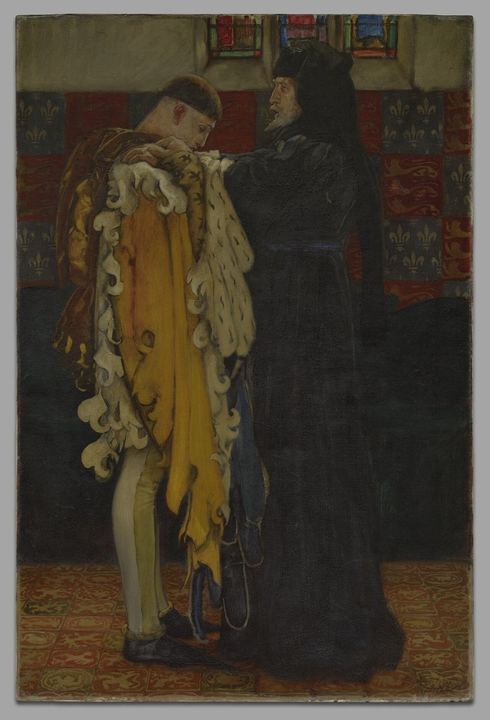
Henry IV, Part 1 shows King Henry IV, who took the crown from Richard II, troubled by rebellion and by his own son. In Act I the king, hoping to lead a crusade to atone for Richard's fall, hears instead of war on the Welsh and Scottish borders, and envies the Earl of Northumberland his son Harry Percy, called Hotspur, who has won a victory at Holmedon, while his own heir, Prince Hal, wastes his days in the taverns of Eastcheap with the fat old knight Sir John Falstaff. Alone, Hal tells the audience that he is only biding his time and will throw off his loose life when it will most amaze the world. Hotspur refuses to hand over his prisoners unless the king ransoms his brother-in-law Edmund Mortimer, and his uncle Worcester draws him into a conspiracy with Northumberland, the Scottish Earl of Douglas, the Welsh leader Owen Glendower and the Archbishop of York. In Act II Falstaff and his companions rob travellers at Gad's Hill and are themselves robbed by Hal and Poins in disguise; back at the Boar's Head, Falstaff's account of the fight swells from two attackers to eleven men in buckram, until Hal exposes him and Falstaff claims he knew him all along by instinct. The two act out an interview between the king and his son, with Falstaff pleading not to be banished, and Hal answering that he will. Meanwhile Lady Percy begs Hotspur to tell her what troubles his sleep. In Act III the rebels quarrel over the map of the kingdom they mean to divide, Hotspur mocking Glendower's claims to magic. The king rebukes Hal, comparing him to the frivolous Richard and Hotspur to his own younger self, and Hal vows to redeem his name on Percy's head. In Act IV Northumberland falls sick and Glendower fails to come, but Hotspur insists on fighting; Falstaff marches a ragged company he has pressed into service. At Shrewsbury in Act V the king offers pardon, which Worcester hides from Hotspur; Falstaff asks what honour is and concludes it is a word. In the battle Douglas kills Sir Walter Blunt, disguised as the king, Hal saves his father from Douglas, and Hal kills Hotspur in single combat, speaking a generous farewell over him and a farewell to Falstaff, who lies apparently dead nearby. Falstaff rises, having counterfeited death, stabs Hotspur's body and claims the kill, and Hal lets the lie stand. Worcester and Vernon are executed, Douglas is freed for his valour, and the king divides his forces against the rebels who remain. The play was first printed in quarto in 1598 and became one of the most often reprinted plays of the age.
Virtues in this work
- Fortitude: Wounded at Shrewsbury, Hal refuses to withdraw and goes back into the fight to save his father from Douglas.
- Magnanimity: Hal praises the dead Hotspur, covers his face with his own favours, and later frees Douglas for his valour.
- Piety: Rebuked by his father in Act 3, Scene 2, Hal asks pardon and vows to prove at Shrewsbury that he is the king's true son.
- Prudence: The king offers the rebels pardon before the battle rather than spill English blood needlessly.
Plot or Argument
- Act 1: A troubled crown and a truant prince
The king's crusade is put off by news from Wales and Holmedon; Hal jests with Falstaff and plans the Gad's Hill trick with Poins, then reveals in soliloquy that his wildness is a disguise; Hotspur defies the king over the prisoners and joins Worcester's plot.
- Act 2: Gad's Hill and the Boar's Head
Falstaff's band robs the travellers and is robbed by Hal and Poins; Lady Percy questions her restless husband; at the tavern Falstaff tells of the men in buckram and plays the king in an extempore scene before the sheriff arrives.
- Act 3: Rebels and reconciliation
Hotspur, Mortimer and Glendower divide the map and quarrel; the king reproaches Hal and Hal vows to win back his honour from Percy; Falstaff accuses the Hostess of picking his pocket and receives a charge of foot.
- Act 4: Before Shrewsbury
Northumberland's sickness and Glendower's delay weaken the rebels; Vernon describes Hal vaulting armed into the saddle; Falstaff confesses he has misused the king's press; Hotspur rehearses his grievances to Blunt.
- Act 5: The battle
The king's offer of mercy is concealed; Falstaff's catechism on honour; Douglas kills the counterfeit kings; Hal rescues his father and kills Hotspur; Falstaff rises from counterfeit death; the rebels are punished and the war goes on.
Characters
- King Henry IV, King of England
Henry Bolingbroke, a shrewd, careworn ruler who usurped Richard II and fears both rebellion and his heir's failings.
- Prince Hal, Henry, Prince of Wales
The king's son, apparently a tavern idler, who plans and achieves a dramatic reformation.
- Hotspur, Henry Percy, rebel
Northumberland's fiery, impatient, honour-hungry son, Hal's rival and opposite.
- Sir John Falstaff, Hal's companion
A fat, witty, cowardly, endlessly inventive old knight who lives for sack and jests.
- Poins, Hal's friend
Devises the Gad's Hill trick to expose Falstaff's lies.
- Earl of Worcester, rebel
Hotspur's uncle, the cool contriver of the rebellion, who hides the king's offer of peace.
- Earl of Northumberland, rebel
Hotspur's father, who falls sick and fails to bring his forces to Shrewsbury.
- Owen Glendower, Welsh leader
A proud, learned chieftain who claims the heavens marked his birth.
- Edmund Mortimer, rebel
Captured by Glendower and married to his daughter; the king calls him a traitor.
- Lady Percy, Hotspur's wife
Kate, who watches her husband's troubled sleep and teases him in turn.
- Earl of Douglas, Scottish rebel
A formidable warrior who hunts the king through the field.
- Mistress Quickly, Hostess of the Boar's Head
The tavern keeper to whom Falstaff owes money.
- Bardolph, Falstaff's follower
A red-faced drinker whose nose is the butt of Falstaff's jokes.
- Sir Walter Blunt, king's loyal knight
Carries the king's message to the rebels and dies wearing the king's coat.
Lessons
Redeeming the time
Hal's soliloquy in Act 1, Scene 2 tells the audience that he will throw off his idle life when it will shine brightest. The play keeps asking whether this is wisdom, calculation or a young man's excuse, and it lets Hal prove himself only at Shrewsbury. Reformation is promised early and earned late.
- What does Hal compare himself to in the soliloquy, and why?
- Is Hal's plan honest, or is he using his friends?
- When do you first believe that Hal has changed?
Three views of honour
Hotspur would leap to the moon for honour; Falstaff calls it a word and air that cannot set a leg; Hal takes Hotspur's honours from him but gives his dead rival a noble farewell. Shakespeare sets the three side by side and lets the audience judge.
- What is honour to Hotspur, to Falstaff and to Hal?
- Is Falstaff's catechism wise, cowardly or both?
- Why does Hal let Falstaff claim the credit for killing Hotspur?
Fathers and sons
The king wishes Hotspur were his son, and Northumberland fails his son at the decisive hour. In Act 3, Scene 2 father and son speak openly at last, and at Shrewsbury Hal saves his father's life. The play is a family drama inside a civil war.
- Why does the king compare Hal to Richard II?
- What does Hal do in the battle that answers his father's doubts?
- How does Northumberland fail Hotspur?
Truth and counterfeits
Falstaff's men in buckram multiply, the rebels quarrel over a map, Douglas kills men dressed as the king, and Falstaff counterfeits death. Against all these false shows Hotspur's plain motto is to tell truth and shame the devil. The play is full of the gap between appearance and reality.
- How does Hal catch Falstaff's lie about Gad's Hill?
- Why do several knights wear the king's coat at Shrewsbury?
Context
The play covers 1402-1403, from Hotspur's victory over the Scots at Homildon Hill (Holmedon) in September 1402 to the Battle of Shrewsbury on 21 July 1403. Henry Bolingbroke had deposed Richard II in 1399, and the Percy family, who had helped him to the throne, rose against him in alliance with Owen Glendower, then leading a Welsh revolt. Shakespeare makes Hotspur Hal's own age, though the historical Percy was born in 1364 and was some twenty years older than the prince, who was sixteen at Shrewsbury.
Composition
Shakespeare wrote the play around 1596-97 for the Lord Chamberlain's Men, drawing chiefly on Raphael Holinshed's Chronicles (1587), Samuel Daniel's poem The Civil Wars (1595), and the anonymous play The Famous Victories of Henry V. Falstaff was first called Sir John Oldcastle, after a historical Lollard knight; the name was changed, apparently after objections from Oldcastle's descendants. The first quarto appeared in 1598, and the play was reprinted many times before the First Folio of 1623.
Reception
The play was a great popular success, and Falstaff became so famous that Shakespeare brought him back in Henry IV, Part 2 and The Merry Wives of Windsor. It has been continuously admired as the richest of the history plays for its mixture of court, battlefield and tavern. Orson Welles's film Chimes at Midnight (1965) combined the Henry IV plays around Falstaff.
Comparisons
- henry-v
The sequel to the Henry IV plays shows Hal as king, winning Agincourt; Falstaff dies offstage, and the reformation promised in the Act 1 soliloquy is complete.
- richard-iii
Both plays open soliloquies to the audience by a royal schemer, but Richard confides plans for murder and Hal a plan for his own reformation.
- the-prince
Hal's calculated management of his reputation, saving his virtue to dazzle the world at the right moment, reads like Machiavelli's advice that a prince must govern how he appears.
- the-iliad
Hotspur's passion for glory and his wrath over prisoners recall Achilles; Hal, like Achilles over Hector, kills his rival, but then covers the face of the dead man with his own favours.
- julius-caesar
Both plays show a rebellion against a ruler who took power, an honourable rebel undone by allies, and a final battle that decides the succession.
Quotes
Frequently cited
“I know you all, and will awhile uphold The unyok’d humour of your idleness.”
Frequently cited
“By Heaven, methinks it were an easy leap To pluck bright honour from the pale-faced moon”
Frequently cited
“Banish plump Jack, and banish all the world.”
Frequently cited
“tell truth, and shame the devil”
Frequently cited
“Honour hath no skill in surgery then? No. What is honour? A word.”
Frequently cited
“The better part of valour is discretion”
“In thy faint slumbers I by thee have watch’d, And heard thee murmur tales of iron wars”
“Ill-weaved ambition, how much art thou shrunk!”
For Students
A reading companion for classical Christian high school students. See the student guide.
Reading Guide
Watch for
- Hal's soliloquy at the end of Act 1, Scene 2 and how each later scene tests his promise.
- The pairing of scenes: court, rebel camp and tavern answering one another across the play.
- The play extempore in Act 2, Scene 4, where Falstaff and Hal take turns playing the king.
- Hal's interview with his father in Act 3, Scene 2 and his vow to redeem himself on Percy's head.
- The many counterfeits at Shrewsbury: knights in the king's coat, Falstaff playing dead, a false claim of victory.
Key terms and names
- Eastcheap and the Boar's Head
- The London street and tavern where Hal spends his time with Falstaff, the Hostess, Bardolph and Poins.
- Gad's Hill
- The place on the Kent road where Falstaff's band robs travellers and Hal and Poins rob the robbers.
- Men in buckram
- The attackers of Falstaff's tall tale, whose number grows from two to eleven as he tells it.
- Sack
- A sweet white wine from Spain or the Canaries, Falstaff's favourite drink.
- Holmedon
- The battle of 1402 in which Hotspur defeated the Scots and took the prisoners he refuses to surrender.
- Shrewsbury
- The battle of 21 July 1403 in which the king defeated the Percy rebellion and Hal killed Hotspur.
- Catechism
- A teaching by question and answer; Falstaff gives the name to his questions about honour in Act 5, Scene 1.
Seminar Questions
- Comprehension Why does Hotspur refuse to send his prisoners to the king, and what does he demand in return?
- Comprehension What happens at Gad's Hill, and how does Hal expose Falstaff's account of it?
- Comprehension Who kills Hotspur, and who claims to have done it?
- Interpretation In the play extempore, Falstaff begs not to be banished and Hal says he will banish him. Is Hal joking?
- Interpretation Why does Hal let Falstaff take credit for killing Hotspur, after vowing to win his honour from Percy?
- Interpretation How do Hotspur's scenes with Lady Percy and with Glendower show both his greatness and his faults?
- Big Question Is it right to hide one's virtues for a time, as Hal does, in order to make them shine more later?
- Big Question Is honour a real good worth dying for, or, as Falstaff says, only a word?
Faith Connections
- Ephesians 5:15-16 (Scripture)
Paul urges believers to walk circumspectly, redeeming the time. Hal ends his first soliloquy with a promise of redeeming time when men think least he will, borrowing the phrase for his own planned reformation.
- Luke 15:11-32 (Scripture)
The prodigal son returns from riotous living to his father. Hal's return to his father in Act 3, Scene 2 echoes the parable, though Hal claims his return was planned from the start.
- Proverbs 16:18 (Scripture)
Pride goeth before destruction. Hotspur's contempt for counsel and his refusal to wait for his allies lead straight to his death at Shrewsbury.
- Augustine, City of God V.12-19 (Church Fathers)
Augustine examines the Roman love of glory and praise, granting that it restrained worse vices yet judging it inferior to the love of God. His discussion sheds light on Hotspur's hunger for honour and Falstaff's dismissal of it.
Logic and Rhetoric
Central argument: Hotspur seeks honour for its own sake and dies for it; Falstaff mocks honour and lives by counterfeit; Hal plays the truant and then, at the right moment, wins honour in battle while showing generosity to the defeated. Therefore the play suggests that the true prince unites courage with self-command and gives honour its place without making it his god.
Rhetorical device: catechism (hypophora). In Act 5, Scene 1 Falstaff asks and answers his own questions about honour, ending What is honour? A word, a parody of the church's question-and-answer teaching.
Debate: Resolved: that Falstaff's view of honour is wiser than Hotspur's.
Memory Work
I know you all, and will awhile uphold The unyok’d humour of your idleness.
The better part of valour is discretion
Writing Prompts
Essay: Argue whether Prince Hal is an honest man redeeming his time or a calculating politician, using the Act 1, Scene 2 soliloquy, the play extempore and his treatment of Falstaff at Shrewsbury.
Comparison with Henry V: Compare Hal in Henry IV, Part 1 with King Henry in Henry V. Argue whether the promise of the first soliloquy is fulfilled, and at what cost.
Medical Lens
Lady Percy's speech in Act 2, Scene 3 lists loss of appetite, broken sleep, starting when alone, pallor, sweats and battle talk in dreams, and it is often cited by writers on combat stress as an early literary description of a soldier's disturbed sleep; that is a modern reading, since in the play the symptoms belong to a man absorbed in plans for a coming war, and in period terms she blames melancholy. Falstaff's catechism (Act 5, Scene 1) asks whether honour can set a leg or take away the grief of a wound, a soldier's-eye view of what battlefield surgery could and could not do. Hotspur's popinjay lord recommends parmacety (spermaceti) for an inward bruise, a remedy of the period's apothecaries. Falstaff's age, girth and sack, the tavern bill of two gallons of sack, and Bardolph's fiery face are comic portraits of heavy drinking. Falstaff's pressed soldiers, food for powder, and the field of Shrewsbury give the play's casualties. History adds what the play omits: Prince Henry was struck in the face by an arrow at Shrewsbury, and the surgeon John Bradmore later described extracting the arrowhead with an instrument he devised and dressing the wound with honey.
- Act 2, Scene 3
Lady Percy describes Hotspur's lost appetite and sleep, his starting, sweating and murmuring of battles in his dreams.
- Act 1, Scene 3
Hotspur mocks the perfumed lord who told him the sovereign remedy for an inward bruise was parmacety and that guns alone kept him from soldiering.
- Act 2, Scene 4 and Act 3, Scene 3
Falstaff's tavern bill, his age and girth, and his jokes on Bardolph's burning face.
- Act 4, Scene 2
Falstaff's ragged pressed men, whom he calls food for powder fit to fill a pit.
- Act 5, Scenes 1, 3 and 4
The catechism on honour and surgery, Blunt's death, Falstaff's ragged men peppered, and Hal wounded but refusing to leave the field.
Listen to the book
Public-domain audiobook from LibriVox, read by Various volunteers. Recording: First Part of King Henry IV (version 2) on LibriVox (Internet Archive).
LibriVox recordings are volunteer readings released into the public domain. The reading may follow a different edition from the text in this library.
Creative Prompts
- Classroom
Stage the play extempore from Act 2, Scene 4 twice, once played for laughs and once with Hal's I do, I will spoken in earnest, and discuss how the scene changes.
- Essay
Compare Hotspur's speech on plucking honour from the moon with Falstaff's catechism. Which view does the play's ending support?
- Fiction
Write Lady Percy's letter to her husband on the eve of Shrewsbury, after he has refused to tell her his plans.
Further Reading
- Henry IV, Part 2, William Shakespeare
The continuation, ending with Hal's rejection of Falstaff.
- Chronicles of England, Scotland and Ireland, Raphael Holinshed
Shakespeare's main historical source.
- The Fortunes of Falstaff, J. Dover Wilson
- Shakespeare's Festive Comedy, C. L. Barber
Includes a chapter on rule and misrule in the Henry IV plays.
- Shakespeare's History Plays, E. M. W. Tillyard
Verification notes
Plot, act and scene locators and all quotes follow the attached Project Gutenberg text (#1516); every quote was found by grep. Dates of Holmedon and Shrewsbury, the Oldcastle name change, the 1598 quarto and the sources are standard. The ages of Hotspur and Hal are historical, not stated in the play. The John Bradmore account of the arrow wound is history of medicine, not part of the play.
- Confirm the details of John Bradmore's treatment of Prince Henry's arrow wound (instrument and honey dressing) against a published edition or study of his surgical treatise before citing it in a newsletter.