Work record
Cyrano de Bergerac
1897 (French) · 19th Century · Drama · French
Abstract
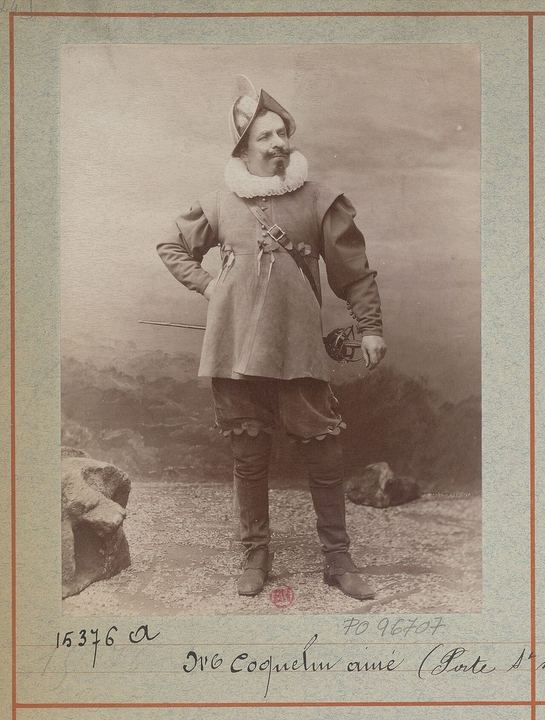
Background. Rostand built his romance on a real seventeenth-century freethinker, duellist and moon-voyage satirist, keeping the famous nose and the siege where he served. It was written for Coquelin and staged at the Porte Saint-Martin.
Plot. Convinced his face forbids love, Cyrano lends his gift of speech to the beautiful but inarticulate Christian, whom their cousin Roxane adores. He courts her for Christian by letter and from the shadows under her window, secures their hasty marriage while stalling de Guiche, and keeps writing from the starving lines at Arras. Christian falls in battle, and Cyrano's silence lasts until a fatal blow to the head brings him, dying, to the convent where she grieves.
Structure. Each act has its own setting and set piece: the duel in rhyme, the refusal of patronage, the night wooing, the coach of provisions, and the letter read at dusk. Comedy dominates the first three acts; war and death darken the last two, which close in a quiet autumn garden.
Themes. The gap between face and soul, independence against flattery, words as weapons and gifts, sacrificial love, and gallantry in defeat.
Significance. Its first night became a legend of French theatre, and the role, crowned by the final word panache, has tempted great actors in many languages ever since.
Main characters
- Cyrano de Bergerac: Long-nosed Gascon poet and duellist
- Roxane: His cousin, a lover of eloquence
- Christian de Neuvillette: Handsome, tongue-tied cadet who woos with borrowed words
- Count de Guiche: Powerful courtier and rival for Roxane
- Le Bret: Cyrano's faithful, exasperated friend
- Ragueneau: Poet-loving pastry cook
- Carbon de Castel-Jaloux: Captain of the Gascon cadets
- Mother Marguerite: Head of the convent where Roxane lives in mourning

Summary
Cyrano de Bergerac is Edmond Rostand's five-act verse play about a seventeenth-century Gascon soldier, poet and swordsman whose enormous nose convinces him that no woman could love him. Act I opens in 1640 at the Hôtel de Bourgogne theatre in Paris. Cyrano drives the fat actor Montfleury off the stage, answers the foppish Viscount de Valvert's dull joke about his nose with a dazzling list of the insults he might have made, and then fights him while composing a ballade, striking home on the last line. Alone with his friend Le Bret he admits that he loves his cousin Roxane, and that night he goes out alone to fight a hundred hired men waiting to ambush the drunken poet Lignière. In Act II, at the pastry shop of Ragueneau, the baker who feeds poets, Roxane tells Cyrano that she loves a handsome young cadet, Christian de Neuvillette, and asks him to protect Christian in his regiment, the Cadets of Gascony. Christian proves his courage by mocking Cyrano's nose, and Cyrano, instead of killing him, offers to write his love letters, since Christian fears he has no wit. Cyrano also refuses the patronage of the powerful Count de Guiche, who wants Roxane for himself. Act III is the balcony scene. When Christian's own words fail beneath Roxane's window, Cyrano speaks for him in the dark, winning her with his eloquence and finally sending Christian up to claim a kiss. A Capuchin brings a letter from de Guiche; Roxane reads it aloud as an order to marry her to Christian at once, and Cyrano delays de Guiche with a mad tale of falling from the moon until the wedding is done. In revenge, de Guiche sends the cadets to the siege of Arras. In Act IV the cadets are starving, and Cyrano crosses the Spanish lines every day to send letters to Roxane in Christian's name. Roxane drives through the lines in a coach full of food with Ragueneau, and tells Christian that she would love him now even if he were ugly, for his soul. Christian realizes that she loves Cyrano, but he is shot before the truth can be told, and Cyrano keeps silent. Act V takes place fifteen years later, in 1655, in the garden of a convent where Roxane lives in mourning. Cyrano, poor and full of enemies, visits every Saturday. On this day a lackey has dropped a heavy log on his head. He arrives anyway, asks to read Christian's last letter, and reads it in the dark, so that Roxane recognizes the voice. Dying, he fights imaginary enemies, Falsehood, Compromise, Prejudice, and goes to God keeping one thing unstained, his panache. The play opened at the Théâtre de la Porte Saint-Martin in December 1897 with Constant Coquelin as Cyrano.
Virtues in this work
- Honor: Cyrano refuses de Guiche's patronage rather than flatter a powerful man for advancement.
- Fortitude: He crosses the Spanish lines at Arras every day to carry Roxane's letters, and dies on his feet, sword in hand.
- Charity: He keeps silent for fifteen years so that Roxane's memory of Christian is not spoiled.
- Friendship: He protects Christian, whom he could have killed for mocking his nose, and keeps his promise to Roxane to watch over him.
Plot or Argument
- Act I: A performance at the Hôtel de Bourgogne
Cyrano stops Montfleury's performance, delivers the nose tirade to Valvert, duels while composing a ballade, confesses his love for Roxane to Le Bret, and leaves to fight a hundred men for Lignière.
- Act II: The poets' cook-shop
At Ragueneau's, Roxane confides her love for Christian; Cyrano rejects de Guiche's patronage, endures Christian's jokes about his nose, and agrees to write Christian's letters.
- Act III: Roxane's kiss
Under the balcony Cyrano speaks for Christian and wins Roxane's heart; he holds off de Guiche with a tale of the moon while a Capuchin marries the lovers; de Guiche orders the cadets to war.
- Act IV: The Cadets of Gascony
At the starving siege of Arras, Cyrano sends daily letters through enemy lines; Roxane arrives with food and says she loves Christian's soul; Christian learns the truth and is killed in battle.
- Act V: Cyrano's Gazette
Fifteen years later at the convent, the mortally injured Cyrano reads Christian's last letter in the dark, is recognized by Roxane, and dies fighting his old enemies with his panache intact.
Characters
- Cyrano de Bergerac, protagonist
Gascon cadet, poet, swordsman and wit, proud, independent and ashamed of his nose.
- Roxane, heroine
Madeleine Robin, Cyrano's cousin, a précieuse who loves fine words and comes to love a soul.
- Christian de Neuvillette, lover
A handsome, brave young cadet who cannot speak his love and borrows Cyrano's words.
- Count de Guiche, rival
Powerful nephew of Richelieu who pursues Roxane and later, as Duke de Grammont, grows wiser.
- Le Bret, friend
Cyrano's loyal friend, who scolds and loves him to the end.
- Ragueneau, pastry cook and poet
A baker who pays poets in tarts and follows Cyrano faithfully into poverty.
- Carbon de Castel-Jaloux, captain
Captain of the Cadets of Gascony.
- The Viscount de Valvert, fop
De Guiche's candidate for Roxane's husband, beaten by Cyrano in wit and sword.
- Lignière, poet
A drunken poet whom Cyrano defends against a hundred hired men.
- Mother Marguerite and Sister Martha, nuns
Sisters of the convent where Roxane lives, fond of Cyrano and hoping to convert him.
Lessons
Beauty of soul and beauty of face
Roxane at first loves Christian's face and believes his words come from him. By Act IV she says she loves his soul and would love him if he were ugly. The play asks what love truly sees, and lets the audience recognize Cyrano's worth before Roxane does.
- What does Roxane love in Christian at the start, and what does she love by Act IV?
- Is Christian wrong to accept Cyrano's help?
- Why does Christian insist that Roxane be told the truth?
Independence and its price
In the No, grammercy speech of Act II, Cyrano refuses to flatter patrons or climb by creeping like ivy. He would rather mount alone. He keeps his freedom, but he ends poor, wounded and full of enemies. The play admires his integrity and lets us count its cost.
- What does Cyrano refuse when de Guiche offers patronage?
- Is Cyrano's pleasure in making enemies a virtue or a fault?
- What does Le Bret think of Cyrano's choices?
Silence as sacrifice
After Christian dies, Cyrano keeps the secret for fifteen years so that Roxane's memory of her husband is not spoiled. His silence is both noble and costly. Only his reading of the last letter in the dark gives him away.
- Why does Cyrano say nothing after Christian's death?
- How does Roxane finally learn the truth?
- Was Cyrano's silence a gift to Roxane, or a wrong done to her?
Panache
Cyrano's last word names the white plume of gallant style and courage he refuses to lose. Even dying, he fights Falsehood, Compromise and Prejudice, knowing he will fall. The play makes a lost cause fought well into a kind of victory.
- Who are the enemies Cyrano fights at the end?
- What does Cyrano mean when he says he fought for lost causes?
Context
The real Savinien de Cyrano de Bergerac (1619-1655) was a soldier, duellist, freethinking writer and author of comic voyages to the moon and sun. Rostand kept his name, his nose, his service at Arras (1640) and his death after a blow to the head, and invented most of the rest, including the love for Roxane. Set in the age of Richelieu, Louis XIII and the précieuses, the play was a heroic verse romance written in the age of naturalist and symbolist theatre in Paris.
Composition
Rostand wrote the play in rhyming alexandrine couplets for the actor Constant Coquelin, who created Cyrano at the Théâtre de la Porte Saint-Martin, Paris, in December 1897. The English translation by Gladys Thomas and Mary F. Guillemard appeared in 1898; reference works describe it as a prose translation, and the Gutenberg text prints most speeches as lines, rhyming in some passages such as the nose tirade.
Reception
The premiere was a triumph, and the play became one of the most performed works of the French theatre. Brian Hooker's 1923 English verse version made it a staple of the English-speaking stage, and it has been filmed many times, notably with José Ferrer (1950) and Gérard Depardieu (1990).
Comparisons
- romeo-and-juliet
Both plays have a balcony scene; Shakespeare's lovers speak for themselves, while Rostand's lover is won by a hidden voice speaking for another man.
- much-ado-about-nothing
Benedick and Beatrice fight with wit and are tricked into love; Cyrano uses wit as armour and lends it to win love for someone else.
- don-quixote
Two heroes of lost causes who live by a code of honour others find absurd, and who die with a final act of faith in their ideals.
- the-misanthrope-and-other-plays
Molière's Alceste, from the same century as Cyrano, also refuses to flatter, but Molière treats his candour comically, while Rostand makes it heroic.
- the-scarlet-pimpernel
Both heroes hide their true selves, Percy behind foppery and Cyrano behind Christian, and both are swashbuckling romances written in the 1890s-1900s about an earlier France.
Quotes
Frequently cited
“Not to mount high, perchance, but mount alone!”
“True; all my elegances are within.”
“Truth, Independence, are my fluttering plumes.”
“Nothing more solemn than a tear--sublimer;”
“A rose-dot on the 'i' of 'adoration,'”
“A nobler pain than hunger,--'tis of the soul, not of the body!”
“I loved but once, yet twice I lose my love!”
“But who fights ever hoping for success? I fought for lost cause, and for fruitless quest!”
For Students
A reading companion for classical Christian high school students. See the student guide.
Reading Guide
Watch for
- The nose tirade and the duel in rhyme in Act 1, Scene 4, which show Cyrano's wit as both weapon and armour.
- Cyrano's long refusal of patronage in Act 2, Scene 8, built on the repeated No, grammercy.
- The balcony scene in Act 3, where darkness lets Cyrano speak his own heart in another man's name.
- Roxane's arrival at Arras in Act 4 and her claim that she would love Christian even if he were ugly.
- The reading of the last letter in Act 5 and how Roxane recognizes the voice.
Key terms and names
- Panache
- The plume on a soldier's hat, and by extension gallant style and spirit; it is Cyrano's last word.
- Cadets of Gascony
- Cyrano's company of proud, poor young noblemen from Gascony in southwest France, led by Carbon de Castel-Jaloux.
- Précieuse
- A woman of the 1640s Paris salons devoted to refined speech and elaborate compliments; Roxane is one.
- Ballade
- A French verse form with a repeated refrain and a closing envoi; Cyrano composes one while fighting Valvert.
- Siege of Arras
- The French siege of the Spanish-held town of Arras in 1640, where the cadets starve and Christian dies.
- Hôtel de Bourgogne
- The Paris theatre where Act I takes place and Cyrano drives Montfleury from the stage.
Seminar Questions
- Comprehension Why does Cyrano agree to write Christian's letters to Roxane?
- Comprehension How does Cyrano keep de Guiche from stopping the wedding in Act III?
- Comprehension What does Christian understand after Roxane says she loves his soul?
- Interpretation Is Cyrano's wit a sign of strength or a way of hiding? Use the nose tirade and his talk with Le Bret in Act I.
- Interpretation Whose love is Roxane really responding to in the balcony scene, and does it matter that she does not know?
- Interpretation Why does Cyrano keep silent for fifteen years, and was he right to?
- Big Question Can honesty and kindness ever pull in opposite directions, and how should a person choose between them?
- Big Question What makes a life a success: winning, or fighting well for the right things?
Faith Connections
- 1 Samuel 16:7 (Scripture)
Man looketh on the outward appearance, but the Lord looketh on the heart. Roxane learns too late to see what God sees, the soul behind Cyrano's face.
- 1 Corinthians 13:4-7 (Scripture)
Love seeketh not her own and beareth all things. Cyrano's years of silence for Roxane's sake show love that asks nothing back.
- 2 Timothy 4:7 (Scripture)
Paul's I have fought a good fight sits near Cyrano's dying claim that he fought for lost causes and will enter Christ's courts with one thing unstained.
- Augustine, Confessions, Book X (Great Conversation)
Augustine warns against the love of human praise; Cyrano's refusal to flatter shows a strong freedom from the opinions of others, but also his own hunger to be admired.
Logic and Rhetoric
Central argument: Outward beauty draws love, but the soul is what is truly loved. Cyrano, who has the soul, believes his face forbids him love, so he gives his words to Christian, who has the face. Roxane comes to love the soul behind the words. Therefore the play argues that true worth lies within, and that a man may win love and honour even while losing everything else.
Rhetorical device: anaphora. In Act 2, Scene 8, Cyrano answers each way of rising in the world with No, grammercy, building to the climax Not to mount high, perchance, but mount alone! (quote 3).
Debate: Resolved: that Cyrano did right to keep his secret from Roxane after Christian's death.
Memory Work
Not to mount high, perchance, but mount alone!
Truth, Independence, are my fluttering plumes.
Writing Prompts
Essay: Argue whether Cyrano is ultimately defeated or victorious, using the Act 5 ending and his idea of panache.
Comparison with Romeo and Juliet: Compare the balcony scenes in Romeo and Juliet and Cyrano de Bergerac. What does each reveal about the relation between words and love?
Medical Lens
The play gives a vivid picture of a soldier's body and its limits. At the siege of Arras the cadets are starving, and Cyrano answers hunger with music and jokes, calling homesickness a nobler pain of the soul. Christian is shot in Act IV. In Act V Ragueneau reports that a lackey dropped a heavy piece of wood on Cyrano from a window; Cyrano was struck down with a large wound in his head and lost consciousness, and the doctor who came spoke of fever and meningitis and warned that he might die if he rose. Cyrano rises anyway, walks to the convent, has a moment of faintness, reads in failing light, and dies after a spell of wandering speech that Le Bret calls raving. To a modern clinician this sequence suggests a head injury with a lucid interval and later deterioration, but that is a reading of a stage death, not a diagnosis. Cyrano's nose, mocked by fools and feared by himself, shapes his whole life; the play treats it as a mark of difference that his wit and courage turn into a kind of armour.
- Act 1, Scenes 4-5
The nose tirade answers Valvert's insult; afterwards Cyrano tells Le Bret how his profile on a wall shames him and why he will not weep.
- Act 4, Scenes 1-3
The starving cadets at Arras complain of hunger; Cyrano has the fifer play the airs of Gascony.
- Act 4, final scenes
Christian is brought back mortally wounded and dies in Roxane's arms as the Spanish attack.
- Act 5, Scene 3
Ragueneau tells Le Bret of the falling wood, the head wound, the loss of consciousness and the doctor's words about fever and meningitis.
- Act 5, Scene 6
The bandaged Cyrano grows faint, wanders in speech, stands against a tree and dies sword in hand.
Listen to the book
Public-domain audiobook from LibriVox, read by Various volunteers, translated by Mary F. Guillemard and Gladys Thomas. Recording: Cyrano de Bergerac on LibriVox (Internet Archive).
LibriVox recordings are volunteer readings released into the public domain. The reading may follow a different edition or translation from the text in this library.
Creative Prompts
- Classroom
Imitate the nose tirade of Act 1, Scene 4: choose an ordinary object and describe it in ten different tones (aggressive, friendly, pedantic, lyric), labelling each.
- Dialogue
Write the conversation Christian and Cyrano might have had if Christian had lived long enough to tell Roxane the truth.
- Essay
Is Cyrano a hero, or is his pride the real cause of his loneliness? Use the No, grammercy speech and Act V.
- Poetry
Write a ballade or rhyming poem with a refrain, as Cyrano does during his duel, in which each stanza moves toward a final point.
Further Reading
- Cyrano de Bergerac (trans. Brian Hooker), Edmond Rostand
The classic 1923 English verse version.
- Other Worlds: The Comical History of the States and Empires of the Moon and the Sun, Cyrano de Bergerac
The historical Cyrano's own moon and sun voyages, in English translation.
- The Misanthrope, Molière
- The Three Musketeers, Alexandre Dumas
Another romance of Gascon swordsmen in the age of Richelieu.
Verification notes
Plot, scene numbers and wording follow the attached Project Gutenberg text (#1254), whose front matter credits the translation to Gladys Thomas and Mary F. Guillemard. The premiere at the Théâtre de la Porte Saint-Martin in December 1897 with Coquelin, the rhyming alexandrine form, and the description of the 1898 translation as prose were checked against the Wikipedia article on the play (en.wikipedia.org/wiki/Cyrano_de_Bergerac_(play)); the Gutenberg layout in lines is noted in historicalContext. The Act V stage direction gives fifteen years later, in 1655, though Mother Marguerite speaks of fourteen years. Facts about the historical Cyrano are standard. Medical readings of Cyrano's death are interpretive. All quotes were found in the attached text.
- Confirm the exact premiere date (27 or 28 December 1897; sources differ).
- Confirm the English title and translator of the edition of the historical Cyrano's moon and sun voyages listed in furtherReading.