Work record
Institutes of the Christian Religion
1536; definitive Latin edition 1559 · Renaissance Early Modern · Philosophy · Latin
Abstract
Background. A young French exile trained in law and classical letters first issued this handbook in 1536 as a catechism for evangelicals and an apology addressed to their persecuting monarch. Across twenty-three years of ministry in Strasbourg and Geneva he kept rewriting and enlarging it, in Latin and in French.
Content. The final arrangement follows the Creed. Part one sets out natural and scriptural knowledge of the Creator, the Trinity, humanity's first state and divine government of the world. Part two moves from Adam's fall and the enslaved will through the moral law and the covenants to the person and offices of the Mediator. Part three explains union with Christ, faith, repentance, self-denial, free justification, prayer, election and resurrection. Part four covers the visible community of believers, its ministers and discipline, baptism and the Supper, and the God-given office of rulers.
Key Concepts. Twofold knowledge; the Spirit's witness to Scripture; providence; imputed righteousness; predestination to life and to death; spiritual presence in the Eucharist; the limits of political obedience.
Significance. No book did more to give Reformed Protestantism a common doctrine. It guided confessions in France, Scotland, the Low Countries and the Palatinate, drew sustained replies from Lutheran, Catholic and Arminian theologians, and still frames debate over grace and church order. This edition reproduces Beveridge's Victorian English, minus his notes and indexes.
Key figures
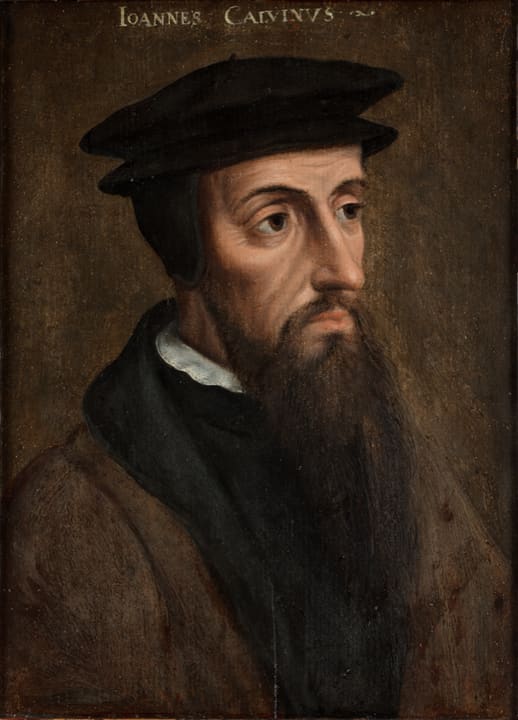
- John Calvin: French reformer and minister at Geneva, writing as teacher of the Church
- Francis I: King of France, to whom the prefatory defence is addressed
- Augustine of Hippo: Church father cited as Calvin's leading authority after Scripture
- Michael Servetus: Anti-Trinitarian writer refuted in the doctrine of God
- Andreas Osiander: Lutheran theologian answered on justification
- Peter Lombard: Medieval Master of the Sentences, quoted and disputed throughout

Summary
Institutes of the Christian Religion is John Calvin's ordered account of Christian doctrine, written to train readers in godliness and to show the King of France what his persecuted evangelical subjects actually believed. The library text opens with the Prefatory Address to Francis I, which pleads that the Reformers teach nothing new but the faith of Scripture and the early fathers, and with Calvin's Epistle to the Reader, dated Geneva, 1 August 1559, in which he says he was never satisfied until the work was set in its present order. A short summary of the plan, taken from Caspar Olevianus's epitome, explains that the four books follow the Apostles' Creed: Father, Son, Holy Spirit and Church. Book I treats God the Creator. True wisdom consists in knowing God and ourselves; a sense of deity is planted in every heart, and the created world displays God's glory, yet human minds turn that knowledge into idols. Scripture is therefore needed, and its authority is sealed by the inward testimony of the Spirit. Calvin defends the Trinity against Michael Servetus, discusses angels and the image of God in humanity, and closes with three chapters on providence, the doctrine that God governs every event for the good of his people. Book II treats God the Redeemer. Adam's fall leaves the human will bound to sin; the moral law, expounded commandment by commandment, exposes that condition and points to Christ. The Old and New Testaments are one covenant differently administered. Christ, true God and true man, saves as Prophet, King and Priest. Book III describes how the Holy Spirit joins believers to Christ. Faith is a firm and sure knowledge of God's favour; repentance and a life of self-denial, cross-bearing and hope follow. Long chapters set out justification by faith alone, Christian liberty and prayer, with an exposition of the Lord's Prayer, before Calvin turns to election and predestination and ends with the resurrection. Book IV concerns the Church as the mother of believers, known where the Word is preached and heard and the sacraments rightly administered. Calvin sets out a ministry of pastors, teachers, elders and deacons, criticises the papacy and its claims, defends church discipline, and treats baptism, including infant baptism, and the Lord's Supper, in which Christ truly feeds believers by the Spirit. The last chapter honours civil magistrates as ministers of God while insisting that obedience to rulers must yield to obedience to God. The first edition (Basel, 1536) had six chapters; Calvin enlarged it repeatedly, translated it into French in 1541, and issued the definitive eighty-chapter Latin text at Geneva in 1559.
Virtues in this work
- Piety: Calvin defines the goal of all his teaching as true godliness and opens with the claim that wisdom begins in knowing God.
- Humility: In Book IV, chapter 17 he confesses that he rather feels than understands how Christ feeds believers in the Supper.
- Fortitude: The Prefatory Address defends persecuted French believers before their king, and the final section urges courage when rulers command what God forbids.
- Faith: Book III, chapter 2 defines faith as a firm and sure knowledge of God's favour, sealed on the heart by the Spirit.
- Temperance: Book III, chapter 10 teaches believers to use food, clothing and pleasures with gratitude and moderation, neither rejecting God's gifts nor indulging in them.
Plot or Argument
- Prefatory Address and Epistle to the Reader
Calvin dedicates the work to Francis I, defending French evangelicals against charges of novelty and sedition, and in the 1559 epistle explains that he rewrote the book until its order satisfied him and that it is meant to prepare students for reading Scripture.
- Book I, chapters 1-9: Knowing God and ourselves
The knowledge of God and of self are bound together. Every person has a sense of deity, and creation is a theatre of God's works, but sin corrupts natural knowledge; Scripture, confirmed by the inward witness of the Spirit rather than by church authority alone, is the sure guide.
- Book I, chapters 10-18: Idols, Trinity, creation and providence
Calvin forbids images of God, defines the three Persons in one essence against Servetus, treats angels, devils and humanity's original state, and teaches that God's providence governs all events, so that believers may face danger with patience, gratitude and freedom from anxiety.
- Book II, chapters 1-5: The Fall and the bondage of the will
Original sin corrupts the whole person; the will is not destroyed but is enslaved to sin, so that good works come from grace. Calvin cites Augustine at length and answers arguments for free will.
- Book II, chapters 6-11: Law and covenant
The law convicts, restrains and guides believers; Calvin expounds the Ten Commandments, and argues that the Old and New Testaments share one covenant of grace, differing in clarity and administration.
- Book II, chapters 12-17: Christ the Mediator
Christ became man to reconcile God and humanity; his two natures, his threefold office as Prophet, King and Priest, and his obedience, death, resurrection and ascension are traced through the articles of the Creed.
- Book III, chapters 1-10: Faith and the Christian life
The Spirit unites believers to Christ. Faith is defined, repentance is distinguished from scholastic penance, indulgences and purgatory are rejected, and the famous chapters on self-denial, bearing the cross, meditating on the future life and using present goods rightly describe ordinary Christian living.
- Book III, chapters 11-20: Justification, liberty and prayer
Justification is God's acceptance of sinners through the forgiveness of sins and the imputed righteousness of Christ, received by faith; Calvin answers Andreas Osiander and the Schoolmen, defines Christian liberty and writes a long chapter on prayer and the Lord's Prayer.
- Book III, chapters 21-25: Election and resurrection
Calvin teaches that God has chosen some to salvation and passed by others by an eternal decree, presents the doctrine as humbling and comforting for believers, answers objections, and ends the book with the final resurrection.
- Book IV, chapters 1-13: The Church and its order
The Church is the mother of the faithful, marked by the preached Word and the sacraments. Calvin describes the offices of the ministry, the government of the early church, his case against papal primacy and councils' claims, church discipline and excommunication, and monastic vows.
- Book IV, chapters 14-19: The sacraments
Sacraments are signs and seals of God's promises. Calvin defends infant baptism against the Anabaptists, teaches a true spiritual feeding on Christ's body and blood in the Supper against both transubstantiation and the Lutheran doctrine of ubiquity, rejects the sacrifice of the Mass, and denies sacramental status to five Roman rites.
- Book IV, chapter 20: Civil government
Magistracy is a calling approved by God; laws, punishments, lawful war and taxes are defended, private persons owe obedience even to unjust rulers, and the closing section limits all obedience: when rulers command what God forbids, God must be obeyed rather than men.
Characters
- John Calvin, author and teacher
Writes in the first person as a teacher of the Church, preparing students to read Scripture and answering opponents by name.
- Francis I, dedicatee
King of France, addressed in the Prefatory Address as a ruler misinformed about his evangelical subjects.
- Augustine of Hippo, chief authority after Scripture
Cited hundreds of times, especially on grace, the will, predestination and the sacraments.
- Michael Servetus, opponent
Spanish physician and anti-Trinitarian writer whose teaching Calvin refutes in the chapter on the Trinity and elsewhere.
- Andreas Osiander, opponent
Lutheran theologian whose doctrine of essential righteousness Calvin answers at length in Book III, chapter 11.
- Peter Lombard and the Schoolmen, opponents and sources
The medieval theologians whose definitions of grace, penance and the sacraments Calvin quotes and disputes.
- The Anabaptists, opponents
Radical reformers whose rejection of infant baptism and of Christian magistracy Calvin answers in Book IV.
Lessons
Knowledge of God and knowledge of self belong together
Calvin's first sentence joins two kinds of knowledge: seeing God's goodness shows us our need, and seeing our need drives us toward God. The whole first book works out this pairing, so that theology is never only about ideas but also about how a person understands himself before his Maker.
- Why does Calvin say it is hard to decide which of the two kinds of knowledge comes first?
- How does looking at God's perfection change the way a person judges his own goodness?
- Can a person know himself truly without reference to God? How would Calvin answer?
The heart makes idols
In Book I, chapter 11, Calvin observes that soon after the Flood people were again making gods for themselves, and calls the human mind a forge of idols. For him idolatry is not only bowing to statues but any picture of God shaped by human fancy instead of God's own word.
- What evidence from Genesis does Calvin give for his claim about the human mind?
- What might count as an idol in Calvin's broad sense?
- Why does Calvin think Scripture is needed to correct what nature teaches about God?
We are not our own
The chapters on the Christian life (Book III, chapters 6-10) are among the most read parts of the Institutes. Self-denial, patience under the cross, hope of the life to come and grateful, moderate use of earthly goods are presented as the shape of a life that belongs to God.
- What does Calvin conclude from the claim that we belong to God rather than to ourselves?
- How does Calvin balance contempt for the present life with gratitude for its good gifts?
- Which of Calvin's counsels on bearing the cross seems most practical to you?
Doctrine and comfort
Calvin presents providence and election not as puzzles for the curious but as comfort for believers: nothing happens apart from God's fatherly care, and salvation rests on God's choice rather than on human merit. He also warns against prying beyond what Scripture says. Lutheran, Catholic and later Arminian readers disputed his account of predestination, and the debate continues among Christians today.
- Why does Calvin warn against curiosity about God's hidden decrees?
- How does he answer the objection that election makes people careless about holiness?
- Why might the same doctrine comfort one reader and alarm another?
Two kinds of government
Calvin distinguishes the spiritual kingdom of Christ from civil government but calls both gifts of God. Magistrates deserve honour and obedience as God's ministers, yet the final section of the book sets a limit: no ruler may command what God forbids.
- Why does Calvin call the magistrate's office a holy calling?
- What reasons does he give for obeying even a bad ruler?
- Where does Calvin draw the line of obedience, and what passage of Scripture does he cite?
Context
The Institutes belongs to the second generation of the Protestant Reformation. By the 1530s Luther's protest had spread to France, where evangelicals faced arrest and execution, especially after the Affair of the Placards in October 1534. Calvin, a young humanist and lawyer who had left France, wrote the first edition partly as a catechism and partly as a defence of his persecuted countrymen. Over the next quarter century Geneva became a refuge for Protestants from France, Italy, England and Scotland, and the Institutes became the textbook of the Reformed churches. The work also answered other reformers: Calvin agreed with Luther on justification by faith and the bondage of the will, but differed on the Lord's Supper, on church order and on the use of the law in the Christian life.
Composition
The first Latin edition, Christianae religionis institutio, appeared at Basel in March 1536 in six chapters, with the dedicatory letter to Francis I dated 1535. Calvin enlarged it in 1539 (Strasbourg), translated it into French in 1541, and revised it again in 1543 and 1550. The definitive Latin edition, printed at Geneva by Robert Estienne in 1559, reorganised the material into four books and eighty chapters following the Apostles' Creed; a French version followed in 1560. Thomas Norton's English translation appeared in 1561, John Allen's in 1813, and Henry Beveridge's, used here, for the Calvin Translation Society at Edinburgh in 1845. The library text, from the Christian Classics Ethereal Library, gives the complete four books with the Prefatory Address, the Epistle to the Reader and the Method and Arrangement; the modern introduction, the general table of chapters, the translator's footnotes and the indexes are omitted.
Reception
The Institutes shaped the confessions and catechisms of the Reformed world, among them the French Confession (1559), the Scots Confession (1560), the Belgic Confession (1561), the Heidelberg Catechism (1563) and later the Westminster Confession (1646), and it was read by Huguenots, Dutch Reformed, Scottish Presbyterians and English and American Puritans. Lutheran theologians, notably Joachim Westphal, rejected its doctrine of the Supper; Roman Catholic writers answered its account of justification, the sacraments and the papacy, and the Council of Trent defined Catholic teaching on these points; Jacobus Arminius and the Remonstrants later challenged the Reformed teaching on predestination, which the Synod of Dort (1618-19) reaffirmed. Historians and theologians continue to differ over how far later Calvinism follows Calvin himself, and the nineteenth-century Dutch statesman Abraham Kuyper presented Calvinism as a whole view of life in his Stone Lectures at Princeton (1898).
Comparisons
- calvin-selected-sermons
The Institutes sets out Calvin's doctrine in system; the sermons on Timothy and Titus show the same teaching on election, Scripture and church order applied week by week to a Genevan congregation.
- luther-bondage-of-the-will
Luther's 1525 reply to Erasmus anticipates Book II's case that the fallen will is enslaved to sin; Calvin cites the same Augustinian sources but sets the argument inside a larger system of covenant and providence.
- erasmus-on-free-will
Erasmus's defence of a limited free will is the position Book II, chapters 2-5 argues against, and reading him shows the humanist case for human cooperation with grace that the Reformed position answers.
- city-of-god
Augustine is Calvin's most cited authority; his two cities lie behind the Institutes' distinction between Christ's spiritual kingdom and civil government.
- summa-theologica
Aquinas's Summa is the great medieval systematic theology; comparing its treatment of grace, merit and the sacraments with Calvin's shows where Catholic and Reformed doctrine part ways and where both draw on Augustine.
- the-pilgrims-progress
Bunyan's allegory dramatises the Reformed teaching of the Institutes on conviction of sin, justification by faith, assurance and perseverance, as Christian loses his burden at the cross.
Quotes
Frequently cited
“Our wisdom, in so far as it ought to be deemed true and solid Wisdom, consists almost entirely of two parts: the knowledge of God and of ourselves.”
Frequently cited
“But I answer, that the testimony of the Spirit is superior to reason. For as God alone can properly bear witness to his own words, so these words will not obtain full credit in the hearts of men, until they are sealed by the inward testimony of the Spirit.”
Frequently cited
“Hence we may infer, that the human mind is, so to speak, a perpetual forge of idols.”
Frequently cited
“We are not our own; therefore, neither is our own reason or will to rule our acts and counsels. We are not our own; therefore, let us not make it our end to seek what may be agreeable to our carnal nature. We are not our own; therefore, as far as possible, let us forget ourselves and the things that are ours. On the other hand, we are God's; let us, therefore, live and die to him (Rom. 14:8).”
Frequently cited
“Thus we simply interpret justification, as the acceptance with which God receives us into his favor as if we were righteous; and we say that this justification consists in the forgiveness of sins and the imputation of the righteousness of Christ”
Frequently cited
“By predestination we mean the eternal decree of God, by which he determined with himself whatever he wished to happen with regard to every man. All are not created on equal terms, but some are preordained to eternal life, others to eternal damnation”
Frequently cited
“I will not be ashamed to confess that it is too high a mystery either for my mind to comprehend or my words to express; and to speak more plainly, I rather feel than understand it.”
“we were redeemed by Christ at the great price which our redemption cost him, in order that we might not yield a slavish obedience to the depraved wishes of men, far less do homage to their impiety.”
For Students
A reading companion for classical Christian high school students. See the student guide.
Reading Guide
Watch for
- The first sentence of Book I, chapter 1, and how often later chapters return to the pairing of knowledge of God and knowledge of ourselves.
- The chapter headings of Book III, chapters 6-10, which together form a short handbook on the Christian life often printed separately.
- How Calvin introduces predestination in Book III, chapter 21 with warnings against curiosity before he defines the doctrine.
- The title of Book IV, chapter 1, which calls the Church the mother of all the godly, and the two marks by which Calvin says a true church can be recognised.
- The final paragraph of the whole work, where obedience to kings meets the apostles' words in Acts 5:29.
Key terms and names
- Institutes (institutio)
- From the Latin for instruction or training; Calvin's title signals a handbook of Christian teaching rather than a book of rules.
- Sense of deity (sensus divinitatis)
- The awareness of God that Calvin says is engraved on every human heart (Book I, ch. 3), so that no one can wholly escape knowing there is a God.
- Inward testimony of the Spirit
- The Holy Spirit's work of persuading believers that Scripture is God's word; for Calvin this certainty rests on God's witness, not on the Church's authority or on proofs alone.
- Providence
- God's continuing care and government of all things, including what seems to happen by chance (Book I, chs. 16-18).
- Threefold office
- Christ's work as Prophet, King and Priest (Book II, ch. 15), a scheme Calvin made standard in Reformed teaching.
- Justification
- God's act of accepting sinners as righteous through the forgiveness of sins and the imputed righteousness of Christ, received by faith alone (Book III, ch. 11).
- Election
- God's free choice of those he will save, which Calvin calls part of predestination and treats in Book III, chs. 21-24.
- Marks of the Church
- The Word of God preached and heard, and the sacraments administered according to Christ's institution (Book IV, ch. 1, sec. 9).
Seminar Questions
- Comprehension According to the Method and Arrangement, how do the four books of the Institutes correspond to the Apostles' Creed?
- Comprehension In Book I, chapter 7, why does Calvin deny that the authority of Scripture depends on the judgment of the Church?
- Comprehension How does Calvin define faith in Book III, chapter 2, and justification in Book III, chapter 11?
- Interpretation Calvin says the human mind is a perpetual forge of idols. How does that claim prepare the way for his teaching on Scripture and on worship?
- Interpretation Calvin presents providence and election as comforts for believers. What makes them comforting in his account, and how does he answer those who find them frightening?
- Interpretation In the Supper, Calvin says believers truly feed on Christ but that he rather feels than understands how. How does his view differ from both the Roman Catholic and the Lutheran positions he answers?
- Big Question Calvin ends a book addressed to a king with the claim that God must be obeyed rather than men. How should a Christian weigh honour for rulers against obedience to conscience?
- Big Question Lutheran, Catholic and Arminian Christians have all disagreed with parts of the Institutes. Choose one disagreement and set out each side's strongest case in its own terms.
Faith Connections
- Romans 14:7-8 (Scripture)
Paul's words that none of us lives to himself and that we are the Lord's in life and death are the text behind Calvin's chapter on self-denial and the repeated phrase that we are not our own.
- Acts 5:29 (Scripture)
Peter's answer to the council, that we ought to obey God rather than men, is the verse Calvin sets at the end of his chapter on civil government.
- Augustine, On the Spirit and the Letter and On the Predestination of the Saints (Church Fathers)
Calvin cites Augustine more than any other writer and claims to stand with him on grace and the will; reading Augustine's anti-Pelagian treatises shows what Calvin inherited.
- Heidelberg Catechism (1563), Question 1 (Great Conversation)
The catechism's first answer, that my only comfort in life and death is that I belong to my faithful Saviour Jesus Christ, echoes the Institutes' teaching that we are not our own but God's.
Logic and Rhetoric
Central argument: True wisdom is the knowledge of God and of ourselves; fallen people corrupt their natural knowledge of God into idols; therefore they need Scripture, sealed by the Spirit, to know God as Creator and, in Christ, as Redeemer; the Spirit unites believers to Christ by faith, through which they are justified freely and sanctified; and God sustains this faith through the ordered ministry, sacraments and discipline of the Church, while civil government protects outward peace under God's authority.
Rhetorical device: anaphora. In Book III, ch. 7, sec. 1, Calvin repeats We are not our own three times and then We are God's three times, turning a doctrine into a rhythm the reader can carry.
Debate: Resolved: that the authority of Scripture is established by the inward testimony of the Spirit rather than by the judgment of the Church.
Memory Work
Our wisdom, in so far as it ought to be deemed true and solid Wisdom, consists almost entirely of two parts: the knowledge of God and of ourselves.
We are not our own; therefore, neither is our own reason or will to rule our acts and counsels. We are not our own; therefore, let us not make it our end to seek what may be agreeable to our carnal nature. We are not our own; therefore, as far as possible, let us forget ourselves and the things that are ours. On the other hand, we are God's; let us, therefore, live and die to him (Rom. 14:8).
Writing Prompts
Essay: Calvin claims that knowledge of God and knowledge of ourselves are so connected that each leads to the other. Using Book I, chapter 1, Book II, chapter 1 and Book III, chapter 7, explain how this claim shapes his account of humility and the Christian life.
Comparison with The Bondage of the Will (De Servo Arbitrio): Compare Luther's argument against Erasmus with Calvin's Book II, chapters 2-5. Where do the two reformers agree about the fallen will, and what does Calvin add or change?
Medical Lens
The Institutes is a work of theology, but a few passages bear on the history of medicine and on the care of anxious minds. In Book I, chapter 5, Calvin cites Galen's On the Usefulness of the Parts as the kind of anatomical learning that reveals the Creator's skill in the human frame, and repeats the old philosophical description of man as a microcosm; physicians, like astronomers, are said to see God's wisdom more fully than others. Book I, chapter 17 is a classic Reformed text of pastoral consolation: Calvin lists the countless dangers of ordinary life, calling the body a receptacle and nurse of a thousand diseases, and argues that trust in providence frees the believer from crushing anxiety while still requiring prudent use of means, including remedies and precautions. Book III, chapters 8-10 on bearing the cross and meditating on the future life treat illness and death as occasions for patience and hope. In Book IV, chapter 19 Calvin argues that the anointing of the sick in James 5 belonged to an apostolic gift of healing that has ceased, while holding that God still heals his people as often as there is need; this places ordinary medicine and prayer, not a sacramental rite, at the centre of care for the sick. Calvin's own long illnesses are well documented in his letters, but the Institutes does not describe them.
- Book I, ch. 5, secs. 2-3
Medicine and astronomy as sciences that disclose God's wisdom; Galen's anatomy of the human body; man called a microcosm.
- Book I, ch. 17, secs. 10-11
The many diseases and dangers that threaten life, and providence offered as the remedy for anxious fear.
- Book I, ch. 17, sec. 4
Providence does not excuse neglect: believers must still take precautions and use the remedies God provides.
- Book III, chs. 8-9
Bearing the cross and meditating on the future life as a discipline for sickness, loss and mortality.
- Book IV, ch. 19, secs. 18-21
Calvin's argument that the apostolic anointing with oil and the gift of healing were temporary, set against the Roman rite of extreme unction.
Creative Prompts
- Essay
Calvin opens by saying that true wisdom is the knowledge of God and of ourselves. Take one chapter from Book I and one from Book III and show how each develops both halves of that sentence.
- Dialogue
Write a conversation in Strasbourg in 1540 between Calvin and a French refugee who has lost everything, in which Calvin draws on what he wrote about providence in Book I, chapter 17.
- Classroom
Divide the class into four groups, one for each book of the 1559 Institutes, and have each group match its book to the article of the Apostles' Creed it expounds and present three chapter titles that show the link.
- Fiction
Imagine a young Huguenot pastor carrying a copy of the 1560 French Institutes back into France. Write the scene in which he reads the dedication to Francis I aloud to a secret congregation.
Further Reading
- Institutes of the Christian Religion (Library of Christian Classics, trans. Ford Lewis Battles, ed. John T. McNeill), John Calvin
- Lectures on Calvinism, Abraham Kuyper
- Calvin, Bruce Gordon
- John Calvin's Institutes of the Christian Religion: A Biography, Bruce Gordon
- John Calvin: A Sixteenth-Century Portrait, William J. Bouwsma
- The Unaccommodated Calvin, Richard A. Muller
Verification notes
The library text (CCEL, Henry Beveridge's 1845 translation for the Calvin Translation Society) was searched with Grep; all eight quotations are exact substrings and their book, chapter and section locators were checked against the section numbering in the file. The familiar line often given as the mind of man is a factory (or manufactory) of idols appears in Beveridge's wording as a perpetual forge of idols (Book I, ch. 11, sec. 8), and is quoted in that form. The Method and Arrangement printed after the Epistle to the Reader is marked in the text as taken from an epitome of the Institutes by Caspar Olevianus, not written by Calvin, and is described that way here. In the library text Book IV, ch. 20 runs section 31 directly into section 32 after its opening clause, so most of section 31 (Calvin's remarks on lesser magistrates appointed to restrain kings) is missing; this record does not quote or describe that section in detail. Publication facts (Basel 1536 in six chapters; Strasbourg 1539; French 1541; Geneva 1559 in four books and eighty chapters; French 1560; Norton 1561, Allen 1813, Beveridge 1845) are standard in Calvin scholarship. Calvin's birth at Noyon, his studies at Orléans and Bourges, his time in Strasbourg 1538-41 and the founding of the Geneva Academy in 1559 are well established.
- Book IV, ch. 20, sec. 31 is truncated in the library text; consult another edition of the Beveridge translation for the full section.
- Exact month of the 1536 Basel first edition (usually given as March) and the printers' names.