Work record
Give Me Liberty or Give Me Death
delivered 1775; text published 1817 · 18th Century · Oratory · English
Abstract
Background. With Boston under military occupation and Lord Dunmore having dissolved the Burgesses, Virginia's leaders gathered in Richmond. Moderates hoped the king would answer Congress's appeal and resisted Henry's motion to raise armed companies.
Content. Henry opens politely, then argues that cherished optimism has blinded his colleagues. Reasoning from the previous decade, he reads warships and regiments as aimed solely at Americans and catalogues every peaceful appeal already rebuffed. Waiting, he contends, will leave them weaker, whereas a populous people defending its rights, aided by providence and allies, cannot be conquered. Fighting has effectively started, so he declares that he personally prefers freedom to survival under bondage.
Method. Questions answered by the speaker himself, triple series, and dense biblical echo from Jeremiah, the Gospels, and Ecclesiastes carry the argument toward its climax. The closing sentence narrows suddenly from the assembly to the speaker's own choice.
Sources. Henry used no script, and nothing was recorded at the time. Wirt pieced together the wording from aging witnesses four decades afterward, and its exact fidelity remains disputed.
Significance. The convention adopted the defense resolutions by a slim margin. Within a month Massachusetts militia exchanged fire with regulars, and Henry's final sentence became a lasting American motto recited in classrooms for two centuries.
Key figures
- Patrick Henry: Delegate from Hanover County moving to arm the militia
- Peyton Randolph: President of the convention, addressed as Mr. President
- William Wirt: Biographer who assembled the surviving text in 1817
- George Washington: Fellow delegate present in the church
- Thomas Jefferson: Fellow delegate present in the church

Summary
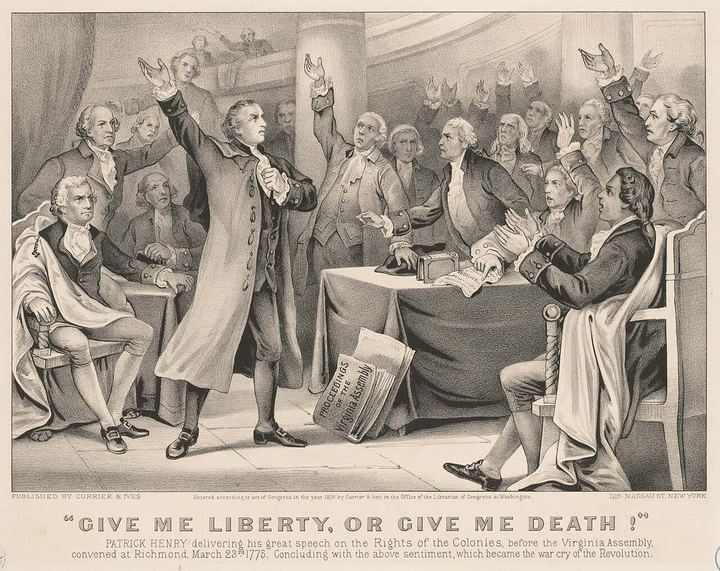
On 23 March 1775 the Second Virginia Convention, meeting in St. John's Church in Richmond to stay clear of the royal governor at Williamsburg, debated Patrick Henry's resolutions to put the colony into a posture of defense by forming and arming a militia. Several respected delegates had urged patience while petitions to the king were pending. Henry rose to answer them, with George Washington and Thomas Jefferson among his hearers, and the resolutions passed narrowly. No manuscript of the speech survives. The text known today was assembled by William Wirt for his 1817 biography of Henry, from the recollections of men who had heard it more than forty years before; how much of the wording is Henry's and how much Wirt's is debated. In Wirt's version Henry begins courteously, honoring the patriotism of the previous speakers but insisting that the question is one of freedom or slavery and that silence would be disloyalty to his country and to the Majesty of Heaven. He then attacks the illusions of hope, comparing them to the song of a siren, and asks whether wise men will be like those who having eyes see not. The center of the speech is an argument from experience, the one lamp by which his feet are guided. Ten years of British conduct, he says, give no ground for hope: the smiling reception of their petition is a snare, a betrayal with a kiss, while fleets and armies gather that can be meant for no one but Americans. Argument, entreaty, petition, remonstrance, and supplication have all been tried and spurned. There is no room left for hope; they must fight. He answers the objection that the colonies are weak. Strength will not grow by delay; millions of people armed in the holy cause of liberty are invincible; a just God will raise up friends; and the battle is not to the strong alone but to the vigilant, the active, the brave. The war has in fact begun, he warns, and the next gale from the north will bring the clash of arms. He ends by asking whether life is so dear or peace so sweet as to be bought with chains, and answers: give me liberty or give me death. Fighting broke out at Lexington and Concord less than four weeks later.
Virtues in this work
- Fortitude: Henry chooses death over living in chains and calls the convention to fight despite the colonies' apparent weakness.
- Prudence: He judges the future by the lamp of experience and insists on knowing the worst in order to provide for it.
- Justice: He frames the question as one of freedom or slavery and of rights long petitioned for and spurned.
- Piety: He counts silence as disloyalty to the Majesty of Heaven and appeals to the God of hosts and a just God who presides over nations.
Plot or Argument
- Exordium: respect and the duty to speak (Paragraph 1)
Henry honors the gentlemen who spoke before him but claims the right to disagree freely, since the question is one of freedom or slavery. To keep silent from fear of offense would be treason to his country and disloyalty to the Majesty of Heaven.
- Against the illusions of hope (Paragraph 2)
It is natural to cling to comfortable hopes, he concedes, but wise men must not be lulled by the siren's song or be among those who have eyes and see not. He would rather know the worst and provide for it.
- The lamp of experience (Paragraph 3)
Judging the future by the past, Henry finds nothing in ten years of British policy to justify hope. Fleets and armies are gathering against America alone; petitions, remonstrances, and supplications have been spurned. Every peaceful means is exhausted, and the conclusion follows: we must fight.
- Refutation: the objection of weakness (Paragraph 4)
Delay will only disarm them further. Millions armed in a holy cause are invincible, God will raise up friends, and the battle belongs to the vigilant, active, and brave. Retreat now means submission and slavery; the war is inevitable, and he welcomes it.
- Peroration: liberty or death (Paragraph 5)
The war has already begun and brethren are in the field, so why stand idle? Refusing to buy life or peace at the price of chains, Henry closes with his personal choice of liberty or death.
Key claims
The main steps of the argument, in order, and how they fit together.
- On a question of freedom or slavery, silence from fear of giving offense would be disloyalty to country and to God.How it is supported: Appeal to duty, framed courteously toward the previous speakers
- Comfortable hopes of reconciliation are an illusion, and wise men should face the worst and prepare for it.How it is supported: The image of the siren's song and the biblical echo of those who have eyes but do not see
- Judged by ten years of experience, British conduct gives no reason to hope for peaceful redress.How it is supported: Reasoning from the past to the future, the lamp of experience
- The fleets and armies gathering in America can only be meant to force the colonists into submission.How it is supported: Rhetorical questions asking what other enemy Britain could have in this part of the world
- Every peaceful remedy, including argument, petition, remonstrance and supplication, has been tried and rejected.How it is supported: A catalogue of the colonies' rebuffed appeals
- Waiting will only leave the colonies weaker, while a large people armed in a just cause cannot be conquered.How it is supported: Answers the objection of weakness with an appeal to numbers, providence and future allies
- The war has in effect already begun, so standing idle now amounts to accepting submission and chains.How it is supported: Points to fellow colonists already in the field in the North
- Liberty is worth more than life itself, so peace bought at the price of slavery should be refused.How it is supported: A personal declaration closing the speech, with no appeal to anyone else's choice
Argument map
Supported by
- 1On a question of freedom or slavery, silence from fear of giving offense would be disloyalty to country and to God.
- 3Judged by ten years of experience, British conduct gives no reason to hope for peaceful redress.
which rests on
- 2Comfortable hopes of reconciliation are an illusion, and wise men should face the worst and prepare for it.
- 4The fleets and armies gathering in America can only be meant to force the colonists into submission.
- 5Every peaceful remedy, including argument, petition, remonstrance and supplication, has been tried and rejected.
- 6Waiting will only leave the colonies weaker, while a large people armed in a just cause cannot be conquered.
- 7The war has in effect already begun, so standing idle now amounts to accepting submission and chains.
- 8Liberty is worth more than life itself, so peace bought at the price of slavery should be refused.
Therefore
Plain-language summaries of the author's argument, not quotations.
Lessons
Facing a painful truth
Henry's first target is not Britain but wishful thinking. He compares hope that ignores evidence to a siren's song and insists on knowing the worst in order to provide for it. The speech treats clear sight about danger as a moral duty, not merely a tactical advantage.
- What does Henry mean by the illusions of hope, and why does he call hope natural to man?
- Is there a difference between Christian hope and the hope Henry rejects?
- When is it wise to keep hoping for peace, and when does such hope become self-deception?
Arguing from experience
The heart of the speech is an inductive argument: ten years of British conduct, set beside fleets and armies arriving, show what the ministry intends. Henry then eliminates the alternatives one by one (argument, entreaty, petition) so that force appears as the only remaining course.
- What evidence does Henry offer that Britain's armies are meant for America?
- How does the series of rhetorical questions in Paragraph 3 lead the audience to his conclusion?
- Could an opponent have accepted Henry's facts and still reached a different conclusion?
Courage and providence
Henry answers the charge of weakness partly with numbers and geography and partly with faith: a just God presides over nations and the battle is not to the strong alone. He joins human vigilance and divine providence rather than setting one against the other.
- How does Henry combine practical and religious arguments in Paragraph 4?
- Why does he list the vigilant, the active, the brave instead of simply saying the righteous?
- Is it presumptuous to claim God's help in a war, or can it be done rightly?
Context
By early 1775 relations between the American provinces and Parliament had broken down. The Coercive Acts of 1774 had closed Boston's port and altered Massachusetts's government, General Gage's troops occupied Boston, and the First Continental Congress had petitioned the king without result. In Virginia, the royal governor, Lord Dunmore, had dissolved the House of Burgesses, so delegates met in convention. Henry's resolutions to arm the militia were opposed by moderates who thought them premature.
Composition
Henry spoke without notes, and no contemporary report of his words survives. William Wirt, a Virginia lawyer, gathered recollections from surviving listeners, among them St. George Tucker, and published the reconstructed text in Sketches of the Life and Character of Patrick Henry (1817). Historians continue to debate how faithfully Wirt's version reflects Henry's actual phrasing; its outline and its famous ending are generally accepted.
Reception
Wirt's text quickly became a school recitation piece and a fixture of American readers and anthologies. The closing words became a watchword of the Revolution in memory and have been echoed in many later struggles. The convention's vote helped move Virginia toward armed resistance, and the news of Lexington and Concord in April seemed to confirm Henry's warning.
Comparisons
- common-sense-rights-of-man-and-other-writings
Paine's Common Sense, published ten months later, makes in print the case Henry made aloud: that reconciliation is a delusion and that the time for petitions has passed.
- paul-reveres-ride
Longfellow's poem tells of the night of 18-19 April 1775, when the war Henry said was already begun broke out at Lexington and Concord.
- the-anti-federalist-papers
Henry's later opposition to the Constitution in 1788 grew from the same suspicion of distant power and devotion to liberty that drives this speech.
- pericles-funeral-oration
Both speeches tie a people's freedom to its readiness to fight, though Pericles honors those already fallen while Henry urges men toward a war not yet declared.
Quotes
Frequently cited
“I have but one lamp by which my feet are guided, and that is the lamp of experience. I know of no way of judging of the future but by the past.”
Frequently cited
“Is life so dear, or peace so sweet, as to be purchased at the price of chains and slavery? Forbid it, Almighty God! I know not what course others may take; but as for me, give me liberty or give me death!”
“I consider it as nothing less than a question of freedom or slavery;”
“Suffer not yourselves to be betrayed with a kiss.”
“I repeat it, sir, we must fight! An appeal to arms and to the God of hosts is all that is left us!”
“The battle, sir, is not to the strong alone; it is to the vigilant, the active, the brave.”
“Gentlemen may cry, Peace, Peace-- but there is no peace. The war is actually begun!”
For Students
A reading companion for classical Christian high school students. See the student guide.
Reading Guide
Watch for
- The courteous opening that praises his opponents before disagreeing with them.
- The siren and the eyes that see not in Paragraph 2, framing his opponents' hope as blindness.
- The long run of rhetorical questions in Paragraph 3, each answered or left to answer itself.
- The climax of We have petitioned; we have remonstrated; we have supplicated, followed by the matching list of rejections.
- The shift to first person singular in the last sentence: as for me.
Key terms and names
- Second Virginia Convention
- The assembly of Virginia delegates that met at St. John's Church, Richmond, in March 1775, after the royal governor had dissolved the House of Burgesses.
- Posture of defense
- The aim of Henry's resolutions: to embody, arm, and discipline a militia so Virginia could defend itself.
- Remonstrance
- A formal protest to authority; Henry lists remonstrances among the peaceful means already tried and spurned.
- Siren
- In Greek myth a singer who lured sailors to ruin; Henry uses it, along with the image of men turned to beasts, for comforting false hope.
- God of hosts
- A biblical title for the Lord as commander of the armies of heaven, invoked in Henry's appeal to arms.
- William Wirt
- A Virginia lawyer and later U.S. Attorney General who reconstructed the speech for his 1817 biography of Henry.
Seminar Questions
- Comprehension What were the gentlemen who spoke before Henry apparently arguing, and how does he describe them?
- Comprehension What peaceful measures does Henry say the colonies have already tried, and how were they received?
- Interpretation Why does Henry call the reception of the petition an insidious smile and compare it to a betrayal with a kiss?
- Interpretation How does Henry answer the objection that the colonies are weak? Which of his answers are practical and which are religious?
- Interpretation Why might Henry end with I know not what course others may take rather than with a command to the whole convention?
- Big Question When, if ever, is armed resistance to a lawful government justified? Does Henry's speech make a sound case by your standard?
- Big Question Should a speech we know only through a later reconstruction be honored as the speaker's own words?
Faith Connections
- Jeremiah 6:14 (Scripture)
The false prophets cry Peace, peace, when there is no peace; Henry applies the prophet's rebuke to those who still hoped for reconciliation.
- Ecclesiastes 9:11 (Scripture)
The Preacher observes that the race is not to the swift nor the battle to the strong; Henry turns the verse into encouragement that a weaker people may still prevail.
- Luke 22:47-48 (Scripture)
Jesus asks Judas whether he betrays the Son of man with a kiss; Henry borrows the image for a friendly gesture that masks hostile intent.
- Romans 13:1-7 (Scripture)
Paul's teaching on submission to governing authorities was the text loyalist clergy pressed against resistance; reading it beside Henry shows the question his hearers had to settle in conscience.
Logic and Rhetoric
Central argument: The future must be judged by the past; ten years of British conduct and the arrival of fleets and armies show that the ministry intends to force submission; every peaceful remedy has been tried and rejected; delay will only weaken the colonies; therefore Virginia must arm and fight, and liberty is worth more than life itself.
Rhetorical device: Hypophora. In Paragraph 3 Henry asks Shall we try argument? and answers that it has been tried for ten years, then asks whether they have anything new to offer and answers Nothing.
Debate: Resolved: In March 1775 Patrick Henry was right that there was no longer any room for hope of reconciliation.
Memory Work
Is life so dear, or peace so sweet, as to be purchased at the price of chains and slavery? Forbid it, Almighty God! I know not what course others may take; but as for me, give me liberty or give me death!
I have but one lamp by which my feet are guided, and that is the lamp of experience. I know of no way of judging of the future but by the past.
Writing Prompts
Essay: Henry's speech survives only as William Wirt reconstructed it in 1817. Analyze its argument and rhetoric as we have them, then consider what it means for a speech to belong to its speaker when the text was written down decades later.
Comparison with Common Sense, Rights of Man, The Age of Reason, and The American Crisis: Compare Henry's spoken case for resistance in March 1775 with Paine's written case for independence in Common Sense. How does each persuade, and how does each use Scripture and appeals to experience?
Listen to the book
Public-domain audiobook from LibriVox, read by Mark F. Smith. Recording: Give Me Liberty on LibriVox (Internet Archive).
LibriVox recordings are volunteer readings released into the public domain. The reading may follow a different edition from the text in this library.
Creative Prompts
- Classroom
Stage the Virginia Convention debate: one student delivers Henry's speech, while others write and deliver short replies for the moderates who urged waiting on the king's answer, then the class votes.
- Essay
Identify every biblical allusion in the speech (the eyes that see not, the lamp, the kiss, Peace, peace, the God of hosts) and explain what each contributes to Henry's argument.
- Fiction
Write a scene set in 1815 in which William Wirt interviews an old man who heard Henry speak, and show how memory shapes what survives of a speech.
Further Reading
- Sketches of the Life and Character of Patrick Henry, William Wirt
The 1817 biography in which the speech was first printed.
- Patrick Henry: Patriot in the Making and Practical Revolutionary, Robert Douthat Meade
Two-volume biography with a detailed account of the 1775 convention.
- A Son of Thunder: Patrick Henry and the American Republic, Henry Mayer
- Patrick Henry: First Among Patriots, Thomas S. Kidd
Verification notes
The date, place, and subject of the debate are well documented. The text is William Wirt's 1817 reconstruction from listeners' recollections; no manuscript exists, and scholars disagree on how much of the wording is Henry's. Tucker is often named among Wirt's informants. The stored Avalon text's punctuation, including the dash in Peace, Peace--, is quoted as stored. The resolutions passed narrowly, by the usually cited vote of 65 to 60.
No verification flags recorded.