Work record
Pearl Harbor Address ("A Date Which Will Live in Infamy")
1941 · Early 20th Century · Oratory · English
Abstract
Background. Months of embargo and stalled diplomacy ended when Japanese carrier planes hit the fleet anchored in Hawaii on a Sunday morning. Roosevelt composed his reply that night and spoke to Congress the next afternoon.
Content. The president opens by fixing the date as one of shame. He argues that the strike was long planned while Tokyo kept up talks, citing the timing of a diplomatic note and the miles of ocean the fleet had crossed. A string of one-line reports follows, covering assaults on Malaya, Hong Kong, Guam, the Philippines, Wake, and Midway. Having ordered defensive measures, he promises complete victory and asks the legislators to recognize a war already under way.
Themes. Deception answered by resolve, collective memory of an injury, and constitutional order, since only Congress may declare war. Trust in soldiers and citizens is joined at the last to an appeal for divine help, in the words of an oath.
Form. Repetition and very short paragraphs give the effect of a dispatch, while the moral vocabulary of infamy, treachery, and righteousness is concentrated at the start and close.
Significance. Both houses approved war within the hour with a single dissent, and Germany and Italy joined the conflict against America three days later. The opening phrase became the lasting name for that day.
Key figures
- Franklin D. Roosevelt: President addressing a joint session of Congress
- Henry A. Wallace: Vice president, addressed in the salutation
- Sam Rayburn: Speaker of the House, addressed in the salutation
- Cordell Hull: Secretary of State who received the Japanese reply
- Kichisaburo Nomura: Japanese ambassador who delivered it with Saburo Kurusu
- Jeannette Rankin: Montana representative who cast the lone vote against war

Summary
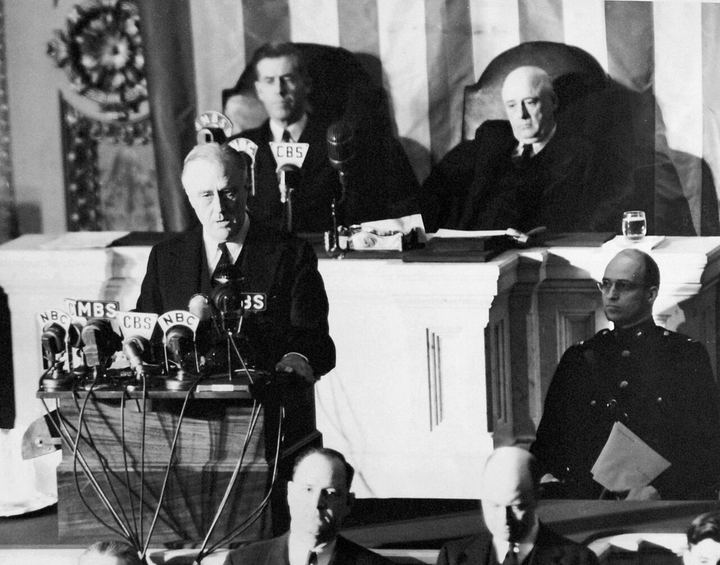
On Sunday morning, 7 December 1941, Japanese carrier aircraft struck the United States Pacific Fleet at Pearl Harbor on Oahu, damaging or sinking all eight battleships in the harbor, destroying much of the aircraft on the island, and killing more than 2,400 Americans. That evening Roosevelt dictated a short draft to his secretary Grace Tully and then revised it by hand. Shortly after noon on Monday, 8 December, he spoke to a joint session of Congress in the House chamber, with a radio audience that was the largest of its time. The address takes about seven minutes. It opens with the date and the charge: the United States was suddenly and deliberately attacked, and the day will live in infamy, a word Roosevelt substituted in his own hand for world history. He then lays out the case for treachery. The nation was at peace and still negotiating at Japan's request; an hour after the bombing began, Japan's ambassador delivered a reply that contained no hint of war; and the distance from Japan to Hawaii proves the attack was planned days or weeks before, while Tokyo deceived Washington with expressions of hope for peace. Next comes a bare litany of the wider offensive: Malaya, Hong Kong, Guam, the Philippine Islands, Wake Island, and Midway, each in its own short paragraph. The facts, Roosevelt says, speak for themselves. As Commander in Chief he has ordered all measures for defense; the nation will remember the character of the onslaught; and the American people in their righteous might will win through to absolute victory. Hostilities exist, he states flatly. He closes with confidence in the armed forces and the people, so help us God, and with the formal request that Congress declare a state of war with the Japanese Empire. The Senate voted 82 to 0 and the House 388 to 1, with Representative Jeannette Rankin the only dissent. Roosevelt signed the declaration that afternoon. Three days later Germany and Italy declared war on the United States.
Virtues in this work
- Fortitude: Roosevelt admits grave danger and very many lives lost, then pledges to see the war through no matter how long it may take.
- Justice: He grounds the declaration in an unprovoked attack made during negotiations, and seeks it through Congress as the Constitution requires.
- Prudence: He keeps the speech brief and factual, letting the list of attacks and the evidence of planning carry the case.
Plot or Argument
- The date and the charge (Paragraph 1)
Roosevelt names the day, brands it with infamy, and states the fact: the United States was suddenly and deliberately attacked by the naval and air forces of the Empire of Japan.
- The evidence of deceit (Paragraphs 2-3)
The nation was at peace and still in talks at Japan's request. The Japanese reply delivered an hour after the bombing began held no threat of war, and the distance from Japan to Hawaii shows the attack was planned long before while Tokyo spoke of peace.
- Damage and the widening offensive (Paragraphs 4-10)
Roosevelt reports severe damage and very many lives lost, then lists the attacks on Malaya, Hong Kong, Guam, the Philippine Islands, Wake, and Midway in short repeated sentences, concluding that the facts speak for themselves.
- Resolve (Paragraphs 11-15)
As Commander in Chief he has ordered all defensive measures. The nation will remember the onslaught and, however long it takes, win absolute victory and ensure that such treachery never again endangers it. Hostilities exist, and he trusts in the forces, the people, and God.
- The request (Paragraph 16)
Roosevelt asks Congress to declare that a state of war has existed with the Japanese Empire since the unprovoked and dastardly attack of Sunday, 7 December.
Key claims
The main steps of the argument, in order, and how they fit together.
- The United States was suddenly and deliberately attacked by Japanese naval and air forces on a day that will live in infamy.How it is supported: Direct statement of the events of Sunday, 7 December 1941.
- The nation was at peace with Japan and still negotiating at Japan's request when the attack came.How it is supported: Japan's diplomatic reply delivered an hour after the bombing began, with no warning of war.
- The distance from Japan to Hawaii proves the attack was planned days or weeks ahead while Japan spoke of peace.How it is supported: Reasoning from the miles of ocean the fleet had to cross.
- Japan has launched a general offensive across the Pacific, and the facts speak for themselves.How it is supported: A list of attacks on Malaya, Hong Kong, Guam, the Philippines, Wake and Midway.
- The nation will remember this onslaught and, however long it takes, win absolute victory so such treachery never threatens again.How it is supported: Appeal to the righteous might of the people, the armed forces and the help of God.
- Hostilities already exist, and as Commander in Chief Roosevelt has ordered all measures for defense.How it is supported: Report of the danger to American people, territory and interests.
Argument map
Supported by
- 1The United States was suddenly and deliberately attacked by Japanese naval and air forces on a day that will live in infamy.
which rests on
- 2The nation was at peace with Japan and still negotiating at Japan's request when the attack came.
- 3The distance from Japan to Hawaii proves the attack was planned days or weeks ahead while Japan spoke of peace.
- 4Japan has launched a general offensive across the Pacific, and the facts speak for themselves.
- 6Hostilities already exist, and as Commander in Chief Roosevelt has ordered all measures for defense.
- 5The nation will remember this onslaught and, however long it takes, win absolute victory so such treachery never threatens again.
Therefore
Plain-language summaries of the author's argument, not quotations.
Lessons
Letting facts carry the argument
Roosevelt makes his case for war almost without adjectives in the middle of the speech. The list of places attacked overnight, one per sentence, does the persuading, and he says so: the facts of yesterday and today speak for themselves. Restraint at the center makes the moral words at the beginning and end weigh more.
- Why might Roosevelt give each place attacked its own short paragraph instead of a single list?
- Which words in the speech are moral judgments rather than reports of fact? Where are they placed?
- Would a longer speech with more detail have been more persuasive or less?
Treachery and the just cause of war
The address rests the justice of war on the manner of the attack as much as its damage: Japan struck while negotiating and sought to deceive the United States with talk of peace. Roosevelt frames the declaration as a response to an unprovoked wrong already done, so that Congress recognizes a war that already exists.
- What evidence does Roosevelt give that the attack was premeditated?
- Why does he ask Congress to declare that a state of war has existed since 7 December rather than that war begins now?
- In the just war tradition, what conditions must be met for a nation to go to war? Which does the speech address?
Memory as a national duty
Roosevelt tells the nation that the date will live in infamy and that the whole nation will always remember the character of the onslaught. The speech does not only ask for a declaration; it fixes how the event will be remembered, joining resolve to remembrance.
- What does Roosevelt want Americans to remember: the losses, the deception, or both?
- How has the phrase a date which will live in infamy shaped the memory of 7 December?
- When is it right for a nation to keep an injury in memory, and when does memory become an obstacle to later peace?
Context
Japan had been at war in China since 1937 and had moved into French Indochina in 1940-1941. The United States responded with embargoes, culminating in the freezing of Japanese assets and the cutoff of oil in the summer of 1941. Negotiations in Washington between Secretary of State Cordell Hull and Ambassador Kichisaburo Nomura, joined by special envoy Saburo Kurusu, continued into December, while the Japanese fleet sailed for Hawaii on 26 November. Within hours of Pearl Harbor, Japan also struck British and American positions across the Pacific and Southeast Asia.
Composition
Roosevelt dictated the first draft to Grace Tully on the evening of 7 December and revised it himself. The typed draft with his handwritten changes survives at the National Archives: a date which will live in world history became a date which will live in infamy, and simultaneously became suddenly. The closing sentence ending so help us God was suggested by Harry Hopkins on the morning of 8 December, under the heading Deity on the second draft, according to National Archives records. The National Archives text stored here reproduces the hyphen after triumph as printed.
Reception
Congress passed the war resolution within about an hour of the speech, Senate 82-0 and House 388-1, and Roosevelt signed it at 4:10 that afternoon. Broadcast audience estimates of the time put it at a large majority of American radio households. Germany and Italy declared war on the United States on 11 December, and Congress answered the same day. The phrase about infamy became the fixed name by which Americans recall the attack.
Comparisons
- we-shall-fight-on-the-beaches
Churchill's speech of June 1940 and Roosevelt's of December 1941 both turn disaster into resolve, but Churchill speaks at length after a retreat while Roosevelt speaks briefly to begin a war.
- fdr-first-inaugural-address
In 1933 Roosevelt asked for power to wage a war against the emergency as if the nation were invaded; in 1941 the invasion was real, and the speech is a fraction of the length.
- give-me-liberty-or-give-me-death
Patrick Henry also told an assembly that the war had already begun and asked it to act; Roosevelt's flat Hostilities exist plays the role of Henry's cry that the war is actually begun.
Quotes
Frequently cited
“Yesterday, December 7, 1941—a date which will live in infamy—the United States of America was suddenly and deliberately attacked by naval and air forces of the Empire of Japan.”
“Last night Japanese forces attacked Hong Kong. Last night Japanese forces attacked Guam. Last night Japanese forces attacked the Philippine Islands.”
“The facts of yesterday and today speak for themselves.”
“No matter how long it may take us to overcome this premeditated invasion, the American people in their righteous might will win through to absolute victory.”
“Hostilities exist. There is no blinking at the fact that our people, our territory, and our interests are in grave danger.”
“With confidence in our armed forces—with the unbounding determination of our people—we will gain the inevitable triumph- so help us God.”
“I ask that the Congress declare that since the unprovoked and dastardly attack by Japan on Sunday, December 7, 1941, a state of war has existed between the United States and the Japanese Empire.”
For Students
A reading companion for classical Christian high school students. See the student guide.
Reading Guide
Watch for
- The placement of a date which will live in infamy between dashes inside the very first sentence.
- The adverbs suddenly and deliberately in Paragraph 1, and deliberately again in Paragraph 3.
- The proof from distance in Paragraph 3: Hawaii is too far from Japan for the attack to have been improvised.
- The litany of Paragraphs 5-9, where Last night and Yesterday repeat and each target stands alone.
- The two-word sentence Hostilities exist, and the shift from fact to resolve that follows it.
Key terms and names
- Infamy
- Lasting public disgrace; Roosevelt's handwritten replacement for world history in the draft's first sentence.
- Joint session
- A meeting of the Senate and House of Representatives together, held in the House chamber, where Roosevelt delivered the address.
- Commander in Chief
- The president's constitutional role over the armed forces, under which Roosevelt says he has already ordered defensive measures.
- Declaration of war
- A formal act that the Constitution reserves to Congress; the address ends by requesting one.
- Oahu
- The Hawaiian island where Pearl Harbor and the headquarters of the Pacific Fleet lay.
- Premeditated
- Planned in advance; Roosevelt's word for the invasion, supported by his argument from distance.
Seminar Questions
- Comprehension What was the state of relations between the United States and Japan on the morning of 7 December, according to Paragraph 2?
- Comprehension Which places does Roosevelt say Japan attacked, and in what order does he list them?
- Interpretation Why does Roosevelt describe the Japanese diplomatic reply in detail? What does it add to the charge against Japan?
- Interpretation What is the effect of the short repeated sentences beginning Last night?
- Interpretation Why does Roosevelt say the people have already formed their opinions? What does that imply about the purpose of the speech?
- Big Question Roosevelt speaks of the righteous might of the American people. What makes a nation's cause righteous in war, and can a nation be righteous in its cause but not in its conduct?
- Big Question Should the power to declare war belong to the legislature rather than the executive? What does this speech show about why the Constitution divides it?
Faith Connections
- Augustine, City of God XIX.7 (Church Fathers)
Augustine teaches that the wise man wages just wars only with grief at the wrong that compels them. Roosevelt's restrained tone, grounded in a wrong already done, sits near that understanding of just cause.
- Thomas Aquinas, Summa Theologiae II-II, q. 40, a. 1 (Great Conversation)
Aquinas names three conditions for a just war: the authority of the sovereign, a just cause such as a wrong inflicted, and right intention. The address supplies the second, and its closing request to Congress observes the first.
- Psalm 20:7 (Scripture)
Some trust in chariots and some in horses, but we will remember the name of the Lord our God. Roosevelt's closing places confidence in armed forces and people and then ends with so help us God, a pairing the psalm invites students to weigh.
- Romans 13:4 (Scripture)
Paul calls the governing authority a minister of God who does not bear the sword in vain. The address shows a constitutional government taking up the sword through its lawful process.
Logic and Rhetoric
Central argument: Japan attacked the United States while at peace and negotiating; the distance involved shows the attack was premeditated and the negotiations deceptive; the attacks across the Pacific show a general offensive; therefore a state of war already exists, and Congress should formally declare it while the nation resolves on absolute victory.
Rhetorical device: Anaphora. In Paragraphs 6-9 Roosevelt opens four consecutive sentences with Last night, each reporting a new attack.
Debate: Resolved: Roosevelt's demand for absolute victory was the right war aim to announce on 8 December 1941.
Memory Work
Yesterday, December 7, 1941—a date which will live in infamy—the United States of America was suddenly and deliberately attacked by naval and air forces of the Empire of Japan.
Hostilities exist. There is no blinking at the fact that our people, our territory, and our interests are in grave danger.
Writing Prompts
Essay: Roosevelt said the facts speak for themselves, yet he chose and arranged them with great care. Analyze how the selection and order of facts in the address turn a report into an argument for war.
Comparison with We Shall Fight on the Beaches: Compare Churchill's address of 4 June 1940 with Roosevelt's of 8 December 1941. How does each leader describe the enemy, the danger, and the certainty of victory, and how does the length of each speech suit its purpose?
Creative Prompts
- Classroom
Compare a facsimile of Roosevelt's typed draft, available from the National Archives, with the delivered text. Discuss each handwritten change and decide what it adds.
- Essay
Roosevelt asks Congress for a declaration of war in about 500 words. Explain how the order of the speech (date, deceit, damage, litany, resolve, request) builds the case, and why he puts the request last.
- Fiction
Write the scene in a family's kitchen on 8 December 1941 as they listen to the address on the radio, with a son of military age at the table.
Further Reading
- At Dawn We Slept: The Untold Story of Pearl Harbor, Gordon W. Prange
The standard detailed history of the planning and execution of the attack.
- Day of Infamy, Walter Lord
A narrative of 7 December built from hundreds of eyewitness accounts.
- Pearl Harbor: FDR Leads the Nation into War, Steven M. Gillon
Follows Roosevelt hour by hour from the first report to the address and the vote.
- A Date Which Will Live: Pearl Harbor in American Memory, Emily S. Rosenberg
Verification notes
The date, timing, vote counts, and the handwritten revision of world history to infamy are well documented in National Archives records. The casualty figure follows the standard count of 2,403 Americans killed. Harry Hopkins's suggestion of the closing sentence is documented in the National Archives drafts. Radio audience figures are period estimates. Paragraph numbers count the sixteen paragraphs after the salutation in the stored text. Quotations keep the stored text's em dashes and the hyphen after triumph.
No verification flags recorded.