Work record
The Popol Vuh (Lewis Spence's account)
c. 1554-1558; Spence 1908 · Renaissance Early Modern · Collection · K'iche'
Abstract
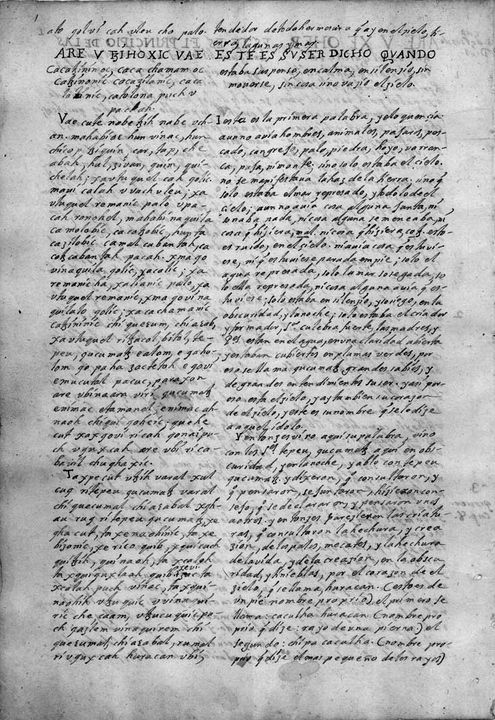
Background. Within a few decades of the Spanish conquest, K'iche' lords set down their people's origins in alphabetic script. Only a Dominican priest's copy from around 1701 survives, and nineteenth-century editors brought it to Europe.
Content. Spence condenses the narrative: the storm god summons land from darkness; a race of carved figures perishes by flood; two divine brothers topple a jewelled braggart; the brothers' parents fall to the death lords; and the young heroes, after surviving a series of deadly chambers, defeat the underworld and send their elders into the sky. Humans of maize then receive their gods, travel and witness the first sunrise.
Commentary. Half the volume argues that the work is authentically American, compares its gods with Mexican ones, sets its creation beside other Native American origin stories, and points to traces of verse composed for chanting and dance.
Limits. Working from French and Spanish versions, Spence omits the earlier people of earth and abridges the dynastic book. His belief that a converted native wrote it in the 1600s has since given way to a date in the 1550s.
Significance. No full public-domain English translation exists, so this 1908 account is the library's stored text; the Maya book itself is the fullest surviving Mesoamerican creation narrative, still honoured by K'iche' communities.
Key figures
- Hurakan: Heart of Heaven, maker of the earth
- Gucumatz: Plumed-serpent creator
- Xmucane: Ancient grandmother of the twins
- Hun-Ahpu and Xbalanque: Hero Twins, blowgun hunters and ball-players
- Vukub-Cakix: Seven Macaw, a vain pretender to the sun
- Xquiq: Underworld princess, mother of the twins
- Hun-Came and Vukub-Came: Death lords of Xibalba
- Lewis Spence: Scottish folklorist who retells and interprets the book

Summary
The Popol Vuh, the Book of the Mat or Council Book, is the sacred and historical book of the K'iche' Maya of highland Guatemala, written in K'iche' by anonymous nobles in the 1550s and preserved in Francisco Ximénez's copy of about 1701. The library's text is not a full translation but Lewis Spence's 1908 English study, which retells and partly translates the first books from Brasseur de Bourbourg's French and Ximénez's Spanish and then comments on them. Spence's First Book opens in primeval darkness, where Hurakan, the Heart of Heaven, calls out the word earth and land appears; with Gucumatz, the feathered serpent, and the ancestral pair Xpiyacoc and Xmucane he makes the animals and then people carved of wood. Because the wooden people do not remember their makers, a flood and a rain of resin destroy them; their dogs, hens, grindstones and cooking pots rise against them, and their descendants are said to be the monkeys of the forest. (The full text also tells of an earlier failed people made of earth, which Spence's summary passes over.) The proud Vukub-Cakix, Seven Macaw, then claims to be sun and moon, until the twin hero-gods Hun-Ahpu and Xbalanque shoot him from his fruit tree; the old pair, disguised as healers, replace his jewelled teeth with maize and take his eyes, and he dies. The twins also defeat his sons Zipacna, the mountain-maker, and Cabrakan, the earthquake. The Second Book goes back to the twins' father and uncle, Hunhun-Ahpu and Vukub-Hunahpu, whose ball-playing draws the lords of Xibalba, the underworld, to summon them; tricked and killed, Hunhun-Ahpu has his head hung in a gourd tree, where it causes the maiden Xquiq to conceive. She flees to Xmucane and bears the twins, who turn their jealous half-brothers into monkeys, find their fathers' ball-game gear, and are summoned in turn. Leaving canes in their grandmother's house that will wither if they die, they outwit the Xibalbans and survive the Houses of Gloom, Lances, Cold, Jaguars and Fire, though Hun-Ahpu loses his head in the House of Bats before he is restored. Finally they let themselves be burned, return from the river as wonder-workers, and destroy the lords of Xibalba by killing them in a feigned trick of revival. Their father and uncle rise as sun and moon. In the Third Book the gods make four men of yellow and white maize, dim their too-perfect sight and give them wives; the people receive the god Tohil and others at Tulan, cross the sea and greet the first dawn. The Fourth Book traces the K'iche' royal lineages. Spence then discusses the cosmogony, gods, metre and early Spanish sources, with notes and a bibliography; the book appeared in London from David Nutt in 1908.
Virtues in this work
- Humility: Vukub-Cakix boasts that his jewelled eyes and teeth make the sun and moon unnecessary, and the twins bring him down.
- Piety: The wooden people are destroyed because they do not think on Hurakan, while the first maize people pray to the Creator for the sun.
- Prudence: The twins send Xan ahead to learn the names of the lords of Xibalba, so they neither bow to the wooden figures nor sit on the red-hot stone.
- Fortitude: The twins pass through the Houses of Lances, Cold, Jaguars and Fire without yielding to the lords of death.
- Charity: Xmucane, at first doubtful, receives the fugitive Xquiq into her home after the miracle of the maize.
Plot or Argument
- Preface and introduction: the manuscript and its people
Spence describes the Popol Vuh as the New World's richest mythological source, recounts how Scherzer found Ximénez's manuscript in Guatemala City and how Scherzer (Spanish) and Brasseur de Bourbourg (K'iche' and French, 1861) published it, explains the title as Book of the Mat or Record of the Community, and sketches the K'iche' language and people.
- The First Book: creation and the wooden people
Hurakan, Gucumatz, Xpiyacoc and Xmucane make the earth and animals, then wooden mannikins who fail to honour them; a flood, a rain of resin and the revolt of their own animals and utensils destroy them.
- The myth of Vukub-Cakix
The twins Hun-Ahpu and Xbalanque humble the boastful Seven Macaw and his wife Chimalmat, then destroy his sons Zipacna, who has killed the four hundred youths, and Cabrakan.
- The Second Book: the first ball-players and the maiden Xquiq
Hunhun-Ahpu and Vukub-Hunahpu are summoned to Xibalba by owl messengers and killed; Hunhun-Ahpu's head in the gourd tree makes Xquiq pregnant, and she escapes to Xmucane, who accepts her after the miracle of the maize.
- The Second Book: the twins in Xibalba
The twins grow up, find the ball-game gear, and descend to Xibalba, where they pass the trials of the houses, die by their own plan, return as wonder-workers, and overthrow the lords One Death and Seven Death (Hun-Came and Vukub-Came); their father and uncle rise as sun and moon.
- The Third and Fourth Books: the maize people and the K'iche' lineages
Four men are made of maize, their sight is dimmed, and four women are made for them; the ancestors receive their gods at Tulan, lose a common speech, migrate, and see the first sunrise on Mount Hacavitz; the last book, in Spence's summary, lists the kings of the three royal houses.
- Spence's commentary
Chapters on the cosmogony and its possible Christian colouring, Kiché and Mexican mythology, the pantheon (Hurakan, Gucumatz, Tepeu), readings of the Vukub-Cakix myth and the descent to Xibalba, the origin of man, early Spanish authors, evidence of metrical composition, a bibliography and notes.
Characters
- Hurakan, Heart of Heaven
Creator god of wind and storm, who calls the earth into being and directs the later creations.
- Gucumatz, feathered serpent
Creator deity in council with Hurakan, linked by Spence with the Mexican Quetzalcoatl.
- Xpiyacoc and Xmucane, ancestral grandparents
Divine elder pair; Xmucane is the grandmother who raises the Hero Twins.
- Hun-Ahpu (Hunahpu), elder Hero Twin
Blowgun hunter and ball-player who defeats Seven Macaw and the lords of the underworld.
- Xbalanque, younger Hero Twin
His brother and partner in every trick and trial.
- Vukub-Cakix (Seven Macaw), proud false sun
Jewelled being who claims to light the world and is brought low by the twins.
- Zipacna and Cabrakan, sons of Vukub-Cakix
Mountain-maker and earthquake, overcome by the twins' stratagems.
- Hunhun-Ahpu and Vukub-Hunahpu, the twins' father and uncle
Ball-players killed in Xibalba who later rise as sun and moon.
- Xquiq, daughter of a lord of Xibalba
Mother of the twins, who disobeys her father and finds refuge with Xmucane.
- Hun-Came and Vukub-Came, lords of Xibalba
Rulers of the underworld who challenge both generations to the ball game.
- Balam-Quitzé, Balam-Agab, Mahucutah and Iqi-Balam, first men
The four ancestors of the K'iche' lineages, made of maize.
- Tohil, tribal god
God received by Balam-Quitzé at Tulan, giver of fire to the K'iche'.
Lessons
Creation and remembrance
In the Popol Vuh the gods make one people after another, seeking beings who will remember and honour their makers. The wooden people are destroyed because they do not think on Hurakan; the maize people, by contrast, pray for the dawn and greet the sun with song.
- Why are the wooden mannikins destroyed, and why do their own dogs, grindstones and pots turn against them?
- What do the gods want from the beings they create?
- Why might it matter that the true people are made of maize?
Pride brought low
Vukub-Cakix believes his jewelled eyes and teeth make the sun and moon unnecessary, and his sons boast of making and unmaking mountains. The twins humble all three, and in Spence's account the false sun loses his glittering teeth and is given maize in their place.
- What exactly is Vukub-Cakix's boast, and why do the gods find it intolerable?
- How do the twins defeat Zipacna and Cabrakan, and what do the methods show about them?
Cunning against death
The Hero Twins succeed where their father and uncle failed, not through strength but through foresight: they send Xan to learn the lords' names, refuse the red-hot seat, and finally turn their own deaths into the trap that defeats Xibalba. The story presents wit, courage and fidelity to the dead as the means of overcoming the powers below.
- What do the twins learn from their father's failure?
- Why do the lords of Xibalba ask to be killed and revived, and why do the twins refuse to revive them?
- What does the rising of the father and uncle as sun and moon add to the story?
Reading a sacred book through a translator
Spence's book is a summary of a summary: he retells a French translation of a K'iche' text copied by a Spanish friar. Students can learn from it how sacred traditions pass through many hands and why scholars return to the original language.
- Which parts of this book are the Popol Vuh's story and which are Spence's opinions?
- What might be lost when a sacred text is known only through summaries and translations?
Context
The K'iche' were the most powerful kingdom of the Guatemalan highlands, with their capital at Q'umarkaj (Utatlán), until the Spanish under Pedro de Alvarado conquered them in 1524. A generation later, members of the K'iche' nobility, having learned the Latin alphabet from missionaries, wrote down their ancestral account of creation, the Hero Twins and their own dynasties, saying that they did so because the ancient book could no longer be seen. The K'iche' and other Maya peoples still live in highland Guatemala, and the Popol Vuh remains for them a treasured record of their ancestors.
Composition
Internal references to K'iche' lords of the mid-16th century date the writing to about 1554-1558. The original is lost; the only surviving text is the K'iche' copy with parallel Spanish made by Francisco Ximénez at Chichicastenango about 1701, now held by the Newberry Library in Chicago. Carl Scherzer published Ximénez's Spanish at Vienna in 1857, and Brasseur de Bourbourg the K'iche' with a French translation at Paris in 1861. Spence, writing in 1908, believed the work had been composed by a Christianized native in the 17th century; later scholarship places it in the 1550s. His summary works from Brasseur's French and Ximénez's Spanish, and his comparisons follow the comparative mythology of the early 1900s.
Reception
Spence's study was one of the first accounts of the Popol Vuh for English readers. Complete English translations followed in the 20th century, notably Adrián Recinos's Spanish version rendered into English by Delia Goetz and Sylvanus Morley (1950) and Dennis Tedlock's translation (1985), both still under copyright. Since the decipherment of Maya hieroglyphs, scholars have recognized the Hero Twins and the maize god on Classic Maya painted vessels many centuries older than the written book, confirming the antiquity of its stories.
Comparisons
- the-bible
Spence notes that the opening resembles Genesis 1, with creation by a spoken word in darkness over the waters, and later finds a likeness to Babel in the confusion of speech at Tulan; he argues the resemblance came from the Christianized setting of the writers rather than deliberate borrowing.
- hesiod-theogony-and-works-and-days
Both explain the present human race as the last of several makings, Hesiod's races of gold, silver and bronze and the Popol Vuh's peoples of wood and maize, and both tell of proud early beings overthrown by younger gods.
- kalevala
Like Lönnrot's epic, the Popol Vuh opens with creation from primeval waters and gives power to the spoken word; both reach English readers through 19th-century collectors and translators.
- epic-of-gilgamesh
Both include a destroying flood sent on an earlier humanity and a hero's journey to the realm of death; Gilgamesh fails to overcome death, while the Hero Twins defeat its lords.
- poetic-edda
Spence compares Vukub-Cakix and his sons, earth-born giants overthrown by young gods, with the Jotuns of Norse myth; the Edda's Völuspá likewise moves from creation to the shaping of the sun and moon.
Quotes
Frequently cited
“Over a universe wrapped in the gloom of a dense and primeval night passed the god Hurakan, the mighty wind. He called out "earth," and the solid land appeared.”
Frequently cited
“These young men were busied at Xibalba with paying fitting funeral honours to their father and uncle, who now mounted to heaven and became the sun and moon, whilst the four hundred youths slain by Zipacna became the stars.”
Frequently cited
“The Creator and Former made four perfect men. These beings were wholly created from yellow and white maize.”
“The "Popol Vuh" is the New World's richest mythological mine.”
“The name "Popol Vuh" signifies "Record of the Community," and its literal translation is "Book of the Mat,"”
“They climbed to the roofs of the houses, but the houses crumbled under their feet; they tried to mount to the tops of the trees, but the trees hurled them from them; they sought refuge in the caverns, but the caverns closed before them.”
“Before their departure they each planted a cane in the middle of the house, which was to acquaint those they left behind with their welfare, since it would wither if any fatal circumstance befel them.”
“These men were too perfect. They knew overmuch.”
For Students
A reading companion for classical Christian high school students. See the student guide.
Reading Guide
Watch for
- The revolt of the animals and household tools against the wooden people in the First Book.
- Every trick the Hero Twins use in Xibalba, beginning with Xan's pricking of the lords to learn their names.
- The canes the twins plant in their grandmother's house, and when they wither and grow green again.
- The point where Spence stops retelling and starts arguing, as in his chapter on the cosmogony.
- The making of the maize people and the clouding of their sight in the Third Book.
Key terms and names
- Popol Vuh
- K'iche' title Spence renders Book of the Mat or Record of the Community; modern translators often call it the Council Book.
- K'iche' (Kiché)
- The Maya people and language of the Guatemalan highlands in which the book was written; Spence uses the older spelling Kiché.
- Xibalba
- The underworld, ruled by Hun-Came and Vukub-Came, reached by a steep road and a river of blood.
- Hurakan
- The Heart of Heaven, the creator god of wind whose word brings the earth out of darkness.
- Ball game
- The Mesoamerican game played with a rubber ball in a walled court; in the story it is the contest between the heroes and the lords of death.
- Tulan
- Tulan-Zuiva or the Seven Caves, where the first men receive their gods and lose their common speech before migrating.
- Milpa
- A maize field cleared from forest; the twins' first labour, undone each night by the animals.
Seminar Questions
- Comprehension In Spence's account, why do the gods destroy the wooden people, and what happens to them?
- Comprehension How do Hun-Ahpu and Xbalanque defeat Vukub-Cakix and his two sons?
- Comprehension How does Xquiq come to bear the twins, and how does she win Xmucane's trust?
- Interpretation Why do the twins succeed in Xibalba where their father and uncle failed?
- Interpretation Why do the gods cloud the sight of the first maize men, and what does that say about the proper place of human beings?
- Interpretation Spence argues that biblical-sounding passages entered the book without design; what evidence does he give, and how convincing is it?
- Big Question What do the creation stories of different peoples share, and what does that suggest about the human search for an origin?
- Big Question How should a reader approach a sacred book known only through a retelling by someone outside the tradition?
Faith Connections
- Genesis 1:1-3 (Scripture)
Genesis opens with darkness over the deep and creation by God's word; Spence's First Book also begins in primeval night with Hurakan calling out the earth, a likeness he himself discusses.
- Genesis 11:1-9 (Scripture)
The confusion of speech among the first men at Tulan recalls the tower of Babel; comparing the two accounts raises the question of how far the writers knew the Bible.
- Acts 17:24-27 (Scripture)
Paul tells the Athenians that God made every nation of men so that they would seek him; the Popol Vuh's first people, praying for peaceable lives and the return of the sun, give a vivid example of such seeking.
- Bartolomé de las Casas, In Defense of the Indians (Great Conversation)
The Dominican Las Casas, of the same order as the friar who preserved the Popol Vuh, argued in the 1550s that the peoples of the Americas were rational nations with true laws and arts, and that their worship, though mistaken, showed a natural seeking after God.
Logic and Rhetoric
Central argument: Spence argues that the Popol Vuh is a genuinely native work: it is written in faultless K'iche', it preserves gods and customs no European of the period could have known, and it fuses several older creation stories; therefore its biblical-seeming features are secondary colouring, not evidence of European invention.
Rhetorical device: tricolon. In the First Book the wooden people's flight is told in three parallel clauses: the houses crumble, the trees hurl them down, and the caverns close before them.
Debate: Resolved: that the Hero Twins win by cunning rather than by courage.
Memory Work
The Creator and Former made four perfect men. These beings were wholly created from yellow and white maize.
Writing Prompts
Essay: Using Spence's First, Second and Third Books, explain what the gods require of the beings they make, and why the wooden people fail and the maize people succeed.
Comparison with Theogony and Works and Days: Compare the successive makings of humanity in the Popol Vuh with Hesiod's five races in Works and Days. Is each story about decline, about improvement, or about something else?
Medical Lens
The medical interest is incidental. In the Vukub-Cakix episode the proud being, wounded in the jaw by the twins' blowgun, is tormented by toothache; the divine grandparents come disguised as healers, persuade him to be operated upon, replace his jewelled teeth with maize and take his eyes, and he dies. The scene shows healers who travel and treat pain, used here as a ruse, and is sometimes cited as an early American reference to tooth extraction, though Spence reads it as an allegory of maize replacing the green turf of the earth. Cabrakan is weakened by a bird poisoned with earth. The twins' final wonders, cutting a man in pieces and restoring him, belong to the poem's theme of death defeated rather than to any medical practice, and the deaths of the lords of Xibalba follow from their wish to experience death and return.
- The myth of Vukub-Cakix (First Book)
Spence's summary of Vukub-Cakix's jaw wound and toothache and the disguised grandparents' false operation on his teeth and eyes.
- The myth of Vukub-Cakix (First Book), close
The twins give Cabrakan a bird poisoned with earth, after which his strength fails.
- The Second Book, the twins' wonders in Xibalba
Spence's account of the twins' self-chosen death, return, and display of killing and restoring men and animals before the lords of Xibalba.
Creative Prompts
- Essay
Compare the three makings of humanity in Spence's account (animals, wooden people, maize people). What is wrong with each attempt before the last, and what do the gods finally want?
- Fiction
Retell the twins' night in one of the Houses of Xibalba (Gloom, Lances, Cold, Jaguars, Fire or Bats) from the point of view of a Xibalban guard.
- Dialogue
Write the conversation in which Xquiq persuades Xmucane to receive her, ending with the miracle of the maize.
- Classroom
Make a two-column chart: one column for statements that come from the Popol Vuh's story and one for Spence's interpretations, using the First Book and his chapter on the cosmogony.
Further Reading
- Popol Vuh: The Definitive Edition of the Mayan Book of the Dawn of Life and the Glories of Gods and Kings, trans. Dennis Tedlock
Complete modern translation from the K'iche' with commentary (1985; revised 1996).
- Popol Vuh: The Sacred Book of the Ancient Quiché Maya, Adrián Recinos, trans. Delia Goetz and Sylvanus G. Morley
The first complete English version (University of Oklahoma Press, 1950).
- Popol Vuh: The Sacred Book of the Maya, trans. Allen J. Christenson
Translation from the K'iche' with full notes (2003).
- The Myths of Mexico and Peru, Lewis Spence
Spence's broader survey of Mesoamerican and Andean myth (1913).
Verification notes
The stored file is Lewis Spence's 1908 study (London: David Nutt), not a translation of the whole Popol Vuh; every quotation is Spence's English, from his preface, introduction or retelling, and each was checked verbatim against the stored Gutenberg text. Speaker fields mark each quote as Spence's. Dating of the K'iche' original (c. 1554-1558), Ximénez's copy (c. 1701) and its present location (Newberry Library, Chicago) follow modern scholarship; Spence's own dating (17th century) and his 1856 date for Scherzer's edition (usually given as 1857) differ and are reported as his. Story details follow Spence's summary, which omits the people of earth and mud described in the full text and abridges Book IV. Spence's comparative-mythology vocabulary of 1908 is reflected only inside quotations, none of which are from those passages.
- Year of Scherzer's Vienna edition of Ximénez's Spanish (1857 in most references; Spence says 1856).
- Lewis Spence's life dates (1874-1955) and the series in which David Nutt issued the 1908 study.
- Publication details of the Christenson translation (2003) before citing.