Work record
Rerum Novarum
1891 · 19th Century · Essays · Latin
Abstract
Background. Factories, mines and great fortunes had remade Western society, and Catholic bishops in Germany, England and America were pressing Rome to speak on wages, unions and the claims of socialism.
Argument. Collective ownership would rob laborers of the very thing they toil to gain, so property must be defended as a right of nature and of the household. Yet owners hold wealth in trust; employers owe fair treatment and adequate pay; and public authority must shield those least able to shield themselves.
Structure. An opening diagnosis of the crisis leads to a refutation of communal property and a defence of the household, then to the Church's teaching on concord between classes and on almsgiving. The second half sets out what governments should do and closes with a long section on unions.
Key Concepts. Labor is both personal and necessary for survival, hence pay must cover a thrifty worker's livelihood. Rest on the Lord's day, limits on hours in mines, protection for the young, spreading ownership widely, and freedom to associate complete the program, which rests finally on charity.
Significance. Successors commemorated it in 1931, 1961, 1981 and 1991, and it inspired Catholic trade unions, Christian democratic parties and the distributist writing of Belloc and Chesterton.
Key figures
- Leo XIII: Elderly pontiff addressing the world's bishops on labor
- Thomas Aquinas: Medieval Dominican cited on ownership and generous use
- Paul the Apostle: Quoted on giving and on love in the final paragraph
- The Socialists: Proponents of collective ownership whose program is refuted
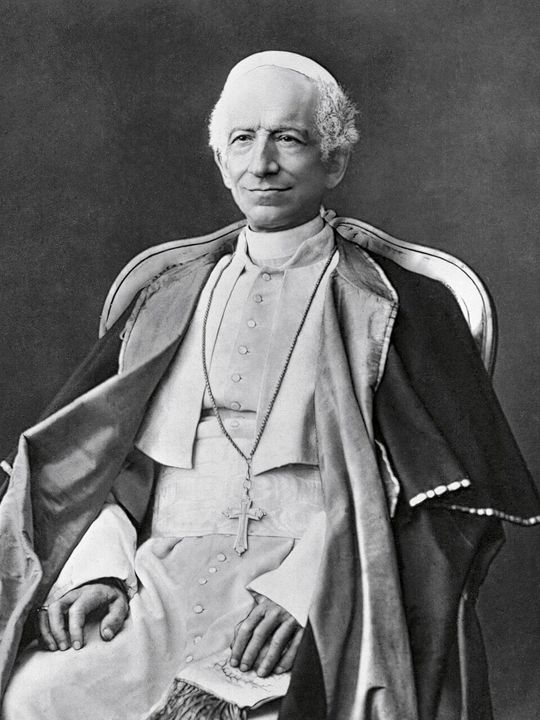

Summary
Rerum Novarum, issued by Pope Leo XIII on 15 May 1891 and addressed to the bishops of the Catholic world, takes its Latin title from its opening words about the spirit of revolutionary change. Its English title is On the Condition of the Working Classes. It was the first papal encyclical devoted entirely to the questions raised by industrial capitalism, and it is usually treated as the founding document of modern Catholic social teaching. The library text is the anonymous English translation printed in The Great Encyclical Letters of Pope Leo XIII (Benziger Brothers, 1903), with its footnote references removed. Leo begins by describing the crisis: the growth of industry, the changed relations between masters and workmen, enormous fortunes beside general poverty, and the abolition of the old guilds, which has left working men isolated and exposed to the hard-heartedness of employers and to unchecked competition. A small number of very rich men, he says, have laid on the laboring poor a yoke little better than slavery. He then rejects the socialist remedy of abolishing private property. A wage-earner works in order to own; his savings invested in land are his wages in another form, so community of goods would injure the very workers it claims to help. Property is a natural right, because man, unlike the animals, provides for the future by reason, and because a father must provide for his family. The family is a society prior to the State, and the State may help it in grave need but may not absorb it. Communism would bring envy, discord and a levelling down of all to misery. The remedy lies first with the Church. Inequality of capacity is natural, labor carries the penalty of the Fall, and the notion that class is naturally hostile to class is false: capital and labor need each other. Religion teaches workers to keep fair agreements and avoid violence, and employers to respect each worker's dignity, not to overburden him, and to pay a just wage. Wealth is to be held as a stewardship, and what remains after one's needs and station are met is owed to the poor in charity. The State must also act, for the good of the whole and with particular care for the poor. It should protect property and keep the peace in strikes, but also guard workers' souls and bodies: Sunday rest, hours suited to the strength of each kind of work (shorter in mines and quarries), protection of children and women, and a wage sufficient to support a frugal and well-behaved worker. Laws should help as many as possible to become owners. Finally Leo praises workingmen's associations, natural societies the State must not forbid, and urges Catholics to form unions guided by religion, ending with a call to charity, the queen of the virtues.
Virtues in this work
- Justice: Leo insists that a wage must suffice for a frugal and well-behaved worker, whatever the bargain says.
- Charity: The encyclical ends by calling charity the queen of virtues and the chief source of the remedies it proposes.
- Industry: Leo calls labor an honorable calling and pictures the worker saving his wages to buy a small estate for his family.
- Piety: Sunday rest is defended as owed to God, a right the worker cannot surrender even if he wished.
Plot or Argument
- The new conflict and its causes
The encyclical opens with the spread of revolutionary change from politics to economics: industrial expansion, new science, enormous fortunes for a few and poverty for the many, and workers' growing combination. The guilds were abolished in the previous century, public institutions have set aside religion, and usury and the concentration of trade have left working men isolated. Leo sets out to define the rights and duties of rich and poor, capital and labor.
- Against community of goods: property as a natural right
The socialist plan to transfer property to the State or municipalities would hurt the wage-earner, who works to acquire property and who has a right to dispose of his wages, including by buying land. Property belongs to man by nature because reason lets him provide for the future; God gave the earth to all mankind without assigning parts, leaving division to human industry and law, and the earth still serves everyone through labor. Leo cites Thomas Aquinas that private ownership is lawful and necessary.
- The family before the State
The family is a true society, older than the State, with rights and duties of its own. A father is bound by nature to provide for his children and can do so securely only by owning property he can hand on. The State may step in when a family is in extreme need or its members' rights are gravely violated, but paternal authority can be neither abolished nor absorbed by the State. Socialism would therefore wrong the family and bring envy, discord and general misery.
- The Church's remedy: classes in concord
No solution is possible without religion. Differences of capacity and fortune are natural, and toil and suffering are part of life after the Fall. Class is not naturally hostile to class; like the members of a body, capital and labor need each other. Religion binds workers to fulfil fair agreements, not damage property and avoid violence, and binds employers to treat workers as men and Christians, to leave time for religion and family, not to tax their strength beyond due measure, and to pay just wages.
- Riches, charity and the dignity of labor
Leo distinguishes the right to own from the right use of property: following Aquinas, possessions are to be shared when others are in need, and what remains after necessity and station is due to the poor as a duty of charity rather than enforceable justice. Christ chose to be a carpenter's son, so poverty is no disgrace, and the Church has always founded works for the relief of the poor.
- The duties of the State
Rulers must promote the prosperity of all through good laws, morals, family life and fair taxes, and give particular care to the poor and helpless, who have fewer means to defend themselves. The State should protect property and prevent agitators from inciting violence, and should remove the causes of strikes. It must protect the worker's soul (Sunday and holy-day rest) and body: hours suited to the work, the season and the worker's strength; shorter hours in mines and quarries; no factory work for children before their bodies and minds are developed; and work suited to women. A wage must suffice for a frugal and well-behaved worker, and a contract that forces less is an injustice. Law should encourage wide ownership of property, and taxation must not confiscate it.
- Associations of employers and workmen
Mutual-aid societies, benevolent foundations and especially workingmen's unions can do much, as the old guilds once did. The right to form private associations is natural, and the State may forbid them only when their aims are plainly unlawful or dangerous. Leo warns against secret societies hostile to religion, urges Catholic workers to form their own associations, and sets out their aims: the moral and religious good of members, mutual help, fair settlement of disputes and provision for sickness, old age and misfortune.
- Conclusion: charity, the queen of virtues
Leo calls on bishops, clergy and all Catholics to work for the good of the people, and above all to cherish and spread charity, citing Paul's description of love in 1 Corinthians 13, before giving the Apostolic Benediction.
Characters
- Thomas Aquinas, authority cited
Quoted on the lawfulness of private property, on the use of possessions as common to all in need, and on the child's place under its parents' care.
- Paul the Apostle, authority cited
Cited on the duty of the rich to share and on charity as patient and kind, in the encyclical's final lines.
- The Socialists, opponents
The movement whose plan of common property administered by the State or municipalities Leo rejects as unjust and injurious to workers.
- The workingmen, subject
The wage-earners of industrial Europe and America, whose wages, hours, families and associations are the encyclical's main concern.
Lessons
Property serves the worker and the family
Leo argues that private ownership is not the possession of the rich alone but the natural goal of the worker's labor and the means by which a father provides for his children. He therefore wants laws that make as many people as possible owners rather than abolishing ownership.
- Why does Leo say the land a worker buys with his savings is only his wages in another form?
- How does the family's priority to the State support Leo's argument for property?
- What does Leo mean by saying the earth, though divided among owners, still serves the needs of all?
Ownership and right use are different questions
The right to own does not settle how one should use what one owns. Following Aquinas, Leo teaches that goods are held for others too, and that what remains after one's needs and station have been met is owed to the poor by charity, a duty beyond what human law enforces.
- Why does Leo call almsgiving a duty of charity rather than of justice, except in extreme cases?
- What does it mean to keep up one's condition in life becomingly, and where does that limit lie?
- How does Christ's choice to be a carpenter's son shape Leo's view of poverty and labor?
A wage is more than a bargain
Leo grants that wages are agreed freely, but holds that a deeper law of natural justice requires a wage sufficient to support a frugal and well-behaved worker. A man who accepts less because he has no alternative is a victim of force, not a free party to a fair contract.
- What two features of labor (personal and necessary) does Leo use to show that a worker cannot simply accept any wage?
- Who, according to Leo, should settle questions such as hours and wages in particular trades: the State, or associations and boards?
- Is a contract freely signed always a just contract?
Concord between classes, not war
Leo rejects the idea that rich and poor are natural enemies. Like the members of one body, capital and labor need each other, and religion gives each a set of duties toward the other. The State, the Church and voluntary associations all have parts to play.
- What duties does Leo give to workers, and what duties to employers?
- Why does he think workingmen's associations are a natural right that the State should not suppress?
- Can concord between classes be achieved without shared religious belief, in Leo's view?
Context
By 1891 industrialization had transformed much of Europe and North America, and the 'social question' of wages, hours, housing and child labor was debated by liberals, socialists and churchmen. The guilds had been suppressed in France in 1791 and later elsewhere. Catholic social thinkers such as Bishop Wilhelm Emmanuel von Ketteler of Mainz, the study circle known as the Fribourg Union, Cardinal Manning in England (who mediated the London dock strike of 1889) and Cardinal Gibbons in the United States (who defended the Knights of Labor at Rome) had urged the Church to address workers' conditions. Leo XIII, who had served in industrial Belgium, chose to speak with the full authority of an encyclical.
Composition
The encyclical was prepared over several drafts in 1890–1891. The Jesuit Matteo Liberatore wrote an early draft, and Cardinal Tommaso Zigliara and others revised it; the final Latin text was signed at St. Peter's on 15 May 1891. English translations appeared at once; the library text comes from the collected Great Encyclical Letters of Pope Leo XIII published by Benziger Brothers in New York in 1903.
Reception
Catholic labor associations, Christian democratic parties and social Catholic movements across Europe and the Americas appealed to the encyclical. Later popes marked its anniversaries with their own social encyclicals, notably Pius XI's Quadragesimo Anno (1931), which gave the principle of subsidiarity its classic formulation, and John Paul II's Centesimus Annus (1991). Writers such as G. K. Chesterton and Hilaire Belloc drew on its call for widespread ownership in developing distributism. Historians differ on how far it was a defence of property against socialism and how far a charter for labor; most read it as both.
Comparisons
- centesimus-annus
John Paul II wrote for the encyclical's hundredth anniversary in 1991, rereading its defence of property and of workers' associations after the collapse of the Soviet bloc and adding reflections on the market economy.
- the-communist-manifesto
Marx and Engels in 1848 called for the abolition of bourgeois property and described history as class struggle; Leo answers both claims directly, defending property as natural and calling class hostility a great mistake.
- the-wealth-of-nations
Smith's account of wages set by the bargaining of masters and workmen, in which masters usually have the advantage, is the market background against which Leo insists on a wage sufficient for a frugal worker's support.
- summa-theologica
Leo's teaching that private property is lawful and necessary yet its use should be common in need comes directly from Aquinas, II-II, q. 66, which he quotes.
- hard-times
Dickens's Coketown (1854) dramatizes the factory hands, long hours and indifferent masters that Leo addresses in principle forty years later.
- kuyper-lectures-on-calvinism
Abraham Kuyper, a Dutch Reformed statesman, opened the first Christian Social Congress in Amsterdam in 1891, the same year as Rerum Novarum, and his idea of sphere sovereignty offers a Protestant parallel to Leo's limits on the State's reach into family and association.
Quotes
“a small number of very rich men have been able to lay upon the teeming masses of the laboring poor a yoke little better than that of slavery itself.”
“For every man has by nature the right to possess property as his own.”
“Man precedes the State, and possesses, prior to the formation of any State, the right of providing for the sustenance of his body.”
“The great mistake made in regard to the matter now under consideration is to take up with the notion that class is naturally hostile to class, and that the wealthy and the workingmen are intended by nature to live in mutual conflict.”
“Those who work in mines and quarries, and extract coal, stone, and metals from the bowels of the earth, should have shorter hours in proportion as their labor is more severe and trying to health.”
“remuneration ought to be sufficient to support a frugal and well-behaved wage-earner.”
“The law, therefore, should favor ownership, and its policy should be to induce as many as possible of the humbler class to become owners.”
“charity, the mistress and the queen of virtues.”
For Students
A reading companion for classical Christian high school students. See the student guide.
Reading Guide
Watch for
- The opening paragraphs, where Leo names the causes of the crisis, including the abolition of the guilds and the setting aside of religion in public institutions.
- The argument that land bought with savings is the worker's wages in another form, which turns the socialist case against the worker himself.
- The image of capital and labor as members of one body, and the lists of duties for workers and for employers that follow it.
- The section on the State's duties, especially Sunday rest, hours in mines and quarries, children's work and the just wage.
- The defence of workingmen's associations as a natural right, and the encyclical's closing call to charity.
Key terms and names
- Encyclical
- A circular letter from the pope to the bishops of the Church, named from its opening Latin words; Rerum Novarum means of new things or of revolutionary change.
- Community of goods
- The socialist proposal, as Leo describes it, to transfer private possessions to the State or municipal bodies; he calls it the main tenet of socialism and rejects it.
- Natural right
- A right that belongs to persons by nature rather than by grant of the State; Leo applies it to property, to the family and to forming associations.
- Just wage
- In Leo's teaching, a wage sufficient to support a frugal and well-behaved worker, owed by natural justice even when a worker would accept less.
- Workingmen's associations
- Unions and mutual-aid societies of workers, which Leo compares to the old guilds and treats as a natural right the State should protect.
- Guilds
- The medieval associations of craftsmen, abolished in the 18th century, whose disappearance Leo blames for leaving workers isolated.
- Stewardship of wealth
- Leo's teaching, from Aquinas, that one should hold outward possessions as common to all in need and give from what remains over.
Seminar Questions
- Comprehension What causes does Leo give at the beginning for the misery of the working classes?
- Comprehension What reasons does Leo give for rejecting the socialist plan of community of goods?
- Comprehension What does Leo say the State should do about hours, Sunday rest, children's work and wages?
- Interpretation Why does Leo say a worker who accepts a wage below what he needs, from necessity or fear, is a victim of force and injustice?
- Interpretation How does Leo's comparison of society to a human body shape his view of the relation between rich and poor?
- Interpretation Leo calls the duty to give from one's surplus a duty of charity, not of justice. What difference does this distinction make?
- Big Question Is it better for a society to have many small owners or a few large ones, and why?
- Big Question What should the State do for the poor, and what should it leave to families, churches and associations?
Faith Connections
- 1 Timothy 6:17-18 (Scripture)
Leo, quoting Aquinas, cites Paul's charge to command the rich of this world to give readily and share, the scriptural basis for his teaching on the right use of wealth.
- Exodus 20:8-11 (Scripture)
Leo grounds Sunday rest in the commandment to keep holy the Sabbath and in God's rest after creation, arguing that the worker's rest belongs to the rights of God.
- 1 Corinthians 13:4-7 (Scripture)
The encyclical closes with Paul's portrait of charity as patient and kind, enduring all things, to name the virtue on which every other remedy depends.
- Thomas Aquinas, Summa Theologiae II-II, q. 66, aa. 2 and 7 (Church Fathers)
Aquinas teaches that private possession is lawful and necessary for human life, but that in use things should be held as common and shared with those in need, the double teaching Leo adopts.
Logic and Rhetoric
Central argument: Every person has a natural right to property, rooted in reason and in the duty to provide for a family, so abolishing private property would wrong the worker himself. Rich and poor are not natural enemies but need each other. Therefore the condition of workers must be remedied not by class war or community of goods, but by religion teaching mutual duties, by a State that protects the weak with laws on rest, hours and just wages and encourages wide ownership, and by free associations of workers and employers.
Rhetorical device: analogy. In the section on the Church's remedy, Leo compares the classes to the members of the human body, whose symmetry comes from their right disposition, to argue that capital and labor need each other (see quote 3).
Debate: Resolved: That the State has a duty to require a wage sufficient to support a frugal worker and his family.
Memory Work
Man precedes the State, and possesses, prior to the formation of any State, the right of providing for the sustenance of his body.
charity, the mistress and the queen of virtues.
Writing Prompts
Essay: Leo rejects both the abolition of property and an unregulated labor market. Explain his reasons for each rejection and argue whether his proposed remedies hold together as one position.
Comparison with The Communist Manifesto: Compare the Manifesto's account of property and class struggle with Leo's account in Rerum Novarum. Where do the two agree about the condition of industrial workers, and where do their remedies divide?
Medical Lens
The encyclical is a document in the history of occupational health as much as of economics. In its section on the State's duties Leo argues that hours must be measured by the worker's health and strength, that miners and quarrymen should work shorter hours because their labor is more trying to health, that the season of the year matters, and that children should not enter workshops and factories until body and mind are sufficiently developed. He compares premature toil to rough weather that destroys the buds of spring. These positions belong to the 19th-century campaigns for factory and mine legislation (for example the British Factory Acts) and to Catholic social thought; Leo frames them as duties of justice owed to the body as well as the soul. The just-wage passage ties wages to the worker's subsistence and that of his family.
- The duties of the State, on hours of labor
Hours to be fitted to the worker's strength, the nature of the work and the season; shorter hours for those in mines and quarries.
- The duties of the State, on children and women
Children not to be put to factory work before their bodies and minds are developed; work to be suited to sex and age.
- The duties of the State, on wages
Wages must be enough for the worker's support; the duty of preserving life makes labor necessary as well as personal.
Creative Prompts
- Classroom
Make a chart with three columns, the duties of workers, the duties of employers, and the duties of the State, and fill it only with what Leo actually says. Then discuss which column is longest and why.
- Dialogue
Stage a conversation in 1891 between a factory owner, a socialist organizer and a parish priest who has just read the encyclical, each responding to its argument on property and wages.
- Essay
Leo says the State may protect the family in grave need but may not absorb it. Using his text, explain where he draws that line and test it against one example of public policy.
- Fiction
Write a short story about a coal miner's family in 1891 who hear the encyclical read from the pulpit, showing what its passages on hours, Sunday rest and ownership would mean to them.
Further Reading
- Quadragesimo Anno, Pope Pius XI
The 1931 encyclical on the fortieth anniversary of Rerum Novarum.
- Compendium of the Social Doctrine of the Church, Pontifical Council for Justice and Peace
A 2004 summary of Catholic social teaching that traces its development from Leo XIII.
- The Servile State, Hilaire Belloc
Belloc's 1912 argument for widely distributed property, influenced by the encyclical.
- Catholic Social Teaching, 1891–Present, Charles E. Curran
Verification notes
Date, addressees and the main contents are standard. The stored Benziger text has no paragraph numbers, so locators name the section of the argument; the Vatican edition's numbered paragraphs are not used here. The stored text contains a few scanning slips (for example 'cannot cannot', 'enjoyroent'), so quotations were chosen from clean passages; all eight were found by search in content/texts/rerum-novarum.txt and copied exactly. The roles of Liberatore and Zigliara in drafting are widely reported in histories of the encyclical. Quadragesimo Anno's statement of subsidiarity, and the influence on distributism, are standard.
- The precise sequence of drafts and drafters (Liberatore, Zigliara, Mazzella, Volpini) behind the final Latin text.
- Paragraph numbers in the Vatican English edition for each quotation, if numbered citations are wanted.