Work record
The Pilgrim's Progress
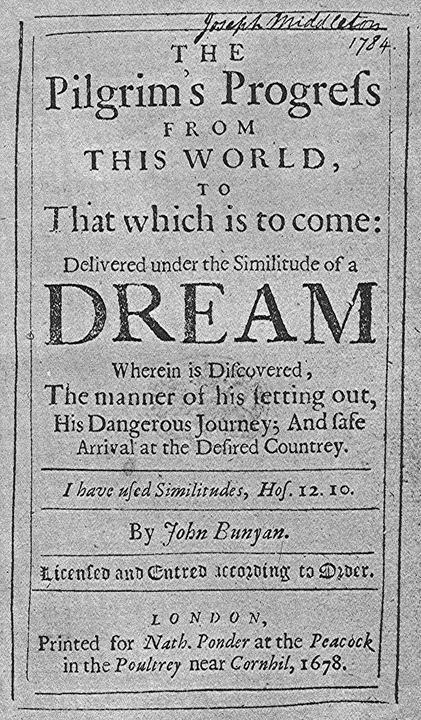
1678 · Renaissance Early Modern · Religious Scripture · English
Abstract
Background. John Bunyan, a Bedfordshire tinker and Nonconformist preacher, was jailed after the Restoration for preaching without a licence. Tradition places the allegory's conception in Bedford jail, though when he wrote it is uncertain.
Audience. Bunyan wrote for ordinary readers steeped in the English Bible, and his prefatory verse defends teaching truth by similitude.
Content. The narrator dreams of Christian, weighed down by sin, who leaves the City of Destruction at Evangelist's direction. He sinks in the Slough of Despond, is misled by Worldly Wiseman, enters by the Wicket Gate, is taught at the Interpreter's House, and loses his burden at the Cross. He climbs Hill Difficulty, fights Apollyon and crosses the Valley of the Shadow of Death. After Faithful's martyrdom at Vanity Fair, Christian and Hopeful escape Doubting Castle with the key called Promise and pass over the river into the Celestial City.
Teaching. The road dramatizes Puritan conversion and perseverance: grace received, assurance tested, and faith sustained by companions and Scripture. Each place name, from Doubting Castle to the Delectable Mountains, gives a spiritual state a location a reader can remember.
Significance. For generations the most widely read English book after the Bible, it was translated into many languages and shaped both popular devotion and the English novel.
Key figures
- Christian: Burdened pilgrim who flees the City of Destruction
- Evangelist: Guide who points Christian toward the Wicket Gate
- Mr. Worldly Wiseman: Smooth adviser who sends Christian toward the village of Morality
- The Interpreter: Host whose house shows Christian instructive scenes
- Apollyon: Fiend whom Christian fights in the Valley of Humiliation
- Faithful: Fellow pilgrim martyred at Vanity Fair
- Hopeful: Companion who joins Christian after Faithful's death
- Giant Despair: Master of Doubting Castle, who imprisons the two pilgrims
- Christiana: Christian's wife, whose pilgrimage is told in Part II

Watch the summary
The Pilgrim's Progress in 87 seconds · 1:27
Summary
John Bunyan’s The Pilgrim’s Progress (1678) is the dream-allegory of Christian fleeing the City of Destruction with a burden on his back, seeking the Celestial City through Slough, Wicket Gate, Hill Difficulty, Vanity Fair, and Doubting Castle. Written by a tinker-preacher in prison, it became the English-speaking world’s most widely read religious narrative after Scripture. Give despair an address on a student map: Doubting Castle must be named to be fled. Faithful’s witness and Hopeful’s help show that pilgrimage is companionship without borrowed feet. Vanity Fair still mirrors crowds that hate pilgrims for refusing the market’s gods. In the dream that Bunyan narrates, Christian reads in his book that his city will be destroyed, and when his family will not listen he runs from home, stopping his ears against their calls. Evangelist sends him toward the gate; Pliable turns back at the first mire, and Mr. Worldly Wiseman tempts him toward the village of Morality before Evangelist sets him right again. At the Interpreter's House he is shown scenes that teach patience, grace and perseverance, and at the Cross his burden rolls away into a sepulchre, after which three Shining Ones give him new garments and a sealed roll. On Hill Difficulty he sleeps in an arbour and loses the roll, so he must retrace his steps; at the Palace Beautiful he is armed for the road ahead. In the Valley of Humiliation he defeats Apollyon, and he passes through the darkness of the Valley of the Shadow of Death alone before Faithful overtakes him. At Vanity Fair the townspeople put both men on trial; Faithful is condemned and dies a martyr, and Hopeful, moved by that witness, becomes Christian's new companion. Leaving the road for the easier By-path Meadow, the two are captured by Giant Despair until Christian remembers the key he has carried all along. Shepherds on the Delectable Mountains warn and encourage them, and at last they cross the river, where Christian nearly loses heart, and are received at the gate of the Celestial City.
Virtues in this work
Plot or Argument
- Flight with a burden
Christian leaves home under conviction and seeks the wicket gate.
- Road of trials
Named places test fear, pride, despair, and worldly show.
- Companions and City
Faithful’s witness and Hopeful’s help lead toward the Celestial City.
Characters
- Christian, protagonist
Pilgrim fleeing destruction toward the Celestial City.
- Faithful, companion
Fellow pilgrim who witnesses even unto death.
- Hopeful, companion
Companion who helps Christian after Faithful’s martyrdom.
Lessons
Named temptations
Bunyan’s places make spiritual dangers concrete enough to watch for.
- Which place frightens you most?
- What does naming a temptation do?
Companionship on the way
Faithful and Hopeful show that pilgrimage is not meant to be solitary egoism.
- How does Faithful die?
- How does Hopeful steady Christian?
Burden and Cross
Relief comes at the Cross, not by self-improvement alone.
- When does the burden fall?
- What changes afterward?
Context
English Puritan allegory of salvation as pilgrimage, born from prison witness. It remains a formative English-language classic for school and home in the public domain.
Composition
Part I published 1678; Part II follows Christiana later.
Reception
Among the most reprinted English books; school and home staple.
Comparisons
- robinson-crusoe
Providence under ordeal in a different narrative form and age.
- aesops-fables
Plain moral narrative that names vices and virtues on the road.
Quotes
“As I walked through the wilderness of this world, I lighted on a certain place where was a Den, and I laid me down in that place to sleep: and, as I slept, I dreamed a dream.”
“I dreamed, and behold, I saw a man clothed with rags, standing in a certain place, with his face from his own house, a book in his hand, and a great burden upon his back.”
For Students
A reading companion for classical Christian high school students. See the student guide.
Reading Guide
Watch for
- Opening dream and the burdened man.
- The Slough of Despond and help out of it.
- Vanity Fair’s hostility to pilgrims.
- Doubting Castle and Giant Despair.
- How the burden falls at the Cross.
Key terms and names
- Allegory
- Story whose places and persons stand for spiritual realities.
- Burden
- Christian’s conviction of sin carried on his back.
- Celestial City
- The heavenly end of the pilgrimage.
- Vanity Fair
- Worldly marketplace hostile to pilgrims.
Seminar Questions
- Comprehension How does the book begin—what does the dreamer see?
- Comprehension Name three places on the road.
- Comprehension Who are Faithful and Hopeful?
- Interpretation Why use allegory instead of a sermon only?
- Interpretation How do companions differ from false counselors?
- Interpretation What does despair look like in Doubting Castle?
- Big Question What must a pilgrim refuse in order to finish the road?
Faith Connections
- Hebrews 11:13 (Scripture)
Strangers and pilgrims on the earth toward a city.
- Psalm 23:4 (Scripture)
Valley of the shadow—fear faced with a companion.
- Puritan allegory (Great Conversation)
Named places as states of soul on the way.
Logic and Rhetoric
Central argument: The Christian life is a journey through named trials toward a real City.
Rhetorical device: allegory. Places externalize inward states.
Debate: Resolved: that hope is a companion, not a mood only.
Memory Work
As I walked through the wilderness of this world, I lighted on a certain place where was a Den, and I laid me down in that place to sleep: and, as I slept, I dreamed a dream.
Writing Prompts
Essay: Map five places and the temptation each names.
Comparison with Robinson Crusoe: Compare Bunyan’s road with Crusoe’s island: how does each picture providence?
Medical Lens
Despair is spiritual allegory, not a clinical manual.
Listen to the book
Public-domain audiobook from LibriVox, read by MaryAnn. Recording: Pilgrim's Progress (version 2) on LibriVox (Internet Archive).
LibriVox recordings are volunteer readings released into the public domain. The reading may follow a different edition from the text in this library.
Creative Prompts
- Classroom
Draw a road map of five places with one-line warnings.
- Essay
How does Hopeful help when argument alone fails?
- Fiction
A new named place on the road and how pilgrims pass it.
Further Reading
- Paradise Lost, John Milton
Epic companion in English Christian imagination.
Verification notes
Plot, characters, and publication facts for The Pilgrim's Progress follow standard sources. Quotes verified against the attached Gutenberg text.
No verification flags recorded.