Work record
The Red Badge of Courage
1895 · 19th Century · Novel · English
Abstract
Background. A New York newspaperman in his early twenties, Crane had never seen combat when he composed this episode, working from veterans' talk and published reminiscences. A cut version reached readers through syndicated papers before Appleton issued the full text.
Plot. Fearful that he will bolt, a farm-bred recruit stands through one assault and then deserts the line during the next. Wandering behind the front, he sees a corpse in a pine grove, witnesses a friend's agonized end, and slips away from a hurt companion. A blow from a retreating soldier's musket gives him a wound he passes off as honorable; the following day he becomes the regiment's standard-bearer in its charges.
Method. Events reach the reader only through the recruit's shifting perceptions, rendered in vivid colors, animal similes and abrupt fragments, while commanders and strategy stay out of view and the battle goes unnamed. Dialogue keeps the soldiers' rural dialect.
Themes. Fear and its rationalizations, the gap between private guilt and public reputation, comradeship, and an indifferent natural world that offers no verdict on human conduct.
Significance. Acclaimed first in Britain, it made its author famous at twenty-four, set a pattern for twentieth-century war fiction centered on the common soldier, and remains a staple of American high school reading.
Main characters
- Henry Fleming: Untested Union private, called the youth
- Jim Conklin: Calm tall soldier, mortally wounded on the first day
- Wilson: Braggart recruit who becomes a humble, loyal comrade
- The tattered soldier: Wounded stranger whose kindly questions torment Henry
- The cheery soldier: Stranger who steers the dazed Henry home through the dark
- Lieutenant Hasbrouck: Fiery company officer who later commends Henry

Summary
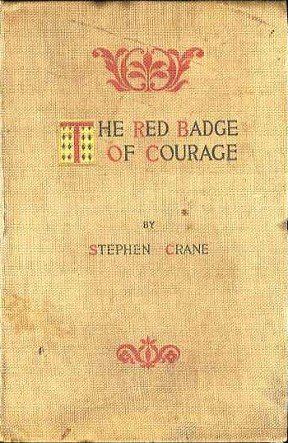
The Red Badge of Courage follows Henry Fleming, a young private of the 304th New York, through two days of fighting in an unnamed Civil War battle that readers have long identified with Chancellorsville in May 1863. Crane calls him almost always simply the youth. As the novel opens, the army is camped along a river in spring, and the tall soldier, Jim Conklin, comes back from washing a shirt with a rumor that they will move at last. Henry had enlisted against his mother's wishes, dreaming of Greeklike struggles; she sent him off while peeling potatoes, with knitted socks, a cup of blackberry jam and plain advice to do his duty. Now he lies awake wondering whether he will run. In the first engagement he fires mechanically and the regiment holds, but when the enemy charges a second time he panics, throws down his rifle and flees into the woods. There he tells himself that he saved himself sensibly, throws a pine cone at a squirrel and takes its flight as a law of nature, and then stumbles into a green chapel of boughs where a dead soldier sits against a tree with ants crawling on his face. Joining a column of wounded men, he is shamed by the gentle questions of a tattered soldier about where he is hit. He finds Jim Conklin mortally wounded, follows him into a field and watches him die in a terrible upright convulsion, then abandons the tattered man, who is wandering in a daze. Henry half wishes for a wound of his own. He gets one by accident: a panicking Union soldier clubs him on the head with a rifle butt. A cheerful stranger leads him back to his regiment, where he claims to have been shot, and his friend Wilson, once a loud braggart and now quietly changed, binds his head and gives him his own blankets. The next day Henry fights in a kind of fury. Sent for water with Wilson, he overhears a general call the regiment mule drivers who can be spared. In the charge that follows Henry seizes the colors from a dying color sergeant, and later Wilson captures a Confederate flag at a rail fence. As the regiment marches away in the rain, Henry recalls his desertion of the tattered man with shame, but feels a quiet manhood. The novel appeared in abridged form in newspapers through the Bacheller syndicate in December 1894 and as a book from D. Appleton and Company in New York in the autumn of 1895, subtitled An Episode of the American Civil War.
Virtues in this work
- Fortitude: On the second day Henry takes up the colors from the dying color sergeant and carries them forward through the charge and the retreat.
- Friendship: Wilson nurses the returning Henry with coffee, a wet handkerchief bandage and his own blankets without questioning his story.
- Humility: Wilson returns from the first day stripped of his boasting and later asks Henry for his packet of letters with plain embarrassment.
- Charity: The tattered soldier, badly wounded himself, worries about Henry's supposed wound and about Jim Conklin, and Henry's desertion of him becomes the sin he cannot forget.
Plot or Argument
- Chapters I-III: Rumors, the mother's farewell, the march
Jim Conklin's rumor stirs the camp; Henry remembers enlisting and his mother's farewell, worries whether he will run, and marches with the regiment across a river toward battle, where the loud soldier Wilson gives him a packet of letters in case he is killed.
- Chapters IV-V: The first engagement
Under fire for the first time, Henry loses himself in the work of loading and firing, becomes not a man but a member, and the regiment repulses the attack.
- Chapter VI: The flight
When the enemy comes on again, Henry sees men running, throws down his rifle and flees to the rear, and then learns that the line held without him.
- Chapters VII-VIII: The forest chapel and the wounded
Henry justifies himself by the fleeing squirrel, meets the seated corpse in the chapel of boughs, and joins a procession of the wounded, where the tattered soldier asks him where he is hit.
- Chapters IX-X: The death of Jim Conklin
Henry finds the tall soldier dying, watches him stride into a field and fall, then abandons the tattered man and wishes for a red badge of his own.
- Chapters XI-XIII: The wound and the return
Watching a rout, Henry is struck on the head by a fleeing soldier's rifle; the cheery man guides him back, and Wilson, believing he was shot, nurses him at the campfire.
- Chapters XIV-XVII: The next morning
Henry notices how Wilson has changed, keeps the packet of letters as a secret advantage, grumbles at the generals and then fights so savagely that his comrades call him a war devil.
- Chapters XVIII-XX: Mule drivers and the colors
Henry and Wilson overhear a general dismiss the regiment as mule drivers; in the charge Henry takes the flag from the falling color sergeant and carries it through the retreat.
- Chapters XXI-XXIII: Mud diggers and the fence
A general rebukes Colonel MacChesnay for stopping short, but the lieutenant praises Henry and Wilson; in the final charge on a rail fence Wilson seizes the enemy colors and prisoners are taken.
- Chapter XXIV: The march away
Marching off in the rain, Henry weighs his public deeds against his private sin, remembers the tattered man, and feels that he has become a man.
Characters
- Henry Fleming, protagonist
The youth, a farm boy and new recruit who runs from his first battle and fights fiercely in his second.
- Jim Conklin, the tall soldier
Henry's steady, philosophical comrade, a rumor-bearer who dies of a side wound after the first day's fighting.
- Wilson, the loud soldier
Boastful recruit who expects to die, then returns from the first day humbled and becomes Henry's faithful friend.
- The tattered soldier, wounded stranger
Gentle, badly hurt man whose repeated question about Henry's wound exposes his shame, and whom Henry leaves behind.
- The cheery soldier, guide
Stranger, whose face Henry never sees, who leads the dazed Henry through the dark forest back to his regiment.
- Henry's mother, mother on the home farm
Plain-spoken woman who opposes his enlistment and sends him off with socks, jam and moral counsel.
- Lieutenant Hasbrouck, company officer
Profane, brave young lieutenant who drives the men forward and praises Henry and Wilson to the colonel.
- Colonel MacChesnay, regimental commander
Commander of the 304th, rebuked by a general after the regiment's charge stops short.
Lessons
Courage is not the absence of fear
Henry imagines courage as a feeling he will either have or lack, and his first test proves that feelings can fail. On the second day he fights well not because fear has vanished but because his attention has turned outward to the regiment, the flag and his friend. Crane shows courage as something done more than something felt.
- What does Henry believe about courage in Chapter I, and how does Chapter VI disprove it?
- Why does Henry fight better on the second day than on the first?
- Is a soldier who fights in a blind fury, as Henry does in Chapter XVII, brave?
The excuses we make
After running, Henry builds argument after argument to excuse himself: he saved a valuable life, nature itself teaches flight, the army was doomed anyway. Crane lets the reader watch self-justification at work, and each argument collapses at the sight of the corpse in the chapel, the wounded column and Jim Conklin's death.
- How does Henry use the squirrel in Chapter VII to excuse himself, and why does the chapel scene undo his argument?
- Why does Henry hope, in Chapter XI, that the army will be beaten?
- When have you seen someone talk themselves out of guilt?
A false badge and a true one
Henry's head wound comes from a fleeing comrade's rifle butt, yet he lets the regiment believe he was shot, and the lie protects him. The novel leaves readers to weigh whether his later bravery and the flag he carries truly answer for the lie and for leaving the tattered man.
- Why does Henry say he was shot when he returns to the regiment?
- Does Henry ever confess his flight or his abandonment of the tattered soldier?
- Has Henry earned the quiet manhood he feels in the last chapter?
Friendship that changes a man
Wilson begins as the loud soldier who boasts and quarrels and ends as a modest friend who nurses Henry without asking questions. His change happens offstage, in the same first day Henry spends running, and it quietly judges Henry's vanity when Henry is tempted to use the packet of letters against him.
- How has Wilson changed when Henry finds him again in Chapter XIII?
- Why does Henry decide not to embarrass Wilson with the packet of letters?
Context
Crane was born six years after the Civil War ended and wrote the book in New York in the early 1890s, when veterans' memoirs and battle histories were widely read. The battle is never named, but the Rappahannock is mentioned, and the two days of fighting in thick woods match Chancellorsville (May 1863), where the Union army under Joseph Hooker was defeated; readers have generally accepted that identification. Instead of generals, maps and causes, the novel offers one private's confused and shifting sensations, a method later called impressionistic for its bursts of color and its fragmentary view.
Composition
Crane wrote the novel in 1893 and 1894, drawing, by most accounts, on veterans' recollections and the Century Magazine series later collected as Battles and Leaders of the Civil War. An abridged version ran in newspapers through the Bacheller syndicate in December 1894. D. Appleton and Company published the full book in New York in 1895, and William Heinemann issued it in London soon after.
Reception
The novel was praised warmly by British reviewers, and its success there helped make Crane famous at home. Readers were struck that a young man who had never been in battle had rendered fear and combat so convincingly. Joseph Conrad, who became Crane's friend in England, admired the book, and it became one of the most widely taught American novels. John Huston filmed it in 1951 with Audie Murphy, the decorated Second World War soldier, as Henry Fleming.
Comparisons
- the-iliad
Henry dreams of Greek-like struggles before he enlists; Homer's warriors also feel panic and flight, but they win glory in single combat, while Crane's youth is a nameless member of a regiment who fights blinded by smoke.
- lord-jim
Jim jumps from the Patna and Henry runs from the firing line; both young men spend the rest of their stories trying to master one moment of fear, and both books ask whether a later act can redeem it.
- across-five-aprils
Irene Hunt shows the same war from an Illinois farm, through letters and news from the front; Crane stays on the battlefield and never returns Henry to the home his mother kept.
- personal-memoirs
Grant writes as the general who sees the whole campaign; Crane's private never learns where he is, what the battle is for or how it ends, and the gap between the two views is the point of the novel.
- henry-v
Shakespeare's king rallies frightened men with a speech about honor on St Crispin's Day; Henry Fleming is rallied instead by an overheard insult, the mule drivers remark, and by love of the flag.
Quotes
Frequently cited
“He wished that he, too, had a wound, a red badge of courage.”
Frequently cited
“The red sun was pasted in the sky like a wafer.”
Frequently cited
“He had been to touch the great death, and found that, after all, it was but the great death. He was a man.”
“The cold passed reluctantly from the earth, and the retiring fogs revealed an army stretched out on the hills, resting.”
“Yer jest one little feller amongst a hull lot of others, and yeh’ve got to keep quiet an’ do what they tell yeh.”
“He became not a man but a member.”
“He had the bustling ways of an amateur nurse.”
“Over the river a golden ray of sun came through the hosts of leaden rain clouds.”
For Students
A reading companion for classical Christian high school students. See the student guide.
Reading Guide
Watch for
- How seldom Crane uses names: Henry is mostly the youth, Jim the tall soldier, Wilson the loud soldier. Notice when names do appear and who speaks them.
- Henry's arguments with himself after he runs in Chapter VI, especially the squirrel he scares with a pine cone in Chapter VII, and what interrupts each argument.
- The chapel of boughs in Chapter VII, where Henry meets a dead man seated against a tree, and the religious language Crane uses for it.
- The tattered soldier's question about where Henry is hit, in Chapter VIII, and the way it returns to Henry's mind in the very last chapter.
- The flags: the colors Henry seizes from the dying sergeant in Chapter XIX and the enemy colors Wilson captures at the fence in Chapter XXIII.
Key terms and names
- The youth
- Crane's usual name for Henry Fleming. It makes him both one particular recruit and any young man facing his first battle.
- The 304th New York
- Henry's regiment, a fictional new unit that the veterans mock as fresh fish. Its reputation is tested in both days of fighting.
- The colors
- The regimental flag carried by the color sergeant, which the men rally to and the enemy tries to capture. Henry takes it up when its bearer falls.
- Red badge of courage
- Henry's name for a wound, which he envies in Chapter IX as visible proof that a man has stood and fought. His own wound comes from a comrade's rifle butt.
- Mule drivers
- The general's contemptuous name for the 304th, overheard by Henry and Wilson in Chapter XVIII. The insult drives the regiment's next charge.
- Mud diggers
- A second insult, from the same general, when the regiment's charge stops short in Chapter XXI.
- The packet of letters
- The yellow envelope the frightened Wilson gives Henry before the first battle. Henry keeps it as a secret hold over his friend and decides not to use it.
Seminar Questions
- Comprehension What does Henry's mother tell him when he leaves for the army in Chapter I, and why is he disappointed by it?
- Comprehension What happens in the second attack in Chapter VI, and what does Henry learn about the line afterwards?
- Comprehension How does Henry get his head wound in Chapter XII, and what does he tell the regiment when he returns?
- Interpretation In Chapter VII Henry decides that the fleeing squirrel proves nature approves of running away. Why does Crane put the dead soldier in the chapel of boughs right after this?
- Interpretation Why does Henry leave the tattered soldier in Chapter X, and why is that act, more than his running, what haunts him at the end?
- Interpretation Crane writes that Henry became not a man but a member. Is losing oneself in the regiment a form of courage or a way of escaping thought?
- Interpretation Read the last chapter closely. Is Henry's feeling that he is a man meant to be trusted, or is Crane quietly ironic about it?
- Big Question Can a hidden failure be redeemed by later public courage without confession, or does it remain on the conscience until it is spoken?
Faith Connections
- Matthew 26:69-75 (Scripture)
Peter, who boasted he would never forsake Jesus, denies him three times out of fear and weeps bitterly. Henry, too, imagined his own heroism before the test and failed it, but where Peter weeps and is later restored, Henry hides his failure and tells himself stories.
- Psalm 32:3-5 (Scripture)
David says that while he kept silent his bones wasted away, until he confessed and was forgiven. Henry's secret about his wound and the tattered soldier keeps returning to him, even in his last chapter of victory.
- Jeremiah 17:9 (Scripture)
The heart is deceitful above all things. Henry's chain of excuses after he runs, from the squirrel to his hope that the army will be beaten, is a close study of a heart deceiving itself.
- Aristotle, Nicomachean Ethics III.6-9 (Great Conversation)
Aristotle defines courage as a mean between cowardice and rashness, shown above all in facing death in battle for a noble end. Henry swings from one extreme in Chapter VI to the other in Chapter XVII, and readers can ask whether he ever reaches the mean.
Logic and Rhetoric
Central argument: Henry believes courage is a fixed quality that a man either has or lacks, and that a wound is its proof. His flight shows that fear can overrule his will, and his accidental wound shows that the outward badge can be false. Yet on the second day, absorbed in his friend, his regiment and the flag, he acts bravely without thinking about himself. Therefore courage is not a feeling or a badge but a habit of attention outside the self, and the novel leaves open whether Henry has truly learned this or has only found a new story to tell himself.
Rhetorical device: irony. The title itself is ironic: the only red badge Henry receives in Chapter XII is from a fleeing Union soldier's rifle butt, yet the regiment takes it as the honorable wound he wished for in Chapter IX, when he longed for a wound, a red badge of courage.
Debate: Resolved: By the final chapter Henry Fleming has become a courageous man.
Memory Work
He wished that he, too, had a wound, a red badge of courage.
The red sun was pasted in the sky like a wafer.
Writing Prompts
Essay: Henry offers himself many reasons for running in Chapters VI through XI. Examine three of them, show how each is undone by something he sees, and argue whether the last chapter shows him finally seeing himself truly.
Comparison with Lord Jim: Henry Fleming runs from the firing line and Conrad's Jim jumps from the Patna. Compare how each young man lives with his moment of fear afterward, and argue which story offers a truer picture of how a man recovers his honor.
Medical Lens
The novel is less about wounds than about fear, and it is often cited as an early literary study of combat stress. Crane renders anticipatory dread in Henry's sleepless nights before battle, an acute panic in which he flees without deciding to, the dissociative sense of becoming part of a machine in the firing line, and afterwards a long stretch of rationalization, guilt and hypervigilance about being found out; later readers sometimes compare these states with modern accounts of acute stress, though Crane writes before any such vocabulary existed and the parallels should be held loosely. The wounded column in Chapter VIII is a moving picture of Civil War casualties walking to the rear without stretchers or surgeons in sight. Jim Conklin's death from a side wound, with his fear of being run over by the artillery wagons, his determined walk into a field and his final convulsion, is one of the most exact deathbed scenes in American fiction, and the tattered soldier's confused wandering suggests a head or abdominal wound advancing toward collapse; neither is diagnosed in the text. Henry's own injury is a scalp blow from a rifle butt, treated only by Wilson's wet handkerchief, a glimpse of the comrade care that made up much of a private soldier's medicine. Crane himself died of tuberculosis in 1900 at twenty-eight.
- Chapter I
Henry lies awake in his hut calculating whether he will run, an extended portrait of anticipatory anxiety before a first battle.
- Chapter VI
Henry's flight: he sees others running, drops his rifle and runs blindly to the rear before he has decided anything.
- Chapter VIII
The procession of walking wounded on the road to the rear: a man with a shoeful of blood laughing hysterically, a singing soldier, an officer carried by two privates, the spectral soldier with the gray seal of death on his face, and the tattered man with wounds to the head and arm.
- Chapter IX
Jim Conklin's death from a torn side, his fear of being crushed by artillery, and his final rigid convulsion in a field.
- Chapter XII
Henry is struck on the head by a retreating soldier's rifle and walks on dazed and bleeding until a stranger guides him.
- Chapter XIII
Wilson nurses Henry by the fire with coffee, a wet handkerchief bandage and his own blankets.
Listen to the book
Public-domain audiobook from LibriVox, read by Mark F. Smith. Recording: Red Badge of Courage (Version 3) on LibriVox (Internet Archive).
LibriVox recordings are volunteer readings released into the public domain. The reading may follow a different edition from the text in this library.
Creative Prompts
- Essay
Trace the color red through the novel, from the eyelike campfires of Chapter I to the red badge, the red sun pasted like a wafer and the red sickness of battle in the last chapter, and argue what Crane makes the color mean.
- Fiction
Write the tattered soldier's account of the afternoon he walked beside the youth, ending at the moment Henry leaves him.
- Dialogue
Write a conversation, years later, in which Henry finally tells Wilson the truth about his head wound and the packet of letters.
- Classroom
Make a two-column chart of Henry's thoughts and his actions in each chapter, and mark where they agree and where they pull apart.
Further Reading
- The Open Boat and Other Stories, Stephen Crane
Crane's stories, including his account of surviving a shipwreck in 1897.
- Battles and Leaders of the Civil War, Robert Underwood Johnson and Clarence Clough Buel (eds.)
The Century Company's collection of participants' accounts, often named as one of Crane's sources.
- Chancellorsville, Stephen W. Sears
- Stephen Crane: A Critical Biography, John Berryman
- Across Five Aprils, Irene Hunt
Verification notes
All eight quotes were found verbatim in content/texts/the-red-badge-of-courage.txt (Project Gutenberg #73), with curly apostrophes copied as in the file, and chapter locators were taken from the file's chapter headings. Plot details (304th New York, Lieutenant Hasbrouck, Colonel MacChesnay, the mule drivers and mud diggers insults, the Rappahannock mention, Wilson's nursing, the flag captures) were checked against the same text. Crane's dates, the 1894 Bacheller newspaper abridgment, the 1895 Appleton book and the 1951 Huston film are well established.
- That Crane relied on the Century Magazine war series later collected as Battles and Leaders of the Civil War; widely stated but not documented in detail here.
- Exact month of the 1895 Appleton publication (generally given as late September or October 1895).
- Whether the Heinemann London edition appeared in late 1895 or early 1896.