Work record
Psalm 23
c. 1000 BC (traditional); KJV 1611 · Ancient · Poetry · Hebrew
Abstract
Background. The Hebrew heading assigns this short song to David, the shepherd boy who became Israel's king, though its date cannot be fixed. It belongs to the first of the Psalter's five books, numbered 22 in the Greek and Latin Bibles.
Content. A single speaker confesses that the LORD tends him as a shepherd tends sheep, giving pasture, water, renewal of soul and right paths. Entering a valley shadowed by death, he turns to speak to God face to face and takes courage from rod and staff. The scene then becomes a feast where God, as host, spreads a table while foes look on, pours oil on the guest's head and overfills his cup. Kindness and mercy, not enemies, will chase him through his days until he lives in God's house.
Themes. Contentment grounded in a relationship rather than in possessions; courage through companionship; divine hospitality and protection; a whole life lived toward God's dwelling place.
Form. Paired clauses carry the Hebrew rhythm, and the move from third-person description to second-person address at the poem's darkest moment gives it a quiet dramatic center.
Significance. Perhaps the best-loved psalm in English, it is a fixture of Christian funerals, recited by soldiers, patients and mourners, and sung in rhymed versions such as the 1650 Scottish Psalter's setting.
Key figures
- The LORD: Shepherd of verses 1-4 and host of verse 5
- The psalmist: First-person speaker, by Hebrew tradition King David
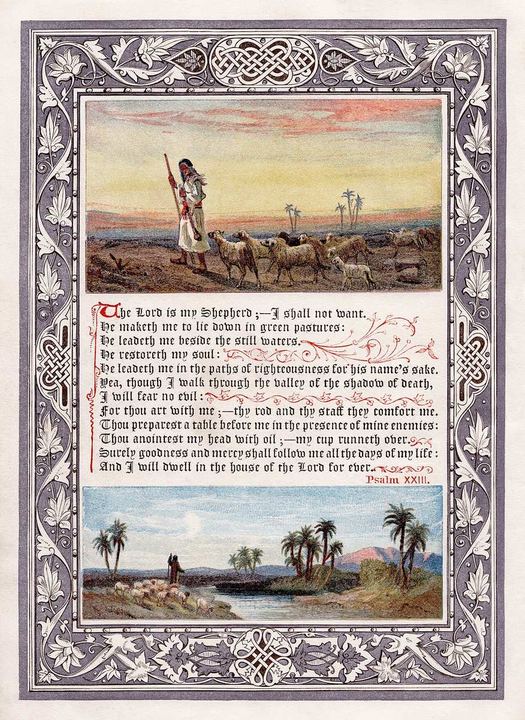

Summary
Psalm 23 is a six-verse song of trust, headed in the Hebrew Psalter as a psalm of David and placed in the first book of Psalms, between the anguished cry of Psalm 22 and the processional hymn of Psalm 24. Its speaker never asks for anything. Instead he declares who the LORD is and what follows from it: because the LORD is his shepherd, he shall not want. The first three verses describe God in the third person as the shepherd who leads his flock to green pastures and still waters, restores the soul, and guides it along right paths for the sake of his own name, so that God's reputation is bound up with the safety of the sheep. At verse 4 the psalm turns. The speaker imagines walking through the valley of the shadow of death and, at that darkest point, begins to address God directly: thou art with me, and the shepherd's rod and staff comfort him. Verse 5 changes the picture from pasture to banquet. God becomes a host who sets a table in full view of the speaker's enemies, anoints his head with oil as an honored guest, and fills his cup until it overflows. The last verse reverses the idea of pursuit: instead of enemies, goodness and mercy shall follow him all his days, and he will dwell in the house of the LORD for ever. The Hebrew behind the shadow of death can also mean deep darkness, and the final phrase can be read as returning to the LORD's house for length of days; the King James wording, however, is the form that has shaped English devotion for four centuries. Jews and Christians have prayed the psalm in sickness, war and mourning. The church has long read it beside Jesus's words in John 10 about the good shepherd who lays down his life for the sheep, and it is among the texts most often read at Christian funerals. Metrical versions, above all the 1650 Scottish Psalter's The Lord's my shepherd, remain standard hymns.
Virtues in this work
- Faith: The psalm opens by resting everything on one confession, that the LORD is the speaker's shepherd.
- Hope: Verse 6 looks ahead to goodness and mercy for all his days and a dwelling in the LORD's house for ever.
- Fortitude: In verse 4 the speaker walks through the valley of the shadow of death and refuses to fear evil.
- Piety: The whole psalm is spoken in reverent dependence, ending with the desire to dwell in God's house.
Plot or Argument
- Verse 1: The confession
The psalm opens with its whole claim in two clauses: the LORD is my shepherd, and therefore I shall lack nothing. Everything after unfolds this sentence.
- Verses 2-3: The shepherd's care
Speaking of God in the third person, the psalmist lists the shepherd's acts: rest in green pastures, water that is still, a restored soul, and guidance in paths of righteousness for his name's sake.
- Verse 4: Through the dark valley
The speaker walks through the valley of the shadow of death without fear and shifts to direct address, thou art with me; the rod defends and the staff guides.
- Verse 5: The host's table
The image changes to hospitality: a table spread before enemies, a head anointed with oil, and a cup running over, signs of an honored and protected guest.
- Verse 6: Goodness and mercy for ever
Goodness and mercy follow the speaker for all his days, and the psalm ends with the hope of dwelling in the house of the LORD for ever.
Lessons
Trust stated, not requested
Psalm 23 contains no petition at all. The speaker simply names the LORD as shepherd and draws the conclusion that he shall not want. The psalm teaches that confidence in God can be voiced as a confession of fact before any need is met.
- What does I shall not want claim, and what does it not claim?
- Why might a psalm of trust follow the lament of Psalm 22?
- How is this different from a prayer that asks for help?
Company in the valley
The psalm does not promise that the speaker will avoid the valley of the shadow of death. It promises presence inside it, and the grammar marks the point: in verse 4 he stops speaking about God and speaks to him. Comfort here comes from a person, not from the removal of danger.
- Why does the psalmist switch from he to thou at verse 4?
- What are the rod and the staff for, in a shepherd's hands?
- Why has this verse been read so often at deathbeds and funerals?
From flock to guest
Verse 5 turns the sheep into a guest at a feast, with oil on the head and an overflowing cup. The enemies are not destroyed; they watch. The psalm teaches that God's favor can be enjoyed in the presence of opposition rather than only after it has ended.
- Why is the table set in the presence of mine enemies?
- What did anointing with oil mean for a guest in the ancient Near East?
- How does goodness and mercy shall follow me answer the enemies of verse 5?
Context
Shepherd imagery for kings and gods was common in the ancient Near East, and the Hebrew Scriptures use it often: David was taken from the sheepfolds to be king, and Ezekiel 34 condemns Israel's false shepherds and promises that God himself will shepherd his flock. Psalm 23 draws on this language and on the hospitality customs of the region, in which a host who received a guest under his roof was bound to protect him.
Composition
The date of composition is unknown; the superscription attributes it to David, and scholars propose dates from the monarchy to after the Exile. The psalm passed into Greek in the Septuagint (where it is numbered 22) and into Latin in the Vulgate. The King James Version of 1611 refined earlier English renderings, especially Miles Coverdale's (1535) and the Geneva Bible's (1560); Coverdale's version survived in the Book of Common Prayer psalter.
Reception
Psalm 23 became a staple of Christian worship and private prayer, read at funerals, sickbeds and in wartime. It was set as metrical hymns, including the 1650 Scottish Psalter's The Lord's my shepherd, Isaac Watts's My Shepherd will supply my need and George Herbert's The God of love my shepherd is. The King James wording is among the best-known passages in English.
Comparisons
- the-pilgrims-progress
Bunyan sends Christian through a Valley of the Shadow of Death drawn from verse 4, turning the psalm's single line into a long allegorical ordeal of darkness and doubt.
- death-be-not-proud
Both face death without fear, but the psalm rests on the shepherd's presence in the valley while Donne's sonnet argues death down and announces its end.
- caedmons-hymn
Two short songs of praise at the head of their traditions: Caedmon's nine lines open English religious poetry as the psalm's English versions shaped later devotion.
- gods-grandeur
Hopkins, like the psalmist, finds God's care in the natural world; his Holy Ghost broods over the bent world as the shepherd leads beside still waters.
Quotes
Frequently cited
“The LORD is my shepherd; I shall not want.”
Frequently cited
“He maketh me to lie down in green pastures: he leadeth me beside the still waters.”
Frequently cited
“Yea, though I walk through the valley of the shadow of death, I will fear no evil: for thou art with me; thy rod and thy staff they comfort me.”
Frequently cited
“Thou preparest a table before me in the presence of mine enemies: thou anointest my head with oil; my cup runneth over.”
Frequently cited
“Surely goodness and mercy shall follow me all the days of my life: and I will dwell in the house of the LORD for ever.”
“He restoreth my soul: he leadeth me in the paths of righteousness for his name’s sake.”
For Students
A reading companion for classical Christian high school students. See the student guide.
Reading Guide
Watch for
- The single claim of verse 1 and how each later verse unfolds what it means to have the LORD as shepherd.
- The change from he to thou in verse 4, exactly where the speaker enters the valley of the shadow of death.
- The shift of image in verse 5 from shepherd and sheep to host and guest at a table.
- The verb follow in verse 6, where goodness and mercy take the place of pursuing enemies.
Key terms and names
- Shepherd
- In Israel a common image for a king or for God as the one who feeds, leads and defends a people; David himself was a shepherd before he was king.
- Rod and staff
- A shepherd's two tools: the rod a club for driving off predators, the staff a long crook for guiding and rescuing sheep.
- Anointing with oil
- In the ancient Near East a host refreshed and honored a guest by pouring oil on his head, as in verse 5.
- Psalter
- The Book of Psalms, Israel's collection of 150 songs and prayers, divided into five books; Psalm 23 is in Book I.
- Parallelism
- The basic device of Hebrew poetry, in which a second line echoes, extends or sharpens the first, as in he maketh me to lie down and he leadeth me.
Seminar Questions
- Comprehension List everything the shepherd does for the speaker in verses 1-4.
- Comprehension What new picture of God appears in verse 5, and what three things does he do there?
- Interpretation Why does the psalm say paths of righteousness for his name's sake rather than for my sake?
- Interpretation Does verse 4 promise that the speaker will not suffer? What exactly does it promise?
- Interpretation Why might the enemies of verse 5 be left at the table rather than defeated?
- Interpretation How does Jesus's claim to be the good shepherd in John 10 change the way a Christian reads this psalm?
- Big Question Is it possible to say I shall not want while still lacking things one needs? What kind of contentment is this?
Faith Connections
- John 10:11-16 (Scripture)
Jesus calls himself the good shepherd who lays down his life for the sheep, taking the psalm's title for God as his own.
- Ezekiel 34:11-16 (Scripture)
God promises to search for his scattered sheep, feed them in good pasture and make them lie down, the same actions the psalmist describes in verses 2-3.
- Revelation 7:17 (Scripture)
The Lamb in the midst of the throne shall feed the redeemed and lead them to living fountains of waters, a final echo of the still waters of verse 2.
- Augustine, Expositions of the Psalms, Psalm 22 (Latin numbering) (Church Fathers)
Augustine reads the psalm as the voice of the church speaking to Christ its shepherd, a reading that shaped the medieval and Reformation use of the psalm in worship.
Logic and Rhetoric
Central argument: If the LORD is my shepherd, then I lack nothing I truly need. A good shepherd feeds, restores and guides; he is present even in the valley of death; he honors his own as a host honors a guest. Therefore the speaker can face danger without fear and expect goodness and mercy for the rest of life and dwelling with God for ever.
Rhetorical device: apostrophe (shift to direct address). In Psalm 23:4 the speaker stops describing the LORD in the third person and speaks to him, for thou art with me, so that the poem's grammar enacts the closeness it describes.
Debate: Resolved: that Psalm 23 is more a poem about the present life than about the life after death.
Memory Work
The LORD is my shepherd; I shall not want.
Yea, though I walk through the valley of the shadow of death, I will fear no evil: for thou art with me; thy rod and thy staff they comfort me.
Writing Prompts
Essay: Trace the two images of God in Psalm 23, shepherd and host, and argue why the psalmist needs both to say what he means.
Comparison with The Pilgrim's Progress: Compare verse 4 with Christian's passage through the Valley of the Shadow of Death in The Pilgrim's Progress. What does Bunyan add to the psalm's single line, and what does the psalm's brevity achieve that the allegory cannot?
Medical Lens
Psalm 23 has no medical content, but it has long been one of the texts most often read to the dying and at funerals in English-speaking Christianity, and chaplains and nurses have used it at the bedside for centuries. For a history-of-medicine reader it is a fixed point in the religious care of the dying that ran alongside, and often preceded, medical care.
- Psalm 23:4
The valley of the shadow of death verse, the part of the psalm most often spoken at deathbeds and in bereavement.
Creative Prompts
- Classroom
Read the psalm aloud twice, once marking every he and once every thou, and discuss what changes at verse 4 when the speaker begins to talk to God rather than about him.
- Poetry
Write a six-line psalm of trust built on one image from your own life (a coach, a lighthouse keeper, a host), moving from description to direct address at the darkest point.
- Essay
Compare the KJV text with one metrical hymn version, such as The Lord's my shepherd, and argue what the rhymed version gains and loses.
Further Reading
- Reflections on the Psalms, C. S. Lewis
- Psalms 1-72 (Tyndale Old Testament Commentaries), Derek Kidner
- The Book of Psalms: A Translation with Commentary, Robert Alter
- In the Beginning: The Story of the King James Bible, Alister McGrath
Verification notes
The text is the KJV as stored from the library's Bible text; the stored file omits the superscription (A Psalm of David), which is mentioned in the record as a fact about the Hebrew Psalter. Dating and Davidic authorship are traditional and debated. The alternative renderings of the Hebrew in verses 4 and 6 are standard notes in modern translations. All quotes are found verbatim in the stored text.
No verification flags recorded.