Work record
The Railway Children
1906 · Early 20th Century · Novel · English
Abstract
Background. Nesbit, already famous for the Bastable and Psammead books, wrote this realistic story without magic for The London Magazine; the dedication thanks her son Paul for his knowledge of railways.
Plot. After their father vanishes with two visitors, three London children and their mother settle in poverty near a rural station. Waving daily to a passing train, they befriend a powerful elderly passenger, stop an express before a fallen cutting, pull an infant from a blazing barge, shelter a Russian refugee, and rescue an injured schoolboy in the tunnel. Bobbie discovers that her father is serving a sentence for espionage, and her letter sets the old gentleman to clear his name.
Structure. Most chapters are self-contained adventures, threaded together by the morning train and by the hidden sorrow that only Mother and later Bobbie carry. A chatty narrator addresses readers directly, includes Mother's comic verses, and in the closing paragraph tactfully leaves the reunited family alone behind a shut door.
Themes. Family loyalty, courage in emergencies, the dignity of working people, gifts that honour rather than shame, and patience under injustice.
Significance. One of the most loved English children's books, it gained a new audience through Lionel Jeffries's 1970 film, and the reunion on the platform remains its most famous scene.
Main characters
- Roberta (Bobbie): Eldest child, who learns the secret and seeks help
- Peter: Middle child, keen on engines
- Phyllis: Youngest child, well-meaning and untidy
- Mother: Writer of stories who supports the family alone
- Father: Official imprisoned for a treason he did not commit
- The old gentleman: Influential passenger on the morning train
- Perks: Proud and friendly station porter
- Jim: Schoolboy with a broken leg, the old gentleman's grandson

Summary
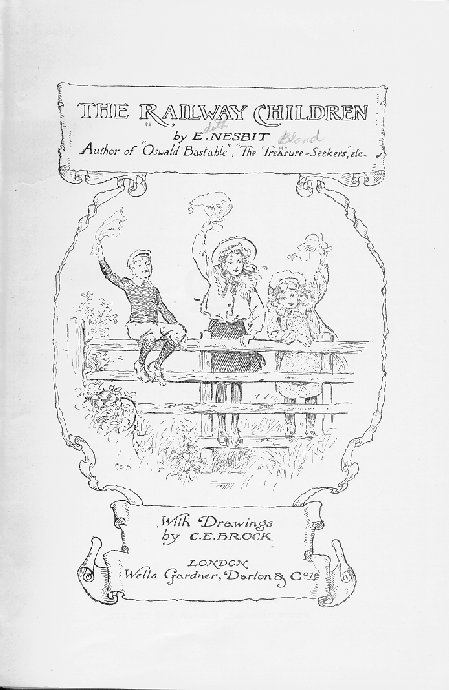
The Railway Children tells how Roberta (Bobbie), Peter and Phyllis lose their comfortable London life and find friends, work and courage beside a country railway line. One evening, just after Peter's birthday, two men call, Father goes away with them, and Mother will say only that he has gone on business and that the children must not ask. Soon the family moves to a small house called Three Chimneys, near a station and a tunnel, with no servants and little money. Mother shuts herself up writing stories to sell, and the children, left to themselves, fall in love with the railway. Peter takes coal from the station yard and is caught by the Station Master, who forgives him. They wave every morning to the 9.15 and send their love to Father by it, and an old gentleman in a first-class carriage waves back. When Mother falls ill with influenza, the children send him a list of what the doctor ordered, and he sends a hamper. Bobbie climbs into an engine to ask the driver to mend Peter's broken toy engine, and the driver and fireman do it. A Russian writer, sent to Siberia for a book about the poor, turns up at the station, and the old gentleman finds his lost wife and child. After a landslide blocks the line, the girls tear their red flannel petticoats into flags and stop a train, and the railway company gives each child a gold watch. They save a bargeman's baby from a burning canal boat, organise birthday gifts from the whole village for the proud porter Perks, and help a boy in a red jersey, Jim, who has broken his leg in the tunnel during a paperchase. He turns out to be the old gentleman's grandson, and he is nursed at Three Chimneys. Meanwhile Bobbie finds an old newspaper and learns the secret: Father has been convicted of selling state secrets and sentenced to five years' penal servitude. Mother tells her he is innocent and that the two of them must be brave together. Bobbie writes to the old gentleman, who works to prove the truth. In the last chapter the passengers of the 9.15 wave newspapers at the children, the village greets Bobbie with strange kindness, and Father steps off the 11.54. The book was serialized in The London Magazine in 1905 and published in 1906 with illustrations by C. E. Brock.
Virtues in this work
- Fortitude: Bobbie keeps the secret of Father's imprisonment from her brother and sister and shares Mother's grief bravely.
- Charity: Mother takes in the sick Russian exile and the children help find his family.
- Prudence: When the landslide falls, the children think quickly of red flags and stop the train in time.
- Friendship: Bobbie stays alone in the dark tunnel with the injured Jim while the others go for help.
- Hope: The children keep sending their love to Father by the 9.15 until he comes home.
Plot or Argument
- Chapters I-II: The beginning of things
Father is taken away; the family moves to Three Chimneys; the children discover the railway, and Peter's coal-mine at the station ends when the Station Master catches him.
- Chapters III-IV: The old gentleman and the engine
The children wave to the 9.15; Mother's influenza brings Dr Forrest and the old gentleman's hamper; Bobbie rides in an engine to have Peter's toy engine mended.
- Chapter V: Prisoners and captives
A Russian exile arrives at the station, ill and without English; Mother takes him in, the old gentleman finds his family, and Mother asks the children to pray for all prisoners and captives.
- Chapters VI-VII: Saviours of the train
A landslide falls across the line; the children wave red petticoat flags until the train stops, and the railway company presents them with engraved gold watches.
- Chapters VIII-IX: The fireman and Perks
The children rescue a baby from a burning barge, then gather presents for Perks's birthday, which he first resents as charity and then accepts.
- Chapters X-XI: The terrible secret
Bobbie reads of Father's trial and sentence in an old newspaper, shares the burden with Mother, and writes to the old gentleman for help; the paperchase leads into the tunnel.
- Chapters XII-XIII: Jim
Bobbie stays in the dark tunnel with Jim, whose leg is broken; he is carried to Three Chimneys and nursed there, and the old gentleman comes to see his grandson.
- Chapter XIV: The End
The passengers on the 9.15 wave their newspapers, the village wishes Bobbie joy, and Father, freed because the real traitor has been caught, steps off the 11.54.
Characters
- Roberta (Bobbie), protagonist
The eldest child, thoughtful and tender-hearted, who learns the family's secret and works to free her father.
- Peter, brother
The middle child, who wants to be an engineer and likes to be in charge.
- Phyllis, sister
The youngest, who means extremely well and is always losing her bootlaces.
- Mother, parent
A brave, merry woman who writes stories and verses to support the family while hiding her grief.
- Father, parent
A government official wrongly imprisoned as a spy.
- The old gentleman, friend
A wealthy, influential passenger on the 9.15 who answers the children's waves and their letters.
- Perks, porter
The station porter, kind and proud, who teaches the children about trains.
- Dr Forrest, doctor
The local doctor, poor himself, who treats the family and talks frankly with Peter.
- Mr. Szezcpansky, Russian exile
A writer imprisoned in Siberia for a book about the poor, who escapes to England.
- Jim, the hound in the red jersey
A schoolboy who breaks his leg in the tunnel; the old gentleman's grandson.
- The Station Master, railwayman
Catches Peter taking coal and becomes a friend.
Lessons
Bearing a burden together
When Bobbie learns that Father is in prison, she keeps the secret from Peter and Phyllis so they need not suffer, and shares it only with Mother. Nesbit shows a child growing up by carrying sorrow quietly for the sake of others, while still finding help from a trusted friend.
- Why does Mother keep the secret from the children at first?
- Why doesn't Bobbie tell Peter and Phyllis?
- What does Bobbie do to help Father?
Courage in an emergency
When the landslide falls, the children think quickly, tear up their red petticoats, and stand on the line waving until the train stops. Bobbie faints afterward. The book shows bravery as doing the needed thing while afraid.
- How do the children know the train is in danger?
- Why do they use the red petticoats?
- What happens to Bobbie when the train stops?
Gifts without charity's sting
Perks is offended when the village sends him birthday presents, because he thinks he is being treated as a beggar. When Bobbie shows him the kind notes of friends who remember his past kindnesses, he is proud and happy. Nesbit shows that a gift must honour the person who receives it.
- Why does Perks get angry about the presents?
- What changes his mind?
Kindness to strangers
Mother takes in the sick Russian when no one at the station can understand him, and the children help him find his family. The prayer for prisoners and captives teaches the children that other people's sorrows are close to their own.
- Why was the Russian sent to prison?
- How does Mother's prayer for prisoners and captives become personal for Bobbie later?
Context
The novel is set around 1905 in Edwardian England, when railways connected the country and were still a source of wonder to children. Nesbit, a founder member of the Fabian Society, gives the book a Russian political exile and a wrongful conviction for espionage. Readers have long seen an echo of the Dreyfus affair in France, in which an army officer was falsely convicted of treason, and of Russian exiles Nesbit knew, such as Sergius Stepniak.
Composition
The story was serialized in The London Magazine from 1905 to early 1906 and published as a book in 1906 by Wells Gardner, Darton & Co., with illustrations by C. E. Brock; Macmillan published it in the United States.
Reception
The book became one of the best-loved English children's novels. Lionel Jeffries's 1970 film, with Jenny Agutter as Bobbie, made the story familiar to later generations, and it has been adapted again for television and the stage.
Comparisons
- five-children-and-it
Nesbit's earlier book also sends a family of children into the country, but it gives them a magical wish-granting creature; here the adventures come from the railway and ordinary courage.
- little-women
In both, a father is absent, a mother keeps the family together on little money, and the eldest girl grows up through care for others.
- the-secret-garden
Both books move children from comfort or neglect into country life where they find friends and help heal someone else.
- hans-brinker
Two poor families with a father lost to them, one by injury and one by false imprisonment, and children whose loyalty and work help bring him back.
- the-wind-in-the-willows
Written in the same Edwardian years, both books love the English countryside, but Grahame's riverbank resists the modern world while Nesbit's children fall in love with the railway.
Quotes
Frequently cited
“They were not railway children to begin with.”
Frequently cited
“Oh! my Daddy, my Daddy!”
“Dears, when you say your prayers, I think you might ask God to show His pity upon all prisoners and captives.”
“How lucky we DID put on our red flannel petticoats!”
“But charity's what I never did abide”
“We two must help each other to be brave.”
“Oh, what useful things flannel petticoats are!”
“Take our love to Father!”
For Students
A reading companion for classical Christian high school students. See the student guide.
Reading Guide
Watch for
- The night Father goes away in Chapter I, and what Mother does and does not say.
- The children's daily wave to the 9.15 and the old gentleman's answer.
- The landslide and the red petticoat flags in Chapter VI.
- Bobbie's discovery in the old newspaper at the end of Chapter X.
- The last chapter, when everyone in the village knows something Bobbie does not.
Key terms and names
- Three Chimneys
- The small white house near the railway where the family goes to live.
- The 9.15
- The morning train the children wave to, which carries the old gentleman.
- Porter
- A railway worker who carries luggage and helps at the station; Perks is the porter.
- Signal
- A raised or lowered arm beside the line that tells the driver whether it is safe to go on.
- Penal servitude
- Imprisonment with hard labour; Father is sentenced to five years of it.
- Paperchase
- A game in which runners called hares lay a trail of paper scraps and hounds follow; Jim is a hound.
Seminar Questions
- Comprehension Why does the family have to move to Three Chimneys?
- Comprehension How do the children stop the train before the landslide?
- Comprehension What does Bobbie find out from the old newspaper?
- Interpretation Was Peter wrong to take coal from the station? What does the Station Master think?
- Interpretation Why is Perks hurt by the birthday presents, and why does he change his mind?
- Interpretation Why does Mother try so hard to be cheerful, and what does it cost her?
- Big Question What should we do when someone we love is treated unfairly and we cannot fix it ourselves?
Faith Connections
- Hebrews 13:3 (Scripture)
Remember them that are in bonds, as bound with them. Mother asks the children to pray for all prisoners and captives, and Bobbie later understands that Father is one of them.
- Galatians 6:2 (Scripture)
Bear ye one another's burdens. Bobbie and Mother share the secret so that neither carries it alone.
- Psalm 37:5-6 (Scripture)
The psalm promises that God will bring forth righteousness as the light; Father's innocence is finally made known to everyone.
- Book of Common Prayer, the Litany (Great Conversation)
The Litany prays for all prisoners and captives; Mother's words to the children echo this prayer of the English church.
Logic and Rhetoric
Central argument: Hard times take away money and comfort but not love, courage or kindness. The children, by helping others, gain friends who help them in turn. Therefore a family that stays loving and brave in trouble can survive even a great injustice until the truth comes out.
Rhetorical device: direct address to the reader. The narrator often talks to the reader, as in Chapter XIV, where she says we will not open the door after Father goes into the house.
Debate: Resolved: that Mother was right to keep Father's imprisonment a secret from the children.
Memory Work
We two must help each other to be brave.
They were not railway children to begin with.
Writing Prompts
Essay: Show how Bobbie grows up during the story, using three moments: the engine, the landslide and the newspaper.
Comparison with Little Women: Compare Bobbie with Meg or Jo in Little Women. How does each eldest daughter help her mother while their father is away?
Medical Lens
Illness and injury recur in an Edwardian country setting with a single local doctor. Mother's influenza brings Dr Forrest, whose list of ordered foods and comforts the poor family cannot afford; the children's appeal to the old gentleman produces a hamper. The Russian exile arrives worn out in mind and body after Siberia. Jim's broken leg is set at Three Chimneys rather than in a hospital, with the children listening in distress to the sounds from the room above, and Mother nurses him. Bobbie's petticoat cushion and the children's game of bone-setting reflect a home-nursing world. Dr Forrest is drawn as kind, frank and not well off himself. None of this is clinical, but it is a fair picture of general practice and home care before the National Health Service.
- Chapter III, The old gentleman
Dr Forrest diagnoses Mother's influenza and lists what she needs; the children ask the old gentleman for it.
- Chapter V, Prisoners and captives
The doctor sees the Russian exile and says he is worn out, mind and body.
- Chapters XII-XIII
Jim, injured in the tunnel, is brought to Three Chimneys; the doctor sets the leg and Mother nurses him.
Listen to the book
Public-domain audiobook from LibriVox, read by Various volunteers. Recording: Railway Children (version 2 Dramatic Reading) on LibriVox (Internet Archive).
LibriVox recordings are volunteer readings released into the public domain. The reading may follow a different edition from the text in this library.
Creative Prompts
- Classroom
Draw a map of the railway near Three Chimneys: the station, the tunnel, the cutting where the landslide fell, the canal and the house, and mark where each adventure happened.
- Fiction
Write the letter the old gentleman might have written back to Bobbie after reading the newspaper she sent him.
- Essay
Which of the three children is the bravest, and why? Use at least two adventures.
- Dialogue
Write the conversation between Perks and his wife after the children explain the birthday presents.
Further Reading
- The Story of the Treasure Seekers, E. Nesbit
- Five Children and It, E. Nesbit
- The Phoenix and the Carpet, E. Nesbit
- A Woman of Passion: The Life of E. Nesbit, Julia Briggs
Verification notes
Plot details, chapter titles and names follow the attached Project Gutenberg text (#1874), including the spelling Szezcpansky and the 1905 date engraved on the watches. Serialization in The London Magazine (1905-06), book publication by Wells Gardner, Darton & Co. in 1906, C. E. Brock's illustrations, the Macmillan US edition, the Dreyfus and Stepniak associations, and the 1970 Lionel Jeffries film were checked against the Wikipedia article on the novel (en.wikipedia.org/wiki/The_Railway_Children). The influences are commonly suggested, not stated by Nesbit in the book. Chapter VIII is titled The amateur fireman in the contents and The amateur firemen in the text. All quotes were found in the attached text.
- Confirm Nesbit's acquaintance with Stepniak as a source for the Russian exile before stating it as fact.