Work record
Speeches on the Compromise of 1850
1850 · 19th Century · Oratory · English
Abstract
Background. Land taken from Mexico in 1848 forced Congress to decide whether slavery would follow the flag westward. California's free-state petition, a Texas claim on Santa Fe, the District's slave markets, and runaway slaves together threatened a sectional break.
Argument. Clay proposes a bundle of measures, each balanced by another, and pleads that disunion could come only through war. Calhoun, speaking through a colleague's voice, holds that compromise treats symptoms: the North has outgrown the South under federal favor, the churches have already split, and only constitutional guarantees can restore safety. Webster accepts most of Clay's plan, calls an antislavery proviso for the Southwest pointless because soil and climate forbid plantation agriculture there, admits Northern failures on fugitives, and denies that the states could part in peace.
Structure. Resolutions of January 29 and Clay's two-day defense come first, followed by Calhoun's address of March 4 and Webster's of March 7. The Clay and Calhoun portions are scanned from 1850s collected editions; Webster's comes from a later edition of his orations.
Significance. These were the final major Senate addresses of all three men. Five statutes enacted that September embodied most of Clay's proposals, and the fugitive provision soon kindled Northern resistance and inspired Stowe's novel.
Key figures
- Henry Clay: Kentucky Senator who proposed the eight resolutions
- John C. Calhoun: South Carolina Senator, mortally ill, whose address was read for him
- Daniel Webster: Massachusetts Senator who spoke on the seventh of March
- James Mason: Virginia Senator who read Calhoun's speech aloud
- Zachary Taylor: President who opposed combining the measures; died in July
- Stephen A. Douglas: Illinois Senator who carried the measures as separate bills
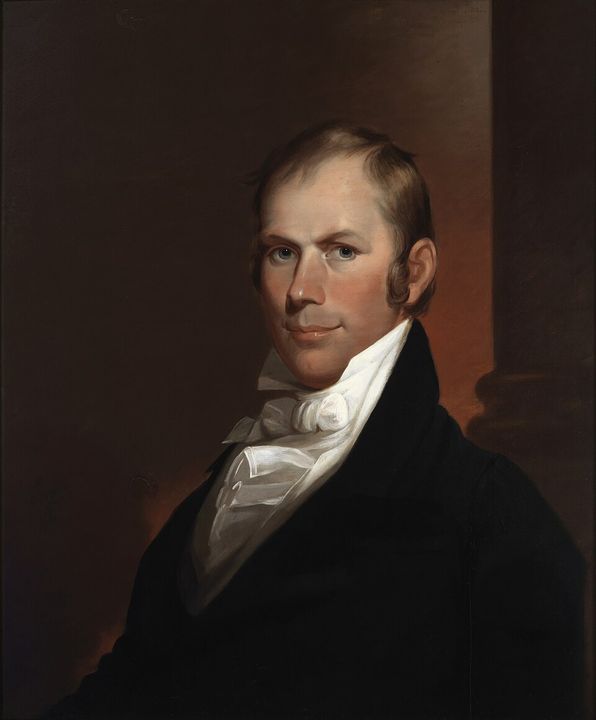

Summary
These three Senate speeches were the central statements in the long debate of 1850 over the lands won from Mexico, and the last great addresses of the three statesmen of their generation. The Mexican War had added California and the Southwest. Gold-rush California asked to enter the Union as a free state, which would end the balance of fifteen free and fifteen slave states; Texas claimed much of New Mexico; Northerners objected to the slave trade in the national capital; and Southerners complained that free states obstructed the return of fugitive slaves. On January 29, 1850, Henry Clay, aged seventy-two, offered eight resolutions: admit California; organize the rest of the cession without any restriction or condition on slavery; fix the Texas boundary and have the United States pay the part of Texas's public debt tied to its former revenues; keep slavery in the District of Columbia but end the trade in slaves brought there for sale; pass a more effective fugitive law; and declare that Congress had no power over the slave trade between states. In his speech of February 5 and 6 he defended each resolution as a mutual concession of feeling rather than principle and closed by warning that disunion and war were the same thing. On March 4 John C. Calhoun, too ill to speak, sat in the chamber while Senator James Mason of Virginia read his address. Calhoun argued that the Union was endangered because the equilibrium between the sections had been destroyed by federal legislation and Northern agitation, that the spiritual, political, and social cords binding the states were snapping one by one, and that neither Clay's plan nor appeals to the Union could save it; only a full settlement on the principle of justice, including an amendment restoring the South's power of self-protection, could do so. On March 7 Daniel Webster spoke, he said, not as a Massachusetts man or a Northern man but as an American. He reviewed the history of slavery and the Constitution, argued that the laws of climate and geography already excluded slavery from New Mexico, so that the Wilmot Proviso was needless, conceded the South's complaint about fugitive slaves, rebuked abolitionist societies and Southern talk of disunion alike, and declared that peaceable secession was impossible. Clay's measures failed as a single bill in July, but after President Taylor's death they passed separately in September under Stephen A. Douglas's management. The library text gives Clay's resolutions and speech, Calhoun's speech, and Webster's Seventh of March speech.
Virtues in this work
- Prudence: Clay withdrew to his room for weeks to frame a plan that gave each section something, and challenged critics to offer a better one.
- Fortitude: Calhoun, near death, came to the Senate to sit through the reading of his speech rather than leave his position unstated.
- Magnanimity: Webster spoke as an American rather than as a Massachusetts man, granting Southern grievances at the cost of his standing at home.
- Hope: Clay closed by praying that he would never see the Union dissolved, staking his last strength on its preservation.
Plot or Argument
- Clay's eight resolutions (January 29)
A preamble and eight resolutions propose admitting California, organizing territorial governments without restriction on slavery, settling the Texas boundary and debt, retaining slavery but ending the slave trade in the District of Columbia, a stronger fugitive law, and a declaration against congressional power over the interstate slave trade.
- Clay's speech: concessions of feeling, not of principle
Clay describes his anxious isolation in preparing the plan, blames passion and party spirit for the crisis, and goes through each resolution to show what each section gives and receives, arguing that nature had already excluded slavery from New Mexico and that no Northern principle was surrendered by omitting the Wilmot Proviso.
- Clay's peroration: war and dissolution are identical
He appeals to Southern Senators not to press matters toward disunion, argues that secession would gain them nothing they seek, predicts a war more terrible than any in history, and prays that he may not live to see the Union dissolved.
- Calhoun: the destroyed equilibrium
Calhoun's address, read by James Mason, traces the growing disparity in population and power between North and South to federal legislation on territories, tariffs, and revenue, and to a concentration of power in the federal government that changed the character of the system.
- Calhoun: the cords of union snapping
He shows the spiritual cords breaking as the Methodist and Baptist churches divide by section, and predicts that the political cords of party will follow, until only force could hold the states together.
- Calhoun: how the Union can be saved
Rejecting Clay's plan and the President's, and appeals to the Union's glory, he answers that the North must concede the South equal rights in the territories, faithfully return fugitives, cease agitation, and agree to an amendment restoring the South's power to protect itself.
- Webster: the history of slavery and the law of nature
Webster recounts the changing opinions of North and South on slavery since the founding, reviews the annexation of Texas and the Texas compact, and argues that the physical geography of California and New Mexico already settles the question, so that he would not re-enact the will of God with the Wilmot Proviso.
- Webster: grievances on both sides and the impossibility of secession
He grants the South's complaint about the failure to return fugitive slaves, criticizes abolitionist societies and the language of the Southern press, refuses to admit that peaceable secession is possible, and closes with an appeal to the Union's destiny.
Lessons
What a compromise asks of each side
Clay insisted that his plan asked neither section to give up a principle, only feelings and opinions held about matters in dispute. He went resolution by resolution to show a give and take. Calhoun replied that the South had nothing left to surrender and asked for justice rather than compromise. The contrast shows two different understandings of what settling a quarrel requires.
- How does Clay distinguish a concession of principle from a concession of feeling, and why does the distinction matter to him?
- Why does Calhoun say the South has no compromise to offer but the Constitution?
- Can a lasting settlement be reached between parties who disagree about justice itself, or only about interests?
Diagnosing a political illness
Calhoun treats the crisis as a disease with a cause. He argues that discontent is a symptom, traces it to the loss of sectional balance, and describes the cords of union breaking one by one, first in the churches. Whatever one concludes about his remedy, his speech is a model of reasoning from symptom to cause.
- What evidence does Calhoun give that the equilibrium between the sections had been destroyed?
- Why does he begin his list of breaking cords with the churches?
- Is Calhoun right that a union held together only by force has ceased to be a union?
Speaking against one's own section
Webster opened by declaring that he spoke as an American rather than as a Massachusetts man, and he went on to grant Southern complaints about fugitives and to rebuke Northern agitation as well as Southern threats. Many of his New England supporters turned against him. The speech raises the question of what a representative owes his constituents and what he owes the whole country.
- Which Southern grievances does Webster grant, and which Southern positions does he reject?
- Why does Webster argue that the Wilmot Proviso is needless in New Mexico?
- When should a representative vote against the strong wishes of the people who sent him?
Three old men facing the end of the Union they built
Clay prays not to survive the Union's dissolution, Calhoun is too weak to read his own speech and dies within the month, and Webster asks what he would be if he were an American no longer. The speeches carry the weight of a generation that had known the founders and feared outliving their work.
- How do Clay's and Webster's perorations use their own age and memories?
- What effect would Calhoun's silent presence in the chamber, while Mason read his words, have had on his hearers?
- What responsibilities does an older generation bear for the political inheritance it hands on?
Context
The Treaty of Guadalupe Hidalgo in 1848 transferred California and the New Mexico region to the United States. The Wilmot Proviso, first offered in 1846, would have barred slavery from all land acquired from Mexico; it repeatedly passed the House and failed in the Senate. By late 1849 California had drafted a free-state constitution, the House had taken three weeks and sixty-three ballots to elect a Speaker, and Southern leaders had called a convention to meet at Nashville in June 1850. President Zachary Taylor wanted California and New Mexico admitted directly as states and opposed linking the questions together.
Composition
Clay introduced his resolutions on January 29 and spoke on February 5 and 6. Calhoun's speech of March 4 was written out and read for him by Senator James Mason of Virginia; it was his last formal address. Webster's speech of March 7, published as The Constitution and the Union, was revised for print soon after. The library text joins Clay's resolutions and speech from Calvin Colton's The Last Seven Years of the Life of Henry Clay (1856), Calhoun's from volume 4 of his Works edited by Richard K. Crallé (1854), both as OCR with page heads removed, and Webster's from the Project Gutenberg edition of his speeches.
Reception
A Senate committee of thirteen under Clay combined the measures into one omnibus bill, which was defeated in pieces on July 31, 1850. Taylor had died on July 9, and his successor Millard Fillmore favored settlement; Stephen A. Douglas then carried the measures as five separate acts in September, including the Fugitive Slave Act. Webster's speech was praised in commercial circles and bitterly condemned by antislavery New Englanders; John Greenleaf Whittier's poem Ichabod lamented his fall. The settlement was widely hailed as final, but the fugitive law and the principle of territorial self-determination became the grounds of new conflict within four years.
Comparisons
- webster-second-reply-to-hayne
Twenty years apart, Webster again answers a South Carolina theory of the Union, but in 1850 he couples his defense of the Union with concessions to the South that he had not been asked for in 1830.
- hayne-speech-on-foots-resolution
Hayne's compact theory of 1830 and Calhoun's equilibrium argument of 1850 present the same South Carolina constitutional school at two stages, before and after the slavery question displaced the tariff.
- lincoln-douglas-debates
Douglas, who passed the 1850 measures, later cited their territorial provisions as the first enactment of popular sovereignty, while Lincoln claimed Clay as his own model of a statesman.
- uncle-toms-cabin
Stowe wrote her novel in response to the Fugitive Slave Act, the part of the settlement Webster defended as a constitutional obligation in the Seventh of March speech.
- democracy-in-america
Tocqueville's chapter on the prospects of the Union, written in the 1830s, weighed the same forces Calhoun describes: the growth of the North and West and the weakening of the federal bond.
Quotes
Frequently cited
“War and dissolution of the Union are identical and inevitable, in my opinion. There can be a dissolution of the Union only by consent or by war.”
Frequently cited
“I implore, as the best blessing which Heaven can bestow upon me, upon earth, that if the direful event of the dissolution of this Union is to happen, I shall not survive to behold the sad and heart-rending spectacle.”
Frequently cited
“The cords that bind the States together are not only many, but various in character.”
Frequently cited
“The South asks for justice, simple justice, and less she ought not to take.”
Frequently cited
“I wish to speak to-day, not as a Massachusetts man, nor as a Northern man, but as an American, and a member of the Senate of the United States.”
Frequently cited
“There can be no such thing as a peaceable secession. Peaceable secession is an utter impossibility.”
“If my plan of peace, and accommodation, and harmony, is not right, present us your plan.”
“Having now shown what cannot save the Union, I return to the question with which I commenced, How can the Union be saved ?”
For Students
A reading companion for classical Christian high school students. See the student guide.
Reading Guide
Watch for
- How Clay presents each of his eight resolutions as giving something to each section, and where he admits the balance is uneven.
- Calhoun's chain of reasoning from the loss of sectional equilibrium to the breaking of the cords of union, beginning with the churches.
- Webster's argument from geography and climate that New Mexico would never be slave territory.
- The three perorations: Clay's prayer, Calhoun's demand for justice, and Webster's vision of the heavenly bodies leaving their spheres.
Key terms and names
- Wilmot Proviso
- The proposal to bar slavery from all territory acquired from Mexico; Clay and Webster argued it was unnecessary, Calhoun that it violated Southern equality.
- Equilibrium
- Calhoun's term for the balance of power between North and South at the founding, which he argued federal policy had destroyed.
- Omnibus bill
- The single bill into which a Senate committee combined Clay's proposals in May 1850; it failed in July, and the measures then passed separately.
- Fugitive slave law
- Clay's seventh resolution, later the Fugitive Slave Act of 1850, providing federal machinery for the return of escaped slaves; Webster defended it as a constitutional duty.
- Peaceable secession
- The idea of a voluntary separation of the states, which Clay and Webster both declared impossible.
- Texas boundary and debt
- The dispute over Texas's claim to land east of the Rio Grande in New Mexico, settled by fixing a boundary and paying part of the Texas debt.
Seminar Questions
- Comprehension List Clay's eight resolutions and say which section each was meant chiefly to satisfy.
- Comprehension Why was Calhoun's speech read by James Mason, and what four things does Calhoun say the North must do to save the Union?
- Interpretation Clay says his resolutions ask for concessions of feeling, not of principle. Does Calhoun's speech accept or reject that distinction?
- Interpretation Why does Calhoun think the division of the churches is the clearest sign of danger?
- Interpretation How does Webster's argument that nature already excludes slavery from New Mexico allow him to oppose the Wilmot Proviso without defending slavery?
- Interpretation Clay and Webster both say secession means war. How do their reasons differ?
- Big Question Is it wise to settle a deep moral and political dispute by a package of concessions, or does such a settlement only postpone the conflict?
Faith Connections
- Matthew 5:9 (Scripture)
Blessed are the peacemakers. Clay presented his resolutions as a plan of peace and accommodation; the speeches invite reflection on whether making peace always means splitting differences.
- Amos 3:3 (Scripture)
Can two walk together, except they be agreed? Calhoun's account of the cords of union breaking, first among the churches, asks how much agreement a people must share to remain one.
- Augustine, City of God XIX.13 (Great Conversation)
Augustine defines peace as the tranquillity of order. Calhoun argued that the order of 1787 had been overturned and that peace required restoring it, while Clay and Webster sought peace through mutual adjustment within the existing order.
Logic and Rhetoric
Central argument: Clay: the controversies can be settled only by mutual concessions that sacrifice no principle; each resolution gives something to each section; disunion means war; therefore both sections should accept the whole plan. Calhoun: the Union is endangered because federal action has destroyed the sectional balance and Northern agitation is breaking every bond; compromise cannot remove that cause; therefore only a full settlement securing the South's equal rights and power of self-protection can save the Union. Webster: the territories are already free by nature, the Constitution obliges the return of fugitives, and secession is impossible without war; therefore both sections should drop their grievances and accept the settlement.
Rhetorical device: erotesis (rhetorical question). Calhoun organizes his whole address around the question how the Union can be saved, raising it at the start and returning to it after dismissing every answer but his own.
Debate: Resolved: that the Compromise of 1850, as Clay proposed it, was the best course available to the Senate in 1850.
Memory Work
I wish to speak to-day, not as a Massachusetts man, nor as a Northern man, but as an American, and a member of the Senate of the United States.
The South asks for justice, simple justice, and less she ought not to take.
Writing Prompts
Essay: Clay, Calhoun, and Webster all claimed to be saving the Union. Explain what each man thought endangered it and what each thought would preserve it, and identify the point on which their diagnoses most sharply disagree.
Comparison with Second Reply to Hayne: Compare Webster's Second Reply to Hayne (1830) with his Seventh of March speech (1850). How had the threat to the Union changed in twenty years, and how did Webster's answer change with it?
Medical Lens
The medical interest is biographical. Calhoun was gravely ill through the winter of 1849-1850, and his contemporaries and biographers describe his final illness as pulmonary consumption (tuberculosis); he could not deliver his own speech and died on March 31, 1850. Clay, who was also in failing health, died of tuberculosis in Washington in June 1852. The scene of a dying Senator sitting wrapped in the chamber while a colleague read his words was much remarked at the time. Nineteenth-century diagnoses of consumption were clinical rather than bacteriological, since Koch did not identify the tubercle bacillus until 1882.
- Calhoun's speech of March 4, 1850, opening
The address was read by James Mason because Calhoun was too ill to speak; it is the last formal speech of a dying man.
- Clay's speech, February 5-6, 1850, final sentence
Clay prays not to survive the dissolution of the Union, a reference to his age and health two years before his death.
Creative Prompts
- Classroom
Assign each of Clay's eight resolutions to a pair of students, one speaking as a Northern Senator and one as a Southern Senator; each states what his section gains and gives up, and the class tallies whether Clay's claim of mutual concession holds.
- Dialogue
Write the conversation between Calhoun and James Mason on the evening of March 3, 1850, as Mason prepares to read the speech the next day.
- Essay
Compare the perorations of Clay and Webster with the final section of Calhoun's speech and explain how each man imagines the Union might end.
Further Reading
- The Great Triumvirate: Webster, Clay, and Calhoun, Merrill D. Peterson
- Prologue to Conflict: The Crisis and Compromise of 1850, Holman Hamilton
- America's Great Debate: Henry Clay, Stephen A. Douglas, and the Compromise That Preserved the Union, Fergus M. Bordewich
- Henry Clay: Statesman for the Union, Robert V. Remini
- John C. Calhoun and the Price of Union, John Niven
- The Impending Crisis, 1848-1861, David M. Potter
Verification notes
The Clay and Calhoun texts are OCR from nineteenth-century collected editions and contain scanning errors (broken words, stray characters); quotes were chosen from clean passages and copied exactly, including OCR spacing such as the space before a question mark. Webster's text is the Project Gutenberg edition of his speeches. All three were revised for print and are not verbatim floor records. The account of the omnibus bill's defeat and the September acts follows standard histories. Calhoun's final illness is described as contemporaries described it. All quotes are found verbatim in the stored text.
- The date on which the omnibus bill was dismembered (usually given as July 31, 1850) and the individual signing dates of the five September acts should be checked before citing.