Work record
Moby-Dick
1851 · 19th Century · Novel · English
Abstract
Background. Melville had sailed on the whaler Acushnet in 1841 and knew of the Essex, sunk by a sperm whale in 1820. Reading Shakespeare and befriending Hawthorne, the book's dedicatee, he enlarged a whaling yarn into a work of tragic scope.
Plot. Ishmael ships out of Nantucket with Queequeg. Once at sea, Ahab reveals his purpose, offering a gold doubloon to the first man to raise the white whale. Through months of hunting, gams with passing ships and gathering omens, the crew is drawn into his vengeance. After a three-day chase the whale wrecks the boats and sinks the Pequod; Ishmael alone is saved, buoyed by Queequeg's coffin and picked up by the Rachel.
Structure. Narrative alternates with cetology, chapters on rope, oil, anatomy and art, and stage-play scenes, so that the novel is also a compendium of the whaling trade and its lore.
Themes. Monomania and the burden of command, the inscrutable whiteness of the whale, friendship across races and creeds, providence, and the limits of human knowledge.
Significance. Neglected in Melville's lifetime, the book was recovered in the 1920s and is now counted among the summits of American fiction. Ahab's fixed idea and Pip's derangement have made it a frequent reference in discussions of obsession and madness.
Main characters
- Ishmael: Schoolmaster turned whaleman; the narrator and sole survivor
- Captain Ahab: One-legged master of the Pequod, sworn to destroy the whale that maimed him
- Moby Dick: Huge white sperm whale, famed among whalemen for his ferocity
- Queequeg: Polynesian harpooneer and Ishmael's devoted friend
- Starbuck: Earnest Quaker chief mate who resists Ahab's quest
- Stubb: Good-humoured second mate, never without his pipe
- Flask: Combative little third mate
- Pip: Black cabin boy driven mad after being abandoned in the sea
- Fedallah: Ahab's secret Parsee harpooneer and prophet of his end
- Father Mapple: Former harpooneer who preaches on Jonah in the Whaleman's Chapel
- Tashtego and Daggoo: Wampanoag and African harpooneers of the mates' boats

Summary
Moby-Dick is Herman Melville's novel of the whaling voyage of the Pequod and of her captain's pursuit of a great white sperm whale. School Launch points readers to parent-chosen selections, while the library provides the complete text of the Etymology, Extracts, one hundred thirty-five chapters and Epilogue for those who want the whole voyage. The narrator, who asks to be called Ishmael, goes to sea whenever he feels a damp, drizzly November in his soul. In New Bedford he shares a bed at the Spouter-Inn with Queequeg, a tattooed harpooneer from a South Sea island, who becomes his bosom friend; they hear Father Mapple preach on Jonah from a pulpit shaped like a ship's bow, and sail to Nantucket, where they sign aboard the Pequod under the Quaker owners Peleg and Bildad. Captain Ahab does not appear until the ship is well at sea. He stands on an ivory leg made from a whale's jaw, having lost his own to the white whale Moby Dick. On the quarter-deck he nails a gold doubloon to the mainmast as a reward for whoever first sights the whale and binds the crew by oath to hunt him; only the chief mate Starbuck protests that vengeance on a dumb brute is blasphemous. Much of the book then becomes an encyclopedia of whaling, with chapters on the classification of whales, the whale's head, tail and spout, the lowering of boats, the cutting-in and trying-out of blubber, and the meaning of the whale's whiteness, mixed with dramatic scenes and soliloquies. The Pequod meets other ships, asking each whether it has seen the White Whale. The cabin boy Pip, left alone in the ocean after a lowering, is rescued but loses his wits. Queequeg falls ill, has a coffin made, recovers, and the coffin is turned into a life-buoy. Ahab forges a harpoon for Moby Dick, ignores storm and broken instruments, and refuses to help the captain of the Rachel search for his lost son. Off the Equator Ahab finally sights the whale. In a three-day chase Moby Dick smashes the boats, drags Ahab's Parsee harpooneer Fedallah to his death and at last rams and sinks the Pequod; Ahab, fouled in his own harpoon line, is pulled into the sea. Only Ishmael survives, floating on Queequeg's coffin until the Rachel, still searching for her missing children, finds another orphan.
Virtues in this work
- Friendship: Queequeg and Ishmael become bosom friends, and Queequeg's coffin bears Ishmael up after the wreck.
- Prudence: Starbuck sees that vengeance on a dumb brute is madness and urges Ahab to turn for home.
- Fortitude: The whalemen face lowerings, storms and the try-works fire with steady courage in dangerous work.
- Piety: Father Mapple's sermon calls his hearers to obey God and to preach truth to the face of falsehood.
Plot or Argument
- Ashore: Ishmael and Queequeg (Chapters 1-22)
Ishmael meets Queequeg in New Bedford, hears Father Mapple's sermon on Jonah, and signs aboard the Pequod at Nantucket despite Elijah's warnings about her captain.
- Ahab's oath (Chapters 23-47)
Ahab appears on his ivory leg, nails the doubloon to the mast and swears the crew to hunt Moby Dick; Ishmael reflects on the White Whale's history and the whiteness that appals him.
- The whaling life (Chapters 48-105)
The boats lower for whales; Melville describes the anatomy of the whale and the work of killing, cutting-in and boiling, while the Pequod gams with other ships and Pip is lost overboard and goes mad.
- Omens and preparations (Chapters 106-132)
Ahab's leg is splintered, Queequeg's coffin becomes a life-buoy, Ahab tempers his harpoon, the compass is reversed in a storm, Starbuck nearly shoots Ahab, and the Rachel is refused.
- The Chase and Epilogue (Chapters 133-135, Epilogue)
Over three days Moby Dick destroys the boats and the ship; Ahab dies on the line and Ishmael alone survives on the coffin.
Characters
- Ishmael, Narrator
A restless, learned, humorous young schoolmaster turned sailor who tells the story and alone survives it.
- Captain Ahab, Captain of the Pequod
A grand, brooding old whaleman maimed by Moby Dick, who bends the whole ship to his monomaniac revenge.
- Moby Dick, The White Whale
A huge, white-headed sperm whale of legendary strength and cunning.
- Queequeg, Harpooneer
A dignified, generous harpooneer and prince from a South Sea island, Ishmael's closest friend.
- Starbuck, Chief mate
A brave, prudent Quaker of Nantucket who alone opposes Ahab's purpose but cannot bring himself to stop him.
- Stubb, Second mate
A jolly, pipe-smoking, easygoing whaleman.
- Flask, Third mate
A short, pugnacious young officer who treats whales as personal enemies.
- Pip, Cabin boy
A bright, cheerful boy from Connecticut who loses his reason after being left alone in the sea and becomes Ahab's companion.
- Fedallah, Ahab's harpooneer
A mysterious Parsee who prophesies Ahab's death.
- Father Mapple, Preacher
A former whaleman and New Bedford chaplain who preaches the sermon on Jonah.
- Tashtego and Daggoo, Harpooneers
The Gay Head harpooneer and the towering African harpooneer of Stubb's and Flask's boats.
Lessons
The captain who will not turn back
Ahab's vengeance draws a whole crew to death. Starbuck reminds him that the whale smote from blind instinct and, on the last day, that Moby Dick seeks him not. Melville shows how a commander's private obsession can override duty to those in his charge.
- What arguments does Starbuck make against the hunt in Chapter 36 and Chapter 135?
- Why does Ahab refuse to help the Rachel search for the lost boy?
Friendship across every distance
Ishmael begins by fearing Queequeg and ends by calling him his bosom friend; Queequeg's coffin saves his life. The friendship of two men of different races, faiths and worlds is the warmest bond in the book.
- What changes Ishmael's opinion of Queequeg in the first chapters?
- Why is it fitting that Queequeg's coffin saves Ishmael?
Jonah and obedience
Father Mapple preaches that Jonah fled God's command, was humbled in the whale and then preached truth to the face of falsehood. The sermon sets a standard of obedience and repentance against which Ahab's defiance can be measured.
- What is the 'delight' Father Mapple describes at the end of his sermon?
- How is Ahab unlike the repentant Jonah?
Work and wonder
Melville gives whole chapters to rope, blubber, spouts and skeletons, insisting that hard, dangerous, skilled labor is worthy of an epic. The whaling chapters teach readers to see knowledge and craft as paths to wonder.
- Which whaling chapter taught you the most, and what did Ishmael draw from it?
- Why might Melville include so much information in a tragedy?
Context
American whaling, centered on Nantucket and New Bedford, reached its height in the 1840s and 1850s, when voyages of three or four years hunted sperm whales across the Pacific for the oil that lit lamps and lubricated machines. Melville's own voyage on the Acushnet in 1841 gave him the life of the forecastle and the boats. He also drew on the sinking of the Nantucket whaler Essex by a sperm whale in 1820, on reports of an albino whale called Mocha Dick, and on whaling histories by Thomas Beale and William Scoresby.
Composition
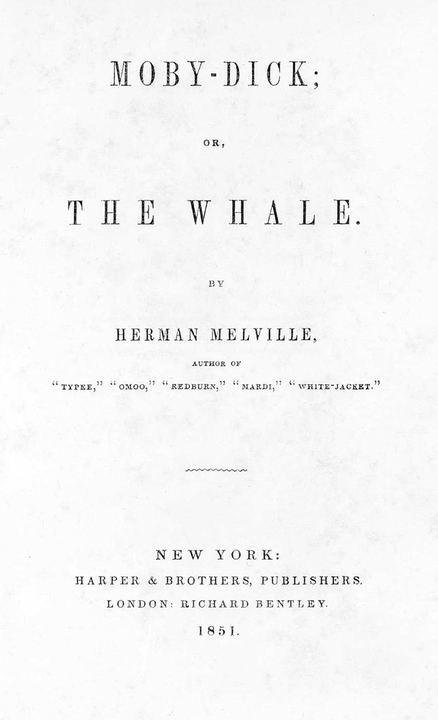
Melville began the book in 1850 as a whaling adventure and, under the influence of Shakespeare and his new friendship with Hawthorne, to whom he dedicated it, expanded it into the work he finished in 1851. It was published in London in October 1851 as The Whale, in three volumes with some cuts, and in New York in November as Moby-Dick; or, The Whale. The attached Gutenberg text follows the American edition.
Reception
Contemporary reviews were mixed, sales were modest, and Melville was largely forgotten by the time of his death. A revival in the 1920s, led by Raymond Weaver's biography and critics such as D. H. Lawrence and Lewis Mumford, established Moby-Dick as one of the great American novels, and its opening line is among the most quoted in literature.
Comparisons
- billy-budd-and-other-stories
Melville's last sea story sets an innocent sailor against a dark master-at-arms under naval law, a more compressed tragedy than Ahab's.
- hamlet
Ahab's soliloquies and his doomed mission of revenge owe much to Shakespeare's tragedies, which Melville read closely while writing.
- the-narrative-of-arthur-gordon-pym-of-nantucket
Poe's earlier Nantucket voyage also mixes sea adventure with a mysterious whiteness at the edge of the known world.
- the-old-man-and-the-sea
Hemingway's fisherman also struggles alone with a great creature of the sea, but with humility and respect rather than hatred.
- the-bible
The names Ishmael, Ahab, Elijah and Rachel, Father Mapple's Jonah and the Leviathan of Job all come from Scripture.
Quotes
Frequently cited
“Call me Ishmael.”
Frequently cited
“Better sleep with a sober cannibal than a drunken Christian.”
Frequently cited
“All visible objects, man, are but as pasteboard masks.”
Frequently cited
“Talk not to me of blasphemy, man; I’d strike the sun if it insulted me.”
Frequently cited
“all my means are sane, my motive and my object mad”
Frequently cited
“Towards thee I roll, thou all-destroying but unconquering whale; to the last I grapple with thee; from hell’s heart I stab at thee; for hate’s sake I spit my last breath at thee.”
Frequently cited
“It was the devious-cruising Rachel, that in her retracing search after her missing children, only found another orphan.”
“whenever it is a damp, drizzly November in my soul; whenever I find myself involuntarily pausing before coffin warehouses, and bringing up the rear of every funeral I meet”
“Delight is to him, who gives no quarter in the truth, and kills, burns, and destroys all sin though he pluck it out from under the robes of Senators and Judges.”
“all deep, earnest thinking is but the intrepid effort of the soul to keep the open independence of her sea”
“To be enraged with a dumb thing, Captain Ahab, seems blasphemous.”
“so in the soul of man there lies one insular Tahiti, full of peace and joy, but encompassed by all the horrors of the half known life. God keep thee! Push not off from that isle, thou canst never return!”
“There is a wisdom that is woe; but there is a woe that is madness.”
“Close! stand close to me, Starbuck; let me look into a human eye; it is better than to gaze into sea or sky; better than to gaze upon God.”
For Students
A reading companion for classical Christian high school students. See the student guide.
Reading Guide
Watch for
- School Launch reads parent-chosen selections; a strong set is Chapters 1-3, 9, 16, 28, 36, 41-42, 93, 132 and 133-135 with the Epilogue, and the full text is here for those who want it all.
- How Ishmael's fear of Queequeg turns into friendship in the first chapters.
- Father Mapple's sermon in Chapter 9 and its lesson about Jonah's flight and repentance.
- Ahab's speeches in Chapter 36 and Starbuck's objections, then their last exchanges in Chapters 132 and 135.
- The repeated question 'Hast seen the White Whale?' at each meeting with another ship.
Key terms and names
- Gam
- A social visit between two whaling ships meeting at sea, with exchange of news and letters.
- Lowering
- Putting the whaleboats into the sea to chase a whale.
- Try-works
- The brick furnace on deck in which blubber is boiled down into oil.
- Harpooneer
- The man in each boat who darts the harpoon into the whale; Queequeg, Tashtego and Daggoo are the Pequod's.
- Monomania
- A nineteenth-century term for madness fixed on a single idea while reason works normally in other matters; Ishmael uses it of Ahab.
- Leviathan
- The great sea creature of the Book of Job, which Melville identifies with the whale.
- Soliloquy
- A speech spoken alone, as on a stage; several chapters are written as Shakespearean soliloquies with stage directions.
Seminar Questions
- Comprehension How did Ahab lose his leg, and what does he announce to the crew in Chapter 36?
- Comprehension What happens to Pip in Chapter 93, and how does it change him?
- Comprehension How does Ishmael survive the sinking of the Pequod?
- Interpretation Why does the crew follow Ahab when Starbuck has shown that the hunt is madness?
- Interpretation What does the whiteness of the whale mean to Ishmael in Chapter 42, and why does it appal him?
- Interpretation What makes Ahab's refusal of the Rachel the turning point of his character?
- Big Question Is Ahab's defiance a form of greatness, or only pride? How does Father Mapple's sermon help you decide?
Faith Connections
- Jonah 1-2 (Scripture)
Father Mapple preaches on Jonah fleeing God's call and being swallowed by the great fish, drawing the lesson of obedience that Ahab rejects.
- Job 41 (Scripture)
God's challenge to Job describes Leviathan as a creature no man can master; its line 'Leviathan maketh a path to shine after him' is among the Extracts that open the book.
- 1 Kings 21-22 (Scripture)
The wicked King Ahab, warned by Elijah, dies in battle as foretold; Melville's Ahab is warned by a prophet named Elijah on the Nantucket wharf.
- Jeremiah 31:15 (Scripture)
Rachel weeping for her children, and refusing to be comforted; the ship Rachel searches for her lost boys and finds Ishmael instead.
Logic and Rhetoric
Central argument: Ahab believes the white whale embodies a malice behind the world and that striking it will strike through the mask. Starbuck, Father Mapple and the Rachel all show the claims of duty, obedience and mercy he refuses. His pursuit destroys his ship and crew. Therefore the novel warns that pride which makes itself the judge of creation ends in self-destruction.
Rhetorical device: anaphora. Father Mapple repeats 'Delight is to him' at the start of clause after clause, building the end of his sermon into a rising chant.
Debate: Resolved: that Starbuck should have stopped Ahab by force.
Memory Work
Call me Ishmael.
There is a wisdom that is woe; but there is a woe that is madness.
Writing Prompts
Essay: Trace Starbuck's opposition to Ahab from Chapter 36 through Chapters 123, 132 and 135, and argue why he never stops him.
Comparison with The Old Man and the Sea: Ahab and Santiago both pursue a great creature of the sea. Compare their attitudes toward it and argue what each story teaches about pride and humility.
Medical Lens
Moby-Dick is a central literary study of monomania, a term from early nineteenth-century psychiatry for insanity fixed on a single object while reasoning otherwise remains intact; Ishmael uses it of Ahab repeatedly and has him know that his means are sane and his motive mad. The novel sets Ahab's fixed idea beside the cabin boy Pip's derangement after being abandoned in the open sea, and Ishmael's own opening melancholy, his hypos, for which going to sea is his substitute for pistol and ball. Ahab's amputated leg, the splintering of his ivory limb and the injury it causes, Queequeg's wasting fever, and the comic ship's surgeon Dr Bunger of the Samuel Enderby, who treats a captain's lost arm, give the book a vivid picture of injury and medicine at sea.
- Chapter 1
Ishmael's hypos and his going to sea as a substitute for pistol and ball.
- Chapter 41
The history of Ahab's injury and the growth of his monomania during the long voyage home.
- Chapter 93
Pip is left alone in the sea and goes about the deck thereafter so changed that his shipmates call him mad, though his speech holds strange wisdom.
- Chapter 100
The Samuel Enderby's Captain Boomer and Dr Bunger describe the loss of his arm to Moby Dick.
- Chapter 106
Ahab's ivory leg is splintered and its injury to him described.
- Chapter 110
Queequeg wastes with fever, orders his coffin and recovers.
Listen to the book
Public-domain audiobook from LibriVox, read by Stewart Wills. Recording: Moby Dick, or the Whale on LibriVox (Internet Archive).
LibriVox recordings are volunteer readings released into the public domain. The reading may follow a different edition from the text in this library.
Creative Prompts
- Classroom
Read Chapter 36, The Quarter-Deck, aloud as a scene, with students as Ahab, Starbuck, Stubb and the crew, and discuss why the crew follows Ahab.
- Essay
Compare Father Mapple's Jonah in Chapter 9 with Ahab in Chapter 36 and argue what Melville wants readers to learn from the contrast.
- Dialogue
Write the conversation between Ishmael and the captain of the Rachel on the day he is picked up.
Further Reading
- Narrative of the Most Extraordinary and Distressing Shipwreck of the Whale-Ship Essex, Owen Chase
- The Natural History of the Sperm Whale, Thomas Beale
- Herman Melville: Mariner and Mystic, Raymond Weaver
- Typee, Herman Melville
Verification notes
Plot, sources and publication history are standard. Chapter locators follow the attached Gutenberg text of the American edition. Quotes are verified against that text. The full text is stored; School Launch uses parent-chosen selections.
No verification flags recorded.