Work record
The Great Gatsby
1925 · Early 20th Century · Novel · English
Abstract
Background. Fitzgerald started the book in Great Neck, Long Island, finished most of it on the Riviera, and saw it issued by Scribner's in 1925 with Maxwell Perkins as editor. Prohibition, bootleg fortunes and the Black Sox scandal form its backdrop.
Plot. Renting a cottage in West Egg, Nick watches his neighbor stage huge parties in hope that Daisy, married to the brutish Tom, will wander in. Nick brings the former lovers together for tea and their affair revives, until a confrontation in a Plaza suite breaks it. Daisy, at the wheel of Gatsby's car, runs down Tom's mistress; Gatsby shields her, and the bereaved husband shoots him. Hardly anyone attends the burial.
Structure. Nick tells the story a year or two later, withholding Gatsby's origins until the middle and his Louisville romance until Chapter VIII, so the man is revealed in layers.
Themes. Wealth inherited and wealth made, love turned into idolatry, the attempt to relive a lost month, and the cost of carelessness borne by those with least protection.
Significance. A commercial disappointment for its author, the book was revived through wartime soldiers' editions and postwar teaching, and its closing image of the green light is among the most quoted passages in American prose.
Main characters
- Nick Carraway: Narrator, bond salesman and Gatsby's neighbor
- Jay Gatsby: Self-invented millionaire, formerly James Gatz of North Dakota
- Daisy Buchanan: Nick's cousin and Gatsby's lost Louisville love
- Tom Buchanan: Daisy's domineering, unfaithful husband
- Jordan Baker: Tournament golfer and Nick's evasive companion
- Myrtle Wilson: Tom's mistress, struck dead on the road
- George Wilson: Garage owner who avenges his wife
- Meyer Wolfshiem: Gambler and Gatsby's business partner

Summary
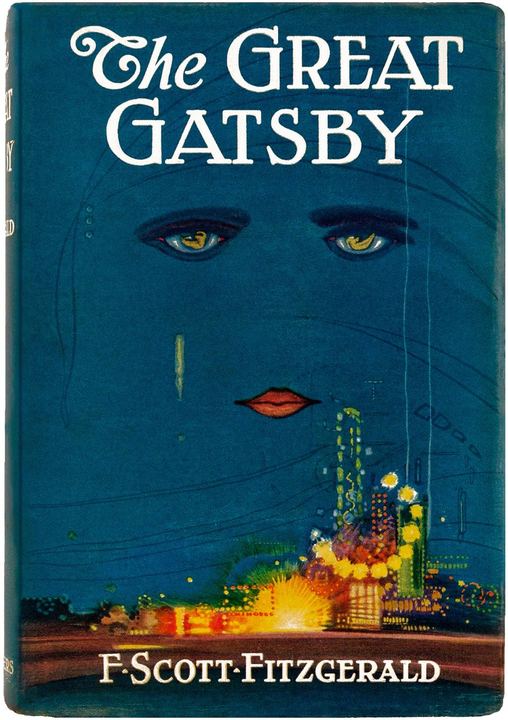
The Great Gatsby is narrated by Nick Carraway, a young Midwesterner and war veteran who comes East in the spring of 1922 to learn the bond business and rents a small house in West Egg, on Long Island, beside the vast mansion of the mysterious Jay Gatsby. Across the bay in fashionable East Egg live Nick's cousin Daisy Buchanan and her husband Tom, a rich former Yale football player, along with Daisy's friend Jordan Baker, a champion golfer. On his first evening Nick learns that Tom has a mistress, and later he sees Gatsby alone on his lawn, stretching his arms toward a green light at the end of Daisy's dock. Tom takes Nick to meet the mistress, Myrtle Wilson, wife of a worn-out garage owner in the valley of ashes, a dumping ground watched over by the faded billboard eyes of Doctor T. J. Eckleburg; at a drunken party in a Manhattan apartment Tom breaks Myrtle's nose. Nick attends one of Gatsby's enormous parties, where guests trade rumors that their host killed a man or was a German spy. Gatsby, who calls everyone old sport, introduces Nick to the gambler Meyer Wolfshiem, the man said to have fixed the 1919 World Series. Through Jordan, Nick learns that Gatsby and Daisy loved each other in Louisville in 1917, before he went to war, and that he bought his house to be across the water from her. Nick arranges a tea where the two meet again; Gatsby shows Daisy his house and tosses his shirts before her, and their affair begins. In Chapter VI Nick reveals that Gatsby was born James Gatz to poor North Dakota farmers and reinvented himself at seventeen while working for the millionaire Dan Cody. On a stifling afternoon at the Plaza Hotel, Tom confronts Gatsby, exposes his fortune as bootlegging through drugstores, and Daisy cannot say she never loved Tom. Driving home in Gatsby's yellow car, Daisy strikes and kills Myrtle, who has run into the road; Gatsby resolves to take the blame. Tom tells the grieving George Wilson whose car it was, and Wilson shoots Gatsby in his swimming pool and then kills himself. The Buchanans leave town without a word. Almost no one comes to the funeral except Nick, Gatsby's father Henry C. Gatz, who proudly shows a boyhood schedule of self-improvement, and a guest Nick calls Owl Eyes. Disgusted with the East, Nick breaks with Jordan, refuses Tom's hand, and returns West, reflecting on Gatsby's hope and the Dutch sailors who first saw the green breast of the new world. Charles Scribner's Sons published the novel on 10 April 1925, with Francis Cugat's cover of eyes above a carnival skyline. It sold modestly in Fitzgerald's lifetime and became a standard American classic after the Second World War.
Virtues in this work
- Hope: Gatsby keeps faith for five years that he can win Daisy back, which Nick calls an extraordinary gift for hope even as it destroys him.
- Friendship: Nick alone stays to arrange Gatsby's funeral and tries to bring his so-called friends to it.
- Honor: Nick ends his romance with Jordan face to face, telling her he is too old to lie to himself and call it honour.
- Industry: The boyhood schedule Henry Gatz shows Nick records young Jimmy's plan of exercise, study and self-improvement.
Plot or Argument
- Chapter I: West Egg and East Egg
Nick recalls his father's advice about judgment, settles in West Egg, dines with Tom and Daisy Buchanan and Jordan Baker, hears that Tom has a woman in New York, and glimpses Gatsby reaching toward the green light.
- Chapter II: The valley of ashes
Tom introduces Nick to Myrtle Wilson at her husband's garage beneath Doctor T. J. Eckleburg's eyes; at an apartment party in New York, Tom breaks Myrtle's nose for repeating Daisy's name.
- Chapter III: Gatsby's party
Nick attends a lavish party, meets Gatsby without recognizing him, hears the rumors about his past, and begins seeing Jordan, whom he finds careless and dishonest.
- Chapter IV: The story of 1917
Gatsby tells Nick an inflated life story, takes him to lunch with Meyer Wolfshiem, and through Jordan asks Nick to invite Daisy to tea; Jordan tells of Daisy and Gatsby's wartime romance in Louisville.
- Chapter V: The reunion
Gatsby and Daisy meet awkwardly at Nick's cottage in the rain, then tour Gatsby's mansion; the green light loses its enchantment now that Daisy is near.
- Chapter VI: James Gatz
Nick tells Gatsby's origins on a North Dakota farm and his years with Dan Cody; Tom and Daisy attend a party that Daisy dislikes; Gatsby insists the past can be repeated.
- Chapter VII: The Plaza and the road
On the hottest day of summer, the group drives into New York; Tom confronts Gatsby at the Plaza and Daisy wavers; on the way home Daisy, driving Gatsby's car, kills Myrtle.
- Chapter VIII: The pool
Gatsby tells Nick of his first love for Daisy; Nick tells Gatsby he is worth the whole bunch; George Wilson, grieving through the night, tracks down Gatsby and shoots him in the pool before killing himself.
- Chapter IX: After
Gatsby's friends abandon him, his father arrives from Minnesota, the funeral is nearly empty, and Nick leaves the East with his final meditation on the green light and the past.
Characters
- Nick Carraway, narrator
A Yale graduate and veteran from the Middle West who sells bonds in New York and judges the Easterners he lives among.
- Jay Gatsby, title character
Born James Gatz; a self-made millionaire of shadowy business who throws great parties in the hope of winning back Daisy.
- Daisy Buchanan, Nick's cousin
Gatsby's lost love from Louisville, charming and enchanting, whose voice Gatsby says is full of money.
- Tom Buchanan, Daisy's husband
A wealthy, physically powerful former athlete who keeps a mistress and defends his marriage and position fiercely.
- Jordan Baker, golfer
Daisy's friend, a cool and evasive tournament golfer rumored to have cheated, with whom Nick has a brief romance.
- Myrtle Wilson, Tom's mistress
The vital, restless wife of a garage owner, killed by Gatsby's car.
- George Wilson, garage owner
Myrtle's exhausted husband, who comes to believe the driver was her lover and kills Gatsby.
- Meyer Wolfshiem, gambler
Gatsby's business associate, said to have fixed the 1919 World Series.
- Henry C. Gatz, Gatsby's father
A plain old man who comes from the West for the funeral, proud of his son's success.
- Owl Eyes, party guest
A spectacled man found in Gatsby's library amazed that the books are real; one of the few at the funeral.
Lessons
A dream fixed on the past
Gatsby builds his whole life to recover one month in Louisville in 1917, and when Nick warns that the past cannot be repeated, Gatsby cries that of course it can. The novel shows how a love turned into an idol cannot survive contact with the living person, who is smaller than the dream.
- What does Gatsby want from Daisy besides Daisy herself?
- Why does the green light lose its meaning once Gatsby and Daisy are reunited in Chapter V?
- Is Gatsby's hope admirable, foolish, or both?
Careless wealth
Tom and Daisy retreat into their money after Myrtle's death and leave others to pay. Fitzgerald separates the old money of East Egg from Gatsby's new money, but the deeper contrast is between people who take responsibility and those who do not.
- Who is responsible for Myrtle's death, and who for Gatsby's?
- Why does Nick refuse to shake Tom's hand at first in Chapter IX, then give in?
- Is Gatsby less careless than the Buchanans?
A narrator who judges
Nick opens by claiming he reserves judgments, yet the novel is full of his verdicts. Reading Gatsby well means weighing Nick's witness: what he admires, what he hides about his own part, and why he is glad he told Gatsby he was worth the whole bunch.
- How honest is Nick about his own role in the affair between Gatsby and Daisy?
- Why does Nick say Gatsby turned out all right at the end?
Self-invention and its limits
James Gatz invents Jay Gatsby out of a boyhood schedule of exercise and study, Dan Cody's yacht and an Oxford term after the war. The novel honors his discipline and imagination while showing how much of the new self rests on lies and crime.
- What does the schedule in the Hopalong Cassidy book reveal about young Jimmy Gatz?
- What would Gatsby have had to give up to win Daisy honestly?
- Can a person remake himself without denying where he came from?
Context
The novel is set in the summer of 1922, in the boom years after the First World War, when Prohibition (from 1920) made bootlegging a path to sudden fortune and the North Shore of Long Island was dotted with great estates. The rumor that Wolfshiem fixed the 1919 World Series alludes to the Black Sox scandal, and Gatsby's war service and brief Oxford term reflect the postwar arrangements that let some American officers study at British universities.
Composition
Fitzgerald began the novel while living in Great Neck, Long Island, the model for West Egg, and wrote most of it in France in 1924. He considered titles such as Trimalchio in West Egg before settling on The Great Gatsby. Charles Scribner's Sons published it on 10 April 1925 in a first printing of 20,870 copies; Maxwell Perkins was his editor. The library text, from Project Gutenberg, follows the 1925 first edition, which prints orgiastic in the final page where Fitzgerald's manuscript is often said to read orgastic.
Reception
Reviews were mixed and sales were well below Fitzgerald's earlier novels; T. S. Eliot wrote to Fitzgerald that it was the first step American fiction had taken since Henry James. In 1945 the Armed Services Editions printed 155,000 copies for American soldiers, and postwar critics and schools made it one of the most widely taught American novels. It entered the United States public domain on 1 January 2021.
Comparisons
- great-expectations
Pip and Gatsby both remake themselves into gentlemen for love of a cold, unattainable woman, Estella or Daisy, and both learn what their new status was built on.
- franklin-autobiography-and-poor-richard
Young Jimmy Gatz's handwritten schedule and list of general resolves imitates Franklin's famous plan for moral perfection, turning the self-improvement tradition toward money and Daisy.
- my-antonia
Both novels are told by a Midwestern man looking back on a remembered figure who embodies a dream; Cather's Jim Burden finds lasting value in Ántonia where Nick finds Gatsby's dream already behind him.
- death-of-a-salesman
Willy Loman and Gatsby both stake everything on an American promise of success and die for it; Miller's family drama sets the dream in a Brooklyn kitchen rather than a Long Island mansion.
- daisy-miller
Henry James's American Daisy dies of fever in Rome and Fitzgerald's survives untouched, but in both the young woman's charm is read by a watching male narrator who cannot decide what she really is.
- this-side-of-paradise
Fitzgerald's first novel (1920) follows Amory Blaine through Princeton and the war years; its themes of romantic ambition, money and disillusion return in a more controlled form in Gatsby.
Quotes
Frequently cited
“just remember that all the people in this world haven’t had the advantages that you’ve had.”
Frequently cited
“Her voice is full of money”
Frequently cited
“They were careless people, Tom and Daisy—they smashed up things and creatures and then retreated back into their money or their vast carelessness”
Frequently cited
“So we beat on, boats against the current, borne back ceaselessly into the past.”
“it was an extraordinary gift for hope, a romantic readiness such as I have never found in any other person”
“He was a son of God—a phrase which, if it means anything, means just that—and he must be about His Father’s business, the service of a vast, vulgar, and meretricious beauty.”
“You’re worth the whole damn bunch put together.”
“Gatsby believed in the green light, the orgiastic future that year by year recedes before us.”
For Students
A reading companion for classical Christian high school students. See the student guide.
Reading Guide
Watch for
- Every appearance of the green light, from Gatsby's outstretched arms in Chapter I to Nick's last meditation in Chapter IX.
- The eyes of Doctor T. J. Eckleburg over the valley of ashes, and what George Wilson makes of them in Chapter VIII.
- The moments where Nick's opening claim to reserve judgment collides with his verdicts on Tom, Daisy, Jordan and Gatsby.
- Weather and heat: the rain at the reunion in Chapter V and the hottest day of the summer in Chapter VII.
- Who comes to Gatsby's parties and who comes to his funeral.
Key terms and names
- West Egg and East Egg
- Two Long Island peninsulas across a bay; East Egg holds the inherited wealth of the Buchanans, West Egg the newer money of Gatsby.
- Valley of ashes
- A gray dumping ground between West Egg and New York where the Wilsons live, overlooked by an oculist's billboard.
- Old sport
- Gatsby's affected English-style form of address, which Tom mocks at the Plaza as proof that Gatsby is a fraud.
- Bootlegging
- Illegal trade in alcohol under Prohibition; Tom charges that Gatsby's fortune comes from it.
- Dan Cody
- A millionaire copper man whose yacht seventeen-year-old James Gatz rowed out to, beginning his new life as Jay Gatsby.
- Unreliable narrator
- A teller whose account the reader must weigh; Nick's partial knowledge and loyalties shape what we learn of Gatsby.
Seminar Questions
- Comprehension How did Gatsby and Daisy first meet, and what separated them?
- Comprehension What happens on the drive back from the Plaza Hotel, and who is driving the yellow car?
- Comprehension How does George Wilson come to believe that Gatsby killed Myrtle?
- Interpretation Nick calls Gatsby a son of God about His Father's business. What does this borrowed phrase suggest about the self Gatsby invented?
- Interpretation Why does Nick say that Gatsby turned out all right at the end, after everything he has learned about him?
- Interpretation What do the billboard eyes of Doctor T. J. Eckleburg mean to Wilson, and what do they mean in the novel as a whole?
- Big Question Can the past be repeated, and what happens to a person who builds his life on trying?
- Big Question Is hope a virtue when it is fixed on the wrong object?
Faith Connections
- Luke 2:49 (Scripture)
The boy Jesus tells Mary and Joseph that he must be about his Father's business. Fitzgerald borrows the phrase for Gatsby's self-creation, so the contrast between the true Son and the self-made one is built into the text.
- Ecclesiastes 2:1-11 (Scripture)
The Preacher builds houses, plants vineyards, gathers silver and gold and singers, and finds it all vanity. Gatsby's mansion, parties and shirts are made for one person and leave him alone.
- Proverbs 15:3 (Scripture)
The eyes of the Lord are in every place, beholding the evil and the good. George Wilson, crazed with grief, says God sees everything while staring at an advertisement; the novel leaves open whether any eyes truly watch over the valley of ashes.
- Augustine, Confessions IV (Church Fathers)
Augustine describes his grief over a friend he had loved as if he would never die, and concludes that only love of God in what we love can rest secure. Gatsby loves Daisy, and a lost moment, in just the way Augustine warns against.
Logic and Rhetoric
Central argument: Gatsby gives his whole life to a dream of recovering Daisy and the past. But Daisy is a person, not the dream, and the past cannot be relived; the wealthy world he enters protects its own and abandons outsiders. Therefore his hope, though more noble than the people around him, is destroyed by being fixed on something that could never bear its weight.
Rhetorical device: symbolism. The green light at the end of Daisy's dock appears in Chapter I, loses its enchantment in Chapter V, and in Chapter IX becomes the orgiastic future that year by year recedes before us.
Debate: Resolved: that Nick Carraway shares responsibility for Gatsby's death.
Memory Work
So we beat on, boats against the current, borne back ceaselessly into the past.
just remember that all the people in this world haven’t had the advantages that you’ve had.
Writing Prompts
Essay: Is Gatsby great? Using his rise, his parties, his love for Daisy and his funeral, argue in what sense the title is meant.
Comparison with Great Expectations: Pip and Gatsby both become gentlemen for the sake of a woman. Compare what each learns about the source of his fortune and argue which novel offers more hope.
Medical Lens
The novel is not medical, but its world runs on Prohibition liquor. Tom says Gatsby and Wolfshiem bought up side-street drugstores and sold grain alcohol over the counter, which points to the period's real loophole: pharmacists could dispense alcohol for medicinal use on a physician's prescription, and drugstore chains were suspected of serving as fronts. Drinking shapes nearly every scene, from Myrtle's apartment party to Gatsby's lawns. George Wilson, already described as pale and sick, spends the night after Myrtle's death rocking and talking to Michaelis before killing Gatsby and himself, a portrait of grief turning into fixed resolve that should not be pressed into a modern diagnosis. Myrtle's death in the road is described with blunt physical detail. Tom's enthusiasm in Chapter I for a book about the threat of rising races by a writer he calls Goddard reflects the popular hereditarian writing of the early 1920s.
- Chapter II
The drunken apartment party ends when Tom breaks Myrtle's nose with his open hand.
- Chapter VII
Tom accuses Gatsby of selling grain alcohol over the counter through drugstores in New York and Chicago.
- Chapter VII
Myrtle runs into the road and is killed by Gatsby's car; the scene at the garage and the body are described.
- Chapter VIII
Wilson's night of grief with Michaelis, his fixation on the billboard eyes as the eyes of God, and the murder of Gatsby and Wilson's suicide.
Listen to the book
Public-domain audiobook from LibriVox, read by Various volunteers. Recording: Great Gatsby (Version 5 Dramatic Reading) on LibriVox (Internet Archive).
LibriVox recordings are volunteer readings released into the public domain. The reading may follow a different edition from the text in this library.
Creative Prompts
- Fiction
Write the afternoon of Chapter VII from Daisy's point of view, ending as she takes the wheel of the yellow car.
- Essay
Track the green light through Chapters I, V and IX and argue what it means at each appearance.
- Dialogue
Write the conversation Nick might have had with Henry C. Gatz on the evening after the funeral.
- Classroom
Map West Egg, East Egg, the valley of ashes and Manhattan, and place each major scene on the map; discuss what each location says about the people in it.
Further Reading
- Tender Is the Night, F. Scott Fitzgerald
- This Side of Paradise, F. Scott Fitzgerald
- Some Sort of Epic Grandeur: The Life of F. Scott Fitzgerald, Matthew J. Bruccoli
- Careless People: Murder, Mayhem, and the Invention of The Great Gatsby, Sarah Churchwell
Verification notes
Plot, chapter structure and characters follow the attached Project Gutenberg text of the 1925 edition. The publication date and first printing of 20,870 copies, and the 155,000-copy Armed Services Edition of 1945, were checked against the Library of Congress blog and Carleton College's account (https://blogs.loc.gov/bibliomania/2025/04/10/the-not-so-great-gatsby/; https://www.carleton.edu/voice/stories/object-lessons-the-great-gatsby-armed-services-edition/). The identification of Tom's Goddard with real writers of the period is a common critical reading, not stated in the novel, so the record leaves it general. Quotes were checked against the attached text.
- Wording of T. S. Eliot's 1925 letter praising the novel; check against a published edition of Fitzgerald's correspondence before quoting it.