Work record
Twenty Thousand Leagues Under the Sea
1869-1870 (French); English 1872-73 · 19th Century · Novel · French
Abstract
Background. Written for Hetzel's family magazine as part of the Voyages extraordinaires, the story drew on recent naval engineering, the Atlantic telegraph and popular oceanography. Verne kept his captain's homeland secret at his publisher's urging.
Plot. A naturalist sent to destroy a supposed sea monster is captured, with his servant and a harpooner, by the very vessel he was hunting. For ten months they share Nemo's underwater life: hunting on the ocean floor, burying a sailor among corals, crossing beneath Suez, standing at the South Pole, nearly suffocating under ice and fighting giant squid. After witnessing the Captain ram a warship in cold fury, the three flee in a small boat as the submarine plunges into a Norwegian whirlpool.
Themes. Scientific wonder, the price of absolute independence, grief hardening into vengeance, and the bonds of loyalty among captives. Nemo's tenderness toward his crew and his ruthlessness toward his enemy stand side by side, and the narrator never settles which is the truer man.
Significance. Nemo became one of fiction's great enigmatic outlaws and the Nautilus a byword for visionary technology; a later Verne novel, The Mysterious Island, supplies his history. The library's anonymous English version is abridged, so complete modern translations differ in wording and chapter numbering.
Main characters
- Pierre Aronnax: Parisian naturalist and physician who narrates the voyage
- Captain Nemo: Nameless engineer-genius who has renounced every nation
- Conseil: Devoted Flemish manservant with a passion for taxonomy
- Ned Land: Hot-tempered Canadian harpooner bent on escape
- Commander Farragut: Captain of the American frigate sent to hunt the monster

Summary
In 1866 ships in several oceans report a huge, swift, glowing creature, and some are holed by it. Pierre Aronnax, a professor at the Museum of Natural History in Paris who happens to be in New York, publishes the opinion that it is a gigantic narwhal and is invited to join the American frigate Abraham Lincoln, under Commander Farragut, which sails to hunt it. With him go his calm Flemish servant Conseil, who loves to classify every living thing, and the Canadian harpooner Ned Land. After months of searching, the frigate finds the monster in the Pacific off Japan; Ned's harpoon rings against metal, the creature rams the ship, and Aronnax, Conseil and Ned are thrown into the sea. They find themselves clinging to the back of a steel submarine boat, the Nautilus. Its commander, who calls himself Captain Nemo, has broken with all nations and lives only by the sea. He will not let his guests go, since they now know his secret, but he treats them as companions in a voyage of discovery. The Nautilus runs on electricity and carries a library, a museum of marine specimens and paintings, and an organ that Nemo plays at night. The prisoners walk on the sea floor in diving dress, hunt in the submarine forest of Crespo Island, see the wreck of La Perouse at Vanikoro, run aground in the Torres Straits, and watch Nemo drive off attacking Papuans with an electrified stair rail. After a drugged sleep during some unseen battle, Aronnax, who is also a physician, is asked to examine a crewman with a crushed skull, who dies and is buried in a coral cemetery. In Part Two Nemo saves an Indian pearl diver from a shark off Ceylon, passes from the Red Sea to the Mediterranean by a secret Arabian Tunnel, gathers Spanish treasure from the galleons sunk in Vigo Bay, and leads Aronnax by night to the ruins of Atlantis. On 21 March 1868 Nemo plants his black flag at the South Pole, but on the way north the Nautilus is trapped under the ice, and the men nearly suffocate before they break free. Giant poulps, or squid, seize a sailor, and Nemo weeps for him. Off Ireland the Captain visits the wreck of the Avenger, a French ship sunk in 1794 rather than surrender, and the next day rams and sinks a warship of an unnamed nation that has fired on him, then kneels sobbing before a portrait of a woman and two children. Ned plans an escape; as the three slip into the dinghy, the Nautilus is drawn into the Maelstrom off Norway, and they wake in a fisherman's hut in the Lofoten Islands, having travelled twenty thousand leagues in under ten months. The fate of Nemo is left unknown. The novel was serialized in Hetzel's Magasin d'education et de recreation from March 1869 to June 1870; the library text is an older anonymous English translation that shortens Verne in places.
Virtues in this work
- Friendship: Trapped under the Antarctic ice, Conseil and Ned give Aronnax the last good air in the diving tanks to keep him alive.
- Charity: Nemo dives against a shark to save a poor pearl fisher off Ceylon and leaves him a bag of pearls.
- Fortitude: When the ice closes around the Nautilus, the crew digs in shifts through the walls of ice while the air grows foul.
- Justice: Aronnax refuses to approve the sinking of the warship, saying that whatever Nemo had suffered, he had no right to punish thus.
Plot or Argument
- Part I, Chapters I-VII: The hunt for the monster
Ships report a vast unknown creature; Aronnax argues for a giant narwhal and sails with Conseil on the Abraham Lincoln, where he meets Ned Land; after a long search the frigate attacks, is rammed, and the three men are thrown overboard.
- Part I, Chapters VIII-XIV: Captain Nemo and the Nautilus
The castaways are taken inside the submarine; Nemo explains that he has done with society and that they may never leave; he shows them the library, the salon museum, the electric machinery and the motto Mobilis in Mobili.
- Part I, Chapters XV-XXI: The Pacific floor and the Papuan coast
Walks in diving dress through the forests of Crespo Island, the La Perouse wreck at Vanikoro, the grounding in the Torres Straits, a few days' hunting on land, and Nemo's electric defence against the Papuans.
- Part I, Chapters XXII-XXIII: Aegri Somnia and the Coral Kingdom
The prisoners are drugged and shut up during an unexplained encounter; Aronnax examines a dying crewman and attends his burial in the coral cemetery.
- Part II, Chapters I-V: Indian Ocean, Ceylon and the Arabian Tunnel
Nemo saves a pearl diver from a shark in the Gulf of Manaar, gives him pearls, and declares that he belongs with the diver's suffering people; the Nautilus crosses beneath the isthmus of Suez.
- Part II, Chapters VI-XI: Mediterranean, Vigo Bay, Atlantis
Nemo meets the Cretan diver Nicholas and sends gold toward the insurgents of Candia, harvests the sunken treasure of Vigo Bay, leads Aronnax to the ruins of Atlantis, and refuels in a volcanic coal mine before crossing the Sargasso Sea.
- Part II, Chapters XII-XVI: Whales, the Pole and the ice
Nemo destroys a herd of cachalots that attack whales, claims the South Pole on 21 March 1868, and is trapped beneath an iceberg until the crew cuts a trench and the ship's weight crushes through the last ice as the air runs out.
- Part II, Chapters XVII-XX: The poulps, the storm and the Avenger
Giant squid kill a sailor off the Bahamas; the Nautilus rides out a hurricane in the Gulf Stream, follows the Atlantic cable, and visits the wreck of the Avenger.
- Part II, Chapters XXI-XXIII: Hecatomb, flight and conclusion
Nemo sinks a pursuing warship with all hands; Aronnax hears his last cry to God; the three escape as the Nautilus enters the Maelstrom, and Aronnax writes his record in the Lofoten Islands.
Characters
- Pierre Aronnax, narrator
French professor of natural history, also trained as a physician, who is torn between wonder at the voyage and the wish to be free.
- Captain Nemo, commander of the Nautilus
Brilliant, cultured engineer who has renounced the land, gives in secret to suffering peoples, and nurses an unexplained hatred of one nation.
- Conseil, Aronnax's servant
Imperturbable Flemish servant who follows his master everywhere and classifies every fish he sees.
- Ned Land, harpooner
Canadian whaler of great strength and temper who never stops planning escape.
- Commander Farragut, captain of the Abraham Lincoln
American officer who leads the hunt for the supposed narwhal.
- The second officer of the Nautilus, Nemo's lieutenant
Unnamed mate who speaks only the crew's private language.
- The Ceylon pearl diver, rescued fisherman
Poor Indian diver whom Nemo saves from a shark and rewards with pearls.
- Nicholas (Pesca), Cretan diver
Swimmer from Cape Matapan who meets the Nautilus in the Greek islands.
Lessons
Wonder as a reason to study
Aronnax and Conseil meet the sea floor, the coral reefs and the polar ice with careful names and measurements, and their science deepens rather than dulls their delight. Verne makes classification, chemistry and navigation into adventure. The book shows that patient knowledge of creation can be a form of joy.
- Why does Conseil keep classifying fish even when the three men are in danger?
- Which scene beneath the sea did Verne describe most vividly for you, and what details made it real?
- Can learning the names of things make you love them more?
Freedom and its limits
Nemo tells Aronnax that beneath the surface he recognizes no masters and is free, yet he keeps three men prisoner for ten months. Ned Land, who loses the most by captivity, insists that no wonder is worth a man's liberty. The story asks whose freedom matters and whether one man may be a law to himself.
- Is Nemo free, or is he a prisoner of his own past?
- Was Ned Land right to keep trying to escape when Aronnax wanted to stay and learn?
- Why does Nemo say he will not obey the laws of society?
Mercy and vengeance in one man
Nemo risks his life to save a pearl diver, weeps over his dead sailors, and sends treasure to people fighting for their country. The same man sinks a warship with all its crew and then sobs before the portrait of his family. Verne lets readers see how grief, nursed into hatred, can twist a generous heart.
- What good things does Nemo do in the book, and what terrible thing does he do?
- Why does Aronnax say Nemo had no right to punish as he did, whatever he had suffered?
- What does Aronnax hope for Nemo at the very end?
Courage and friendship under pressure
When the Nautilus is trapped beneath the ice, Conseil and Ned give their last breaths of good air to Aronnax, and the crew works in turns to cut through the ice. Faithfulness among friends is tested most when the danger is slow and suffocating, not sudden.
- What do Conseil and Ned do for Aronnax when the air runs out?
- How is courage in a slow danger different from courage in a sudden fight?
Context
Verne wrote in the decade when submarine telegraph cables, ironclad rams and early submarines were in the news. The French navy's Plongeur had been built in the early 1860s, Robert Fulton had already named an experimental submarine Nautilus around 1800, and the Atlantic cable was completed in 1866; Aronnax describes the cable lying on the ocean floor. The novel also reflects the age's passion for natural history and its fascination with the unexplored poles and ocean depths.
Composition
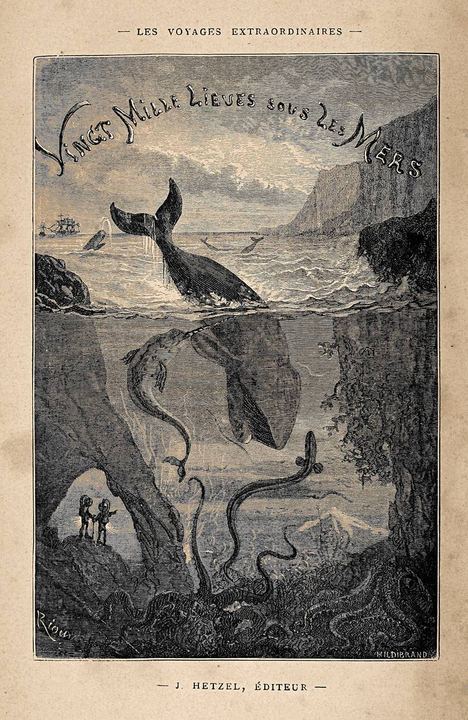
Vingt mille lieues sous les mers was serialized in Pierre-Jules Hetzel's Magasin d'education et de recreation from March 1869 to June 1870 and published by Hetzel in two parts; the illustrated edition of 1871 carried pictures by Alphonse de Neuville and Edouard Riou. Verne's letters with Hetzel indicate that Nemo was first imagined as a Pole avenging the Russian crushing of his country, and that the publisher urged him to keep the Captain's nation hidden. English versions appeared in 1872-73; the library text is an older anonymous translation that shortens and simplifies parts of the French.
Reception
The book became one of the most widely read of Verne's Voyages extraordinaires and has been translated into many languages. Verne gave Nemo an origin in The Mysterious Island (1874-75). Captain Nemo and the Nautilus became lasting figures of popular imagination, and the United States Navy gave the name Nautilus to its first nuclear submarine, launched in 1954.
Comparisons
- moby-dick
Both books follow a captain of commanding intellect who has turned grief into a private war at sea, seen through a narrator who admires and fears him; Ahab hunts a whale, while Nemo defends whales and hunts warships.
- around-the-world-in-eighty-days
Verne's other great circuit of the globe sets a punctual Englishman racing across the surface of the world by rail and steamer, where Nemo wanders slowly beneath it with no wish ever to arrive.
- robinson-crusoe
Nemo, like Crusoe, builds a whole self-sufficient world from his own skill and stores, but Crusoe longs to return to society while Nemo has fled it on purpose.
- frankenstein
Both novels set a solitary genius beyond the reach of ordinary law and ask what his discoveries cost the people around him; Aronnax, like Walton, tells the story of a man he cannot save.
- the-swiss-family-robinson
Both books, popular with young readers, turn natural history into adventure and teach readers the names and uses of plants and animals along the way.
Quotes
Frequently cited
“I am not what you call a civilised man! I have done with society entirely, for reasons which I alone have the right of appreciating.”
Frequently cited
“The sea is everything. It covers seven-tenths of the terrestrial globe. Its breath is pure and healthy. It is an immense desert, where man is never lonely, for he feels life stirring on all sides.”
“Yes, forgotten by all else, but not by us. We dug the grave, and the polypi undertake to seal our dead for eternity.”
“That Indian, sir, is an inhabitant of an oppressed country; and I am still, and shall be, to my last breath, one of them!”
“I am the law, and I am the judge! I am the oppressed, and there is the oppressor! Through him I have lost all that I loved, cherished, and venerated”
“Almighty God! enough! enough!”
“May the judge disappear, and the philosopher continue the peaceful exploration of the sea!”
For Students
A reading companion for classical Christian high school students. See the student guide.
Reading Guide
Watch for
- The moment Ned Land's harpoon rings against metal and the monster turns out to be a machine.
- The motto Mobilis in Mobili and what it says about Nemo's life.
- The burial in the coral cemetery at the end of Part I, and how Nemo behaves afterward.
- Nemo's rescue of the pearl diver off Ceylon and what he says about the diver's country.
- The days beneath the Antarctic ice when the air runs out, and what Conseil and Ned do for Aronnax.
Key terms and names
- Nautilus
- Nemo's electric submarine, shaped like a long steel cigar, with a sharp spur in front for ramming.
- League
- An old measure of distance of roughly three miles; the twenty thousand leagues of the title are the distance travelled, not the depth reached.
- Mobilis in Mobili
- Latin for moving in a moving element; Nemo's motto, stamped on the ship's belongings.
- Narwhal
- An Arctic whale with a long tusk; Aronnax first guesses the monster is a giant one.
- Poulp
- The old word in this translation for an octopus or squid; giant poulps attack the Nautilus in Part II.
- Maelstrom
- A dangerous whirlpool off the coast of Norway into which the Nautilus is drawn at the end.
- The Avenger
- A French warship that sank rather than surrender in 1794; Nemo visits its wreck the day before his own act of vengeance.
Seminar Questions
- Comprehension How do Aronnax, Conseil and Ned Land end up aboard the Nautilus?
- Comprehension Why will Captain Nemo not let his three guests leave?
- Comprehension What happens when the Nautilus is trapped beneath the ice near the South Pole?
- Interpretation Each of the three captives answers captivity differently: Aronnax with study, Conseil with loyalty, Ned with plans to escape. Which response does Verne seem to admire most?
- Interpretation Why does Verne place the visit to the wreck of the Avenger just before Nemo sinks the warship?
- Interpretation Nemo hides his name, his nation and his past. How does the mystery make him more frightening, and how does it make him more pitiable?
- Big Question Can a person who has been deeply wronged ever rightly make himself the judge of those who wronged him?
Faith Connections
- Ecclesiastes 7:24 (Scripture)
Aronnax closes the book with the Preacher's question about what is far off and exceeding deep, and claims that he and Nemo alone can answer it. The verse in Ecclesiastes is about the limits of human wisdom, which sets the boast against a humbler background.
- Romans 12:19 (Scripture)
Vengeance is mine, I will repay, saith the Lord. Nemo calls himself the law and the judge; Aronnax's horror after the sinking echoes Paul's warning against taking vengeance into one's own hands.
- Psalm 104:24-26 (Scripture)
The psalmist praises the great and wide sea with creatures innumerable; Aronnax's wonder at the life of the deep is the scientist's version of this praise.
- Augustine, Confessions X (Great Conversation)
Augustine writes that men go abroad to wonder at the waves of the sea and pass themselves by without wondering. Nemo, who knows every ocean, has never made peace with his own heart.
Logic and Rhetoric
Central argument: Knowledge and power cut loose from human society can produce marvels, as the Nautilus shows; but a man who answers to no law except his own grief will turn those marvels to vengeance. Therefore wonder at creation, which Aronnax hopes will finally heal Nemo, is a better master for science than hatred.
Rhetorical device: catalogue. Aronnax and Conseil list fish, shells and corals by their scientific names throughout the voyage, and in Part II, Chapter XXII Aronnax runs through every event of the voyage in one breathless list, from the Torres Straits to the Avenger.
Debate: Resolved: that Aronnax was right to stay aboard the Nautilus for the sake of science rather than help Ned Land escape at the first chance.
Memory Work
The sea is everything. It covers seven-tenths of the terrestrial globe. Its breath is pure and healthy. It is an immense desert, where man is never lonely, for he feels life stirring on all sides.
May the judge disappear, and the philosopher continue the peaceful exploration of the sea!
Writing Prompts
Essay: Is Captain Nemo a hero or a villain? Use his rescue of the pearl diver, his grief at the coral cemetery and the sinking of the warship to argue your answer.
Comparison with Moby-Dick: Compare Captain Nemo and Captain Ahab: what each has lost, what each hunts, and how each narrator judges his captain.
Medical Lens
Medicine is a minor strand in an adventure of natural history, but Verne gives it a few exact scenes. Aronnax reveals that he practised as a doctor and resident hospital surgeon before entering the museum, and Nemo calls on him to examine a crewman whose skull has been shattered; the narrator's description of exposed, bruised brain, slow breathing, facial spasms, an intermittent pulse and cooling limbs is a period bedside account of a fatal head wound, and he can only dress it and predict death. Earlier the prisoners are put into a heavy, sudden sleep, evidently by a narcotic in their food, while the Nautilus is engaged in some action they are not allowed to see. Trapped under the Antarctic ice, the men suffer from want of air: Aronnax describes yawning, panting, headache, dizziness and a rattling in the throat among the crew, then his own purple face, blue lips and loss of sense, and his revival when Ned and Conseil give him the last air in a diving apparatus. Nemo's long grief for his lost wife and children and his final cry are drawn with sympathy; any modern reading of him in terms of trauma is the reader's interpretation, not Verne's vocabulary.
- Part I, Chapter XXII, Aegri Somnia
Aronnax and his companions fall into a sudden, irresistible sleep after a meal, apparently drugged, during an unexplained encounter.
- Part I, Chapter XXIII, The Coral Kingdom
Aronnax, acknowledging his medical training, examines a crewman with a shattered skull and exposed brain and judges the wound fatal.
- Part II, Chapter XVI, Want of Air
As the oxygen runs out beneath the ice, Aronnax records headache, dizziness, laboured breathing and the near-collapse of the crew.
- Part II, Chapter XXI, A Hecatomb
After sinking the warship, Nemo kneels before the portrait of a young woman and two children and breaks into sobs.
Listen to the book
Public-domain audiobook from LibriVox, read by Michele Fry, translated by F. P. Walter. Recording: Twenty Thousand Leagues Under The Sea (Version 3) on LibriVox (Internet Archive).
LibriVox recordings are volunteer readings released into the public domain. The reading may follow a different edition or translation from the text in this library.
Creative Prompts
- Classroom
Trace the Nautilus's route on a world map, from the Pacific off Japan to the Lofoten Islands, and mark ten stops with one scientific fact Aronnax records at each.
- Fiction
Write a page of Captain Nemo's private journal on the night after the burial in the coral cemetery.
- Dialogue
Stage the argument between Aronnax and Ned Land about whether to stay aboard the Nautilus or escape at the first chance.
- Essay
Compare the Nautilus's electric technology with a real submarine of today: what did Verne foresee, and what did he imagine wrongly?
Further Reading
- The Mysterious Island, Jules Verne
The sequel in which Captain Nemo's origin is revealed.
- Around the World in Eighty Days, Jules Verne
- Journey to the Centre of the Earth, Jules Verne
- Moby-Dick, Herman Melville
Verification notes
Plot details, names, dates within the story (21 March 1868 at the Pole; 1 and 2 June 1868 at the Avenger and the sinking) and chapter titles follow the attached Project Gutenberg text (#164), an anonymous older English translation that is shortened in places; chapter numbers follow its table of contents and may not match complete modern translations. The serialization dates (20 March 1869 to 20 June 1870 in the Magasin d'education et de recreation) and the 1871 de Neuville and Riou illustrated edition were checked by web search against the Wikipedia article on the novel. In this translation the French ship Le Vengeur is called the Avenger. All quotes were found in the attached text.
- Confirm the wording of Verne's correspondence with Hetzel on Nemo's original Polish identity before citing it in detail.
- Confirm the dates of the French Plongeur submarine and of Fulton's Nautilus if they are used in a published note.