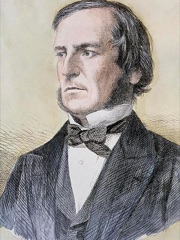
George Boole
1815–1864 · English mathematician who created Boolean algebra, the logic of true and false later used in computers.
George Boole was born in 1815 in Lincoln, England, the son of a shoemaker who loved science and instruments. The family was poor, and George largely taught himself mathematics and languages, including Latin and Greek. At sixteen he began working as an assistant teacher to help support his family, and he later ran his own schools. In his spare time he studied advanced mathematics and published research papers, and in 1844 he received a gold medal from the Royal Society. His book The Mathematical Analysis of Logic (1847) showed that logical reasoning could be written in algebraic symbols. Although he had no university degree, he was appointed in 1849 as the first professor of mathematics at Queen's College, Cork, in Ireland. His major work, An Investigation of the Laws of Thought (1854), developed what is now called Boolean algebra, in which statements are treated as true or false and combined with operations such as AND, OR and NOT. Nearly a century later, this became the basis of digital circuits and computers. He died in Ireland in 1864.
George Boole is also an author in the library: author page and works.
Faith: Biographers describe him as an 'agnostic deist' who read Christian theology widely and was drawn to Unitarianism. Source: Wikipedia

Key dates
- 1815 Born in Lincoln, England
- 1844 Royal Society gold medal
- 1847 The Mathematical Analysis of Logic
- 1849 First professor of mathematics at Queen's College, Cork
- 1854 The Laws of Thought published
- 1864 Dies near Cork
Fun facts
- Boolean algebra, the logic used inside every computer, is named after him, and so is a crater on the Moon. (Source: George Boole (Wikipedia))
Read about them
Grades 9–12
- An Investigation of the Laws of Thought · In the library
More lives
Edwin A. Abbott · Charles Babbage · Claude Bernard · Josef Breuer · Lewis Carroll · Charles Darwin