Charles Martel
c. 688–741 · Frankish ruler who stopped an Umayyad army near Tours in 732.
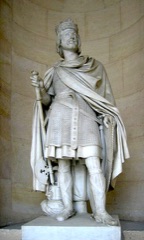
Charles Martel was the son of Pepin of Herstal, the mayor of the palace who held real power in the Frankish kingdom while the Merovingian kings were rulers in name only. When Pepin died in 714, Charles was imprisoned by his stepmother, but he escaped, raised an army, and by 718 had made himself master of the Frankish lands. He spent years fighting to unite them, campaigning against Frisians, Saxons, Bavarians and Alemanni, and he supported missionaries such as Boniface in Germany. In 732 an army of the Umayyad Caliphate, which had conquered most of Spain, raided north into Gaul under the governor Abd al-Rahman. Charles met it between Tours and Poitiers. His infantry held firm, and Abd al-Rahman was killed; the invaders withdrew. Later chroniclers gave Charles the name Martel, meaning the Hammer. Historians debate how decisive the battle was, but it ended the largest Umayyad advance into Gaul. Charles ruled without taking the title of king, and when he died in 741 he divided his lands between his sons. His son Pepin became king, and his grandson was Charlemagne.
Faith: A Frankish ruler whose support Pope Gregory II sought in 722 for Boniface's mission. Source: Catholic Encyclopedia (1913)

Key dates
- 718 Becomes master of the Frankish lands
- 732 Battle of Tours
- 737 Rules without a king on the throne
- 741 Dies at Quierzy
Fun facts
- His nickname, 'Martel', means 'the Hammer'. (Source: Charles Martel (Wikipedia))
More lives
Genghis Khan · Joan of Arc · Richard I of England · Saladin · Usama ibn Munqidh · Geoffrey de Villehardouin