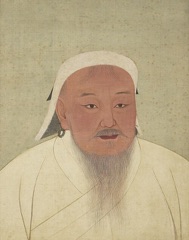
Genghis Khan
c. 1162–1227 · Founder of the Mongol Empire, the largest land empire in history.
Genghis Khan was born Temüjin on the Mongolian steppe. When he was about nine, his father was poisoned by enemies, and his family was abandoned by their clan and lived in poverty. As a young man he was captured and escaped, and he slowly built up followers through loyalty, alliances and victories. In 1206 an assembly of the Mongol tribes proclaimed him Genghis Khan, meaning universal ruler. He organized his army into units of ten, a hundred, a thousand and ten thousand, promoted men for ability, set up a written law code and a relay system of messengers, and adopted a script for the Mongol language. His mounted archers conquered northern China and then the Khwarazmian Empire in Central Asia, whose ruler had killed his envoys. Cities that resisted, such as Nishapur and Merv, were destroyed and their people massacred, and millions died in his wars. He allowed freedom of religion and protected trade. He died in 1227, and his sons and grandsons expanded the empire from Korea to eastern Europe.
Faith: Believed the Mongol sky god Tengri had destined him to rule; he was tolerant of other religions. Source: Wikipedia

Key dates
- c. 1162 Born as Temüjin
- 1206 Proclaimed Genghis Khan
- 1215 Takes Zhongdu (Beijing)
- 1219–1221 Conquers the Khwarazmian Empire
- 1227 Dies on campaign
Read about them
As an Amazon Associate I earn from qualifying purchases. As a Bookshop.org affiliate I earn from qualifying purchases, which also support independent bookstores.
Grades 9–12
- Genghis Khan and the Making of the Modern World by Jack Weatherford (Three Rivers Press, 2005; ISBN 9780609809648)
Bookshop.org · Amazon
More lives
Alfred the Great · Charlemagne · Charles Martel · Henry II of England · Joan of Arc · Justinian I