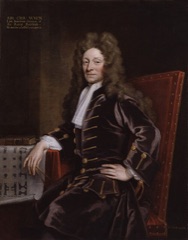
Christopher Wren
1632–1723 · Architect of St. Paul's Cathedral who rebuilt London after the Great Fire.
Christopher Wren was born in Wiltshire, England, the son of a clergyman. At Oxford he studied mathematics and science and became part of the group that founded the Royal Society in 1660. He was professor of astronomy in London and at Oxford, and Isaac Newton praised his work. In September 1666 the Great Fire of London destroyed much of the city, including the old St. Paul's Cathedral and eighty-seven parish churches. Wren drew up a plan for a new city of broad avenues, which was not adopted, but as surveyor of the king's works he designed fifty-one new churches, each with its own steeple. His greatest work was the new St. Paul's Cathedral, with its great dome, begun in 1675 and declared complete in 1711. He also designed the Royal Hospital at Chelsea and the Royal Naval Hospital at Greenwich, and with Robert Hooke the Monument to the fire. He lived to ninety and was buried in St. Paul's. His tomb bears the Latin words: if you seek his monument, look around you.
Faith: Faith not well documented. Source: Wikipedia
Key dates
- 1660 Helps found the Royal Society
- 1666 Great Fire of London
- 1675 Work begins on St. Paul's Cathedral
- 1711 St. Paul's declared complete
- 1723 Dies in London
Fun facts
- Besides buildings, he invented a tipping-bucket rain gauge in 1662. (Source: Christopher Wren (Wikipedia))
Watch


Videos load from YouTube in privacy-enhanced mode only when you press play.
More lives
Fra Angelico · Francis Bacon · Robert Boyle · Filippo Brunelleschi · Benvenuto Cellini · Nicolaus Copernicus