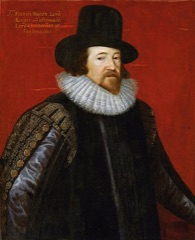
Francis Bacon
1561–1626 · English statesman and essayist who championed experiment and observation in science.
Francis Bacon was the son of Sir Nicholas Bacon, Lord Keeper of the Great Seal under Elizabeth I. He entered Trinity College, Cambridge, at twelve and trained as a lawyer. He sat in Parliament for many years and rose under King James I to become Attorney General and then Lord Chancellor in 1618. His Essays, short, wise reflections on topics such as truth, studies, friendship and ambition, became classics of English prose. In The Advancement of Learning and the Novum Organum he argued that knowledge of nature should be built from careful observation and experiment, collecting many particular facts before reaching general laws, rather than relying on ancient authorities or pure reasoning, and he warned against the idols, habits of mind that mislead us. He saw science as a way to relieve human suffering. In 1621 he was charged with accepting gifts from people with cases before him, admitted the charges, was fined and removed from office. According to a well-known story, he caught a chill while stuffing a chicken with snow to see whether cold would preserve meat, and died in 1626.
Francis Bacon is also an author in the library: author page and works.
Faith: A devout Anglican. Source: Wikipedia

Key dates
- 1597 First edition of the Essays
- 1605 The Advancement of Learning
- 1618 Becomes Lord Chancellor
- 1620 Novum Organum
- 1621 Convicted of taking bribes
- 1626 Dies in London
In their words
“REVENGE is a kind of wild justice; which the more man's nature runs to, the more ought law to weed it out”
Read about them
Grades 9–12
- Essays · In the library
- Novum Organum · In the library
- The Advancement of Learning · In the library
- New Atlantis · In the library
More lives
Robert Boyle · William Bradford · Nicolaus Copernicus · Oliver Cromwell · René Descartes · Desiderius Erasmus