Robert Boyle
1627–1691 · Irish-born chemist and experimenter, known for Boyle's law of gases.
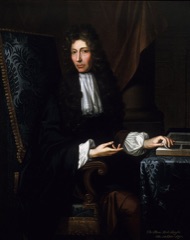
Robert Boyle was born at Lismore Castle in Ireland, the fourteenth child of the Earl of Cork, one of the richest men in the British Isles. He was educated at Eton and on a long tour of Europe, where he was in Florence when Galileo died. He settled at Oxford, where with his assistant Robert Hooke he built an improved air pump and used it to study air and vacuum. He showed that sound does not travel in a vacuum and that a flame and living creatures need air. In 1662 he published his finding that the pressure and volume of a gas are inversely related, now known as Boyle's law. In The Sceptical Chymist of 1661 he attacked the old idea of four elements and argued for careful experiment in chemistry and for matter made of tiny particles. He insisted on describing experiments in detail so others could repeat them. He was a founding member of the Royal Society. A devout Christian, he paid for translations of the Bible and founded the Boyle Lectures to defend Christianity. He died in London in 1691.
Robert Boyle is also an author in the library: author page and works.
Faith: A committed Christian who wrote works of Christian apologetics and endowed the Boyle Lectures. Source: Stanford Encyclopedia of Philosophy
Key dates
- 1627 Born at Lismore, Ireland
- 1659 Builds an air pump with Robert Hooke
- 1660 Helps found the Royal Society
- 1661 The Sceptical Chymist
- 1662 Publishes Boyle's law
- 1691 Dies in London
Fun facts
- Of all the sciences he worked in, chemistry was his favourite. (Source: Robert Boyle (Wikipedia))
Watch


Videos load from YouTube in privacy-enhanced mode only when you press play.
In their words
“if men would more carefully distinguish those things that they know, from those that they ignore or do but think”
Read about them
Grades 9–12
- The Sceptical Chymist · In the library
More lives
Francis Bacon · Nicolaus Copernicus · René Descartes · Galileo Galilei · William Gilbert · Christiaan Huygens