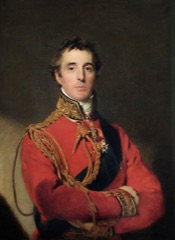
Arthur Wellesley, Duke of Wellington
1769–1852 · British general who defeated Napoleon at Waterloo and later served as prime minister.
Arthur Wellesley was born in Dublin into an Anglo-Irish noble family. A poor student, he was sent to a French military academy and entered the army in 1787. He first made his name in India, where his brother was governor-general, winning the Battle of Assaye in 1803. In 1808 he was sent to Portugal to fight the French in the Peninsular War. Over six years, using careful supply lines, defensive positions such as the Lines of Torres Vedras, and the help of Spanish and Portuguese forces, he drove the French out of Portugal and Spain and invaded southern France. When Napoleon escaped from exile and returned to power in 1815, Wellington commanded an allied army in Belgium. On June 18, 1815, at Waterloo, his troops held their ridge through a day of French attacks until the Prussian army under Blücher arrived, and Napoleon was defeated for the last time. Wellington later entered politics and served as prime minister from 1828 to 1830, when he pushed through Catholic emancipation despite his own reluctance. He died in 1852 and received a state funeral.
Faith: A Protestant who told Parliament that England was 'a Christian country'. Source: Wikipedia
Key dates
- 1803 Victory at Assaye in India
- 1808–1814 Peninsular War
- 1815 Defeats Napoleon at Waterloo
- 1828–1830 Prime Minister
- 1852 Dies; state funeral
Fun facts
- His style of white trousers, dark tunic, Hessian boots and black cocked hat became very popular and influenced fashion in Britain. (Source: Arthur Wellesley, 1st Duke of Wellington (Wikipedia))
Record-breaker
Firsts and records, worded as the sources give them ("first known", "at the time").
- He fought in some 60 battles during his military career. (Source: Arthur Wellesley, 1st Duke of Wellington (Wikipedia))
Watch


Videos load from YouTube in privacy-enhanced mode only when you press play.
More lives
John Quincy Adams · Susan B. Anthony · Frédéric Bastiat · Otto von Bismarck · Simón Bolívar · John C. Calhoun